


 Have a great day, y'all!
Only 418 Antarctic blue whales were left. Fifty years on, there are about 4,000
A study published on 5 November in Endangered Species Research estimates the Antarctic blue whale has grown from about 418 animals in 1973 to 4,018, and is rising by 4.5% a year, though it remains far from its former numbers.

In 1973, the year of the last recorded catch, roughly 418 Antarctic blue whales were left in the entire Southern Ocean. Fifty-three years later, eight scientists from four countries estimate there are 4,018. Their paper, published on 5 November in the journal Endangered Species Research, also calculates that the population is growing by about 4.5% a year.
- The population has grown almost tenfold since commercial whaling of the species ended.
- It is rising by around 4.5% a year, a pace consistent with how slowly blue whales breed.
- It is still only 1.9% of the number that lived in Antarctic waters before industrial whaling.
- The last full circumpolar survey ended in 2004, and the authors want fresh counts.
Both halves of the story are true at once. The largest animal ever to have lived did not disappear, even after being cut down to a few hundred individuals. And the road back is very long: according to a figure in the paper, the population stood at 205,905 blue whales in the early 1900s.
A count that starts in the whalers' logbooks
The lead author is Zoe Rand, a postdoctoral scholar at the University of Washington's School of Marine and Environmental Affairs. Her co-authors are Trevor A. Branch, professor of aquatic and fishery sciences at the same university; Paula A. Olson and Douglas Kinzey of the US National Oceanic and Atmospheric Administration (NOAA); Michael C. Double and Brian S. Miller of the Australian Marine Mammal Centre; Koji Matsuoka of Japan's Institute of Cetacean Research; and Ken Findlay of the University of Pretoria in South Africa. NOAA funded the work, according to the University of Washington's news release.
Two of those names have been counting these whales for more than two decades. In 2004, Branch and Matsuoka, together with Tomio Miyashita, published in Marine Mammal Science what became the standard reference figure: about 1,700 Antarctic blue whales in 1996, within a wide range of 860 to 2,900. That put the population at 0.7% of its original size. The new estimate, well over double, fits the picture of a slow but steady recovery.
To understand why the numbers fell so far, go back to the first half of the 20th century. The Antarctic blue whale was the prime target of commercial whaling in the southern hemisphere. An adult can weigh more than 400,000 pounds, around 180 tonnes, and its blubber was boiled down into valuable oil. Factory ships, which hauled whole carcasses up a stern ramp and processed them on board, let fleets hunt for weeks far from any coast.

The result was a 99.8% collapse, the new study says. Speaking to New Zealand's public broadcaster RNZ in 2015, Double estimated that the Southern Ocean could hold about 250,000 blue whales in the early 1900s and that whalers killed roughly 360,000 between then and 1960. The catch exceeds the starting population because the whales kept breeding while they were being hunted.
"No whale was hunted quite to the extent that Antarctic blue whales were hunted."
Zoe Rand, University of Washington
The International Whaling Commission (IWC) banned killing them in 1964. Soviet fleets carried on illegally for about another decade, which is why the authors treat 1973 as the starting line for the recovery.
Biology does the rest. Blue whales live a long time, and a female has a single calf every two to three years. A population like that cannot bounce back quickly, even once the threat is gone. Rand called annual growth of 4.5% "relatively realistic" for a species that reproduces at that pace.
How to count an animal almost nobody sees
Even researchers who go looking for Antarctic blue whales rarely find them. The classic way to estimate their numbers is the line-transect survey: a ship sails a straight course, observers log every sighting and its distance from the vessel, and those records are turned into a density estimate. The IWC ran three large circumpolar surveys of this kind, in 1978-1984, 1985-1991 and 1991-2004. Few have been carried out since.
Rand's team did not rely on any single expedition. Their model blends three kinds of evidence: catch records from the whaling era, the results of those transect surveys, and photo-identification, which recognises individual whales from the mottled pattern on their skin, much like a fingerprint. Put together, they let the researchers rebuild the population curve year by year and arrive at today's figure.
That reconstruction builds on earlier work by the same author. In November 2024, Rand, Branch and Jennifer Jackson of the British Antarctic Survey published, in the same journal, an analysis of the metal "Discovery" marks that were fired into whales last century and recovered when the animals were caught. The marks showed whales moving often between the Atlantic, Indian and Pacific sectors of the Southern Ocean. As the University of Washington summarised, the conclusion is that they form a single circumpolar population. That fits another clue: only one song type has ever been recorded from Antarctic blue whales, while pygmy blue whales have five, linked to five populations.

Listening instead of looking
Song is the tool that has most changed fieldwork. In 2013, a seven-week voyage carrying 18 people, including observers, biologists and acousticians, tested a system of directional listening buoys in the Southern Ocean. The buoys first picked up the direction of a call, then several were used together to pin down the whales' position to within a few kilometres. According to the Australian Antarctic Division, the team found seven hotspots, some audible from 1,100 km away; it sighted 84 blue whales, took 50 photo-IDs and 23 biopsy samples, and deployed two satellite tags.
"Antarctic blue whales have very loud, low frequency songs that are distinctive from other populations of blue whales."
Brian Miller, acoustician, Australian Antarctic Division
Miller has kept listening. In 2024 he published in Frontiers in Marine Science an analysis built on seven voyages and some 150,000 km at sea. In seven comparisons between listening stations there was no change; in seven others, a higher share of stations picked up blue whales in recent years. "That's suggesting that the trend is either neutral or going up over time, so that's really good news," he told ABC News. The new study reaches the same direction by a different route.
There is still a limit. Recordings can show how many whales are in an area, but they cannot yet be scaled up to a total for the whole of Antarctica. Rand hopes the technology will make monitoring easier in the coming years.
Ships themselves are changing too. In Chile, a polar cruise ship built in Valdivia switches off its diesel engines and runs on batteries when whales are nearby, as we reported in our story on the Magellan Discoverer.
What one more whale means for the Southern Ocean
Blue whales feed almost entirely on krill, a crustacean a few centimetres long. A study led by Matthew Savoca of Stanford University and published in Nature in 2021 calculated that a blue whale eats an average of about 16 tons of food a day, roughly three times earlier estimates, as National Geographic reported.
That appetite has a counter-intuitive effect. Whales feed at depth and defecate near the surface, and their faeces are rich in iron, a nutrient in short supply in the Southern Ocean. The iron feeds phytoplankton, which in turn feeds krill. Over time, more whales can mean more krill, not less. In the same report, researcher Emma Cavan cautioned that the picture is incomplete, since warming water and fishing also play a part.
The authors of the new paper describe blue whales as "ecosystem engineers". Their role continues even after death.

One precedent helps picture what could come next. Humpback whales in the western South Atlantic, which breed off Brazil and feed in Antarctic waters, were reduced to about 440 animals in 1958. A study led by Alexandre Zerbini, published in Royal Society Open Science in 2019, estimated they had climbed back to around 25,000, close to 93% of their pre-whaling numbers, according to Science News. Humpbacks breed faster than blue whales, but the case shows that a ban held for decades works.
It is not the only story of its kind in these pages. Leatherback turtles have set a nesting record on Ecuador's Manabí coast, and the Montreal Protocol has just topped up its fund nearly four decades after it was signed. These are long-term efforts measured in generations.
What's missing: counting again
The open question is whether Antarctic blue whales will ever be as numerous as they were. "I think it's probably an open question whether they will make it back to pre-whaling levels," Rand said. The ocean they are recovering in is not the one they lived in a century ago. Vanessa Pirotta, a wildlife scientist at Macquarie University, told the ABC that shrinking sea ice could reduce krill habitat, and with it the whales' food.
That is why the authors are asking for more monitoring and, above all, for monitoring that keeps going. Without new surveys, nobody will be able to tell whether the curve is still rising. "We really need more monitoring and continued monitoring to figure out what is going to happen," Rand said. More than twenty years have passed since the last full circumpolar survey, and the new model is partly a way of making up for that gap in field data.
Within its Southern Ocean Research Partnership, the International Whaling Commission runs an international programme devoted to the abundance and ecology of this subspecies. This year's UN climate action yearbook records similar progress on other environmental indicators: slow, measurable and still incomplete.
At 4.5% a year, the population would double roughly every 16 years. If that pace held, simple arithmetic suggests it would take close to sixty years just to reach a quarter of what once swam there.
The detail you might not know
When a blue whale dies, its body sinks deep in what scientists call a whale fall. For years it feeds entire communities of seabed life, and that descent is thought to take carbon out of circulation and leave it on the ocean floor. The whales' songs, meanwhile, are so low that recordings have to be sped up about eight times before human ears can pick them out, researchers explained to RNZ in 2015.
Further reading
- The original paper in Endangered Species Research, with the full population series since 1900.
- University of Washington news release with comments from Zoe Rand.
- Whale songs of the Southern Ocean, from the Australian Marine Mammal Centre.
- Tracking blue whales in the Southern Ocean, RNZ's report from the Tangaroa voyage.
Go further
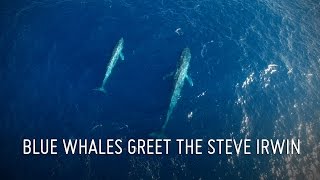 YouTube · Sea ShepherdBlue Whales Greet Steve Irwin
Imágenes aéreas de ballenas azules en el océano Austral, grabadas con dron en 2015-16.
- Web · University of WashingtonAs Antarctic blue whales advance along the road to recovery, continued oversight is key
La presentación del estudio, con la gráfica de la población desde 1900.
- Web · Australian Marine Mammal CentreAcoustic trends sounds
Vídeos para escuchar cómo canta la ballena azul antártica frente a otras poblaciones.
- Web · Australian Antarctic DivisionSound science finds Antarctic blue whale hotspots
Cómo se localizaron ballenas a más de mil kilómetros solo por su canto.
- Web · RNZ – Our Changing WorldTracking blue whales in the Southern Ocean
Crónica de una expedición neozelandesa y australiana tras las ballenas azules.
- Blog · Zoe RandZoe Rand
La web de la autora principal, con sus trabajos sobre ballenas y modelos de población.
Sources
- Endangered Species Research: Critically Endangered Antarctic blue whales are increasing but still far from pre-whaling levels
- Universidad de Washington (EurekAlert!): As Antarctic blue whales advance along the road to recovery, continued oversight is key
- Ecomagazine: Antarctic Blue Whales Show Signs of Recovery After 50 Years of Protection
- University of Washington News: As Antarctic blue whales advance along the road to recovery, continued oversight is key
- UW School of Aquatic and Fishery Sciences: One or many? Exploring the population groups of the largest animal on Earth
- Branch, Matsuoka & Miyashita (2004): Evidence for increases in Antarctic blue whales based on Bayesian modelling
- Australian Antarctic Division: Sound science finds Antarctic blue whale hotspots
- ABC News: Australian Antarctic Division listening in on critically endangered blue whales
- RNZ: Tracking blue whales in the Southern Ocean
- National Geographic: Whales eat three times more than previously thought
- Science News: Humpback whales in the South Atlantic have recovered from near-extinction





