


 ¡Qué volá, asere! Hoy toca sonreír
Technology

Electric trucks now make up half of China's heavy-truck sales
In September, for the first time, more than half the heavy trucks sold in China were electric, driven by a growing network of battery-swap stations that can already replace a full battery pack in five minutes.

Utah is now selling round-the-clock power from hot rock
Cape Station in Beaver County turns dry rock into steady power for the western U.S. grid, with new contracts, new transmission and open questions.

70% of countries now have early warnings, cutting disaster deaths sixfold
A UN report unveiled at COP31 shows 136 countries now run multi-hazard early warning systems, up from 56 in 2015, with disaster deaths running 6.1 times lower where those systems are strong.

Voyager 1 reaches one light-day from Earth after 49 years
Voyager 1, NASA's 1977 probe, is now one light-day from Earth, 25.9 billion km away, and still sending data from interstellar space.

174 machines and 26 plants in the pipeline: the world's fusion map keeps growing
The International Atomic Energy Agency now counts 174 fusion facilities worldwide, 40 more than in 2022, and a record $4.5 billion of private investment in a single year.

A billion cosmic objects, free to all: Euclid opens its first big map of the sky
On 12 November the European Space Agency released Euclid's first large archive: 1.7 million gigabytes covering over 900 million galaxies and some 15,000 likely gravitational lenses, open to anyone who wants to use it.

Hera is now circling the asteroid humanity knocked off course in 2022
The European Space Agency's Hera probe is flying about 30 kilometres from Didymos and Dimorphos, the asteroid pair NASA struck with DART, to measure at last how well that collision works as a shield for Earth.

One DNA change, many cell types: AlphaGenome 2 tries to pinpoint where it matters
Google DeepMind has released a new version of its genomics model that predicts how a DNA variant behaves in each specific cell type. In a test on immune cells it found almost twice as many causal variants as its predecessor, and it is free for academic research.

6.5 million lines of proof: how Signal's encryption code was shown to keep its word
Google DeepMind has mathematically verified, down to machine code, the core that encrypts Signal's messages. It took four weeks, a job that used to take years, and every proof has been published openly.

Sand, clay and rust: the ten energy technologies that could scale before 2030
The World Economic Forum and science publisher Frontiers screened 80 technologies and unveiled at COP31 the ten with a credible path to large-scale use before 2030, from clay cement to sand batteries.

Caught in mid-air after 22 hours in orbit: Starship's upper stage flies home whole
For the first time, a rocket's upper stage has returned from orbit to its launch tower and been caught by two steel arms. The SpaceX ship had circled the Earth about 14 times and deployed 26 satellites.
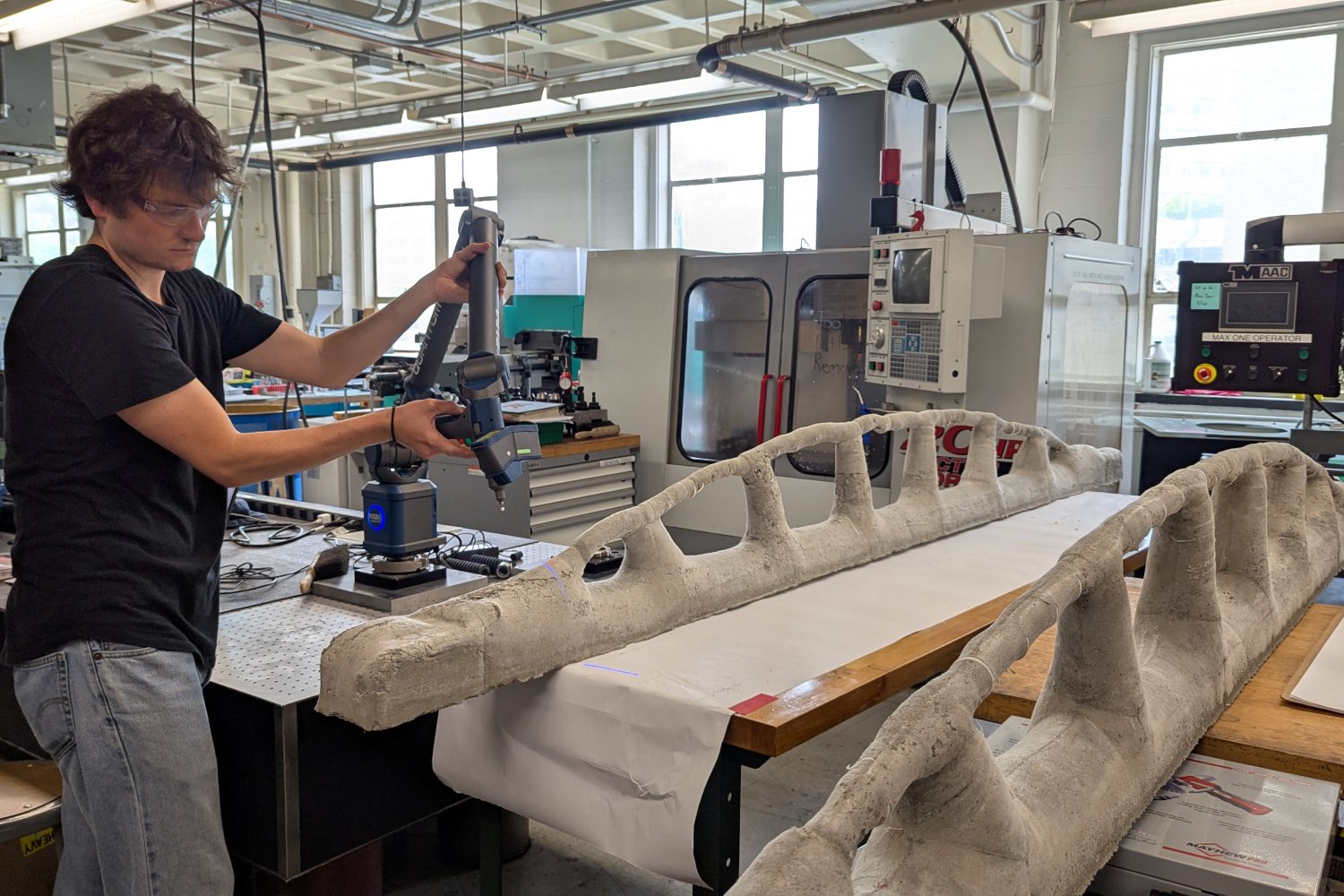
Sewn like a garment: the concrete beam that uses a third of the material
MIT engineers cast a 3-metre beam in a hand-sewn cotton mould. It carries its design load with a third of the concrete and half the steel, and costs 10 to 20% less under Global South prices.

No astronauts needed: a Caltech robot assembles a structure in orbit for the first time
A robot called ASTRA put together a section of a truss in space with no astronaut on hand. It is a first step towards building antennas, telescopes and solar arrays in orbit that are too big to fit in a rocket.

Sodium batteries are closing in on lithium's cost: how they work and who makes them
A Wood Mackenzie report counts more than 70 GWh of supply deals and estimates that over 20 years, storing energy with sodium can be 21% cheaper. The chemistry has been studied since the 1980s, and CATL, BYD and HiNa now make it at scale.

Three in four people now use the internet, and the poorest countries are growing fastest
The ITU estimates that 6.3 billion people use the internet in 2026, 76% of humanity. The least developed countries are growing almost three times faster than the global average, and for the first time mobile internet is affordable in landlocked and small island developing states.

About 9,500 payments a second: India's mobile payment network sets a new record
India's Unified Payments Interface (UPI) handled 25.47 billion transactions in October 2026, up 23% on a year earlier. Ten years after its launch, the model is already shaping payment systems elsewhere, including Namibia.

A molecule that changes in the light takes a tandem solar cell to a record 28.04%
A team at the Chinese Academy of Sciences' Institute of Chemistry has reached a certified 28.04% efficiency, the best yet for a perovskite-organic tandem solar cell. The key, reported in Nature, is an additive that changes under light and slows the material's breakdown.