


 Chin up, it's going to be a lovely day!
Ecuador wins its eighth Pan American German Shepherd breeding title in Lima
Two Ecuadorian females won their classes at the COAPA Peru 2026 championship, and the delegation placed nine dogs among the best in their categories. Here is how a title that rewards a whole country, not a single dog, is scored.

Ecuador came home from Lima as Pan American Champion of German Shepherd Breeding. It is the eighth time the country has taken the title. The championship of the American Confederation of the German Shepherd Dog (COAPA) was held in the Peruvian capital from 18 to 22 November, with teams from across the Americas and Europe, according to a press release from the Ecuadorian German Shepherd Breeders Association (ACOA Ecuador).
- Ecuador won the breeding championship by country for the eighth time.
- Two Ecuadorian females took VA1, first place in their class.
- Nine dogs from the delegation finished among the best in their categories.
- The next Pan American championship will be held in Santiago, Chile, on 30 and 31 October 2027.
Nobody climbs the podium at a breeding show for being the fastest dog or the best at following a command. The judge studies the animal's build, watches it trot around the ring, compares it with a standard written more than a century ago and gives it a grade. And the title Ecuador brought home does not belong to one dog. It belongs to a country, worked out with a sum that punishes teams for bringing many dogs and rewards the ones who bring good ones.
Who judged and who won
The judge was Christoph Ludwig of Germany, from the SV (Verein für Deutsche Schäferhunde), the parent association of the breed. Roswitha Dannenberg, president of the SV and of the World Union of German Shepherd Dog Clubs (WUSV), also attended.
Ecuador's two best results were both females. Jackie di Casa Caputi took VA1, Excellent Select in first place, in the class for approved short-haired females. Acyrka Schnelle Söhne took the same VA1 in the long-haired class. Jordan di Casa Caputi, Jackie's brother, added a VA3 among approved males.
In the younger classes, Emi Schnelle Söhne and Karma di Casa Caputi won with the grade SG1. Xica von den Anden and Kal-El di Casa Caputi came second in their classes, and Ilianah di Casa Caputi and Visum von der Reich finished third.
The names carry a clue. "Di Casa Caputi" and "Schnelle Söhne" are kennel affixes, the family name a breeder gives every puppy, much as a winery signs its bottles. When several finalists share an affix, it points to bloodlines worked over generations rather than single dogs.
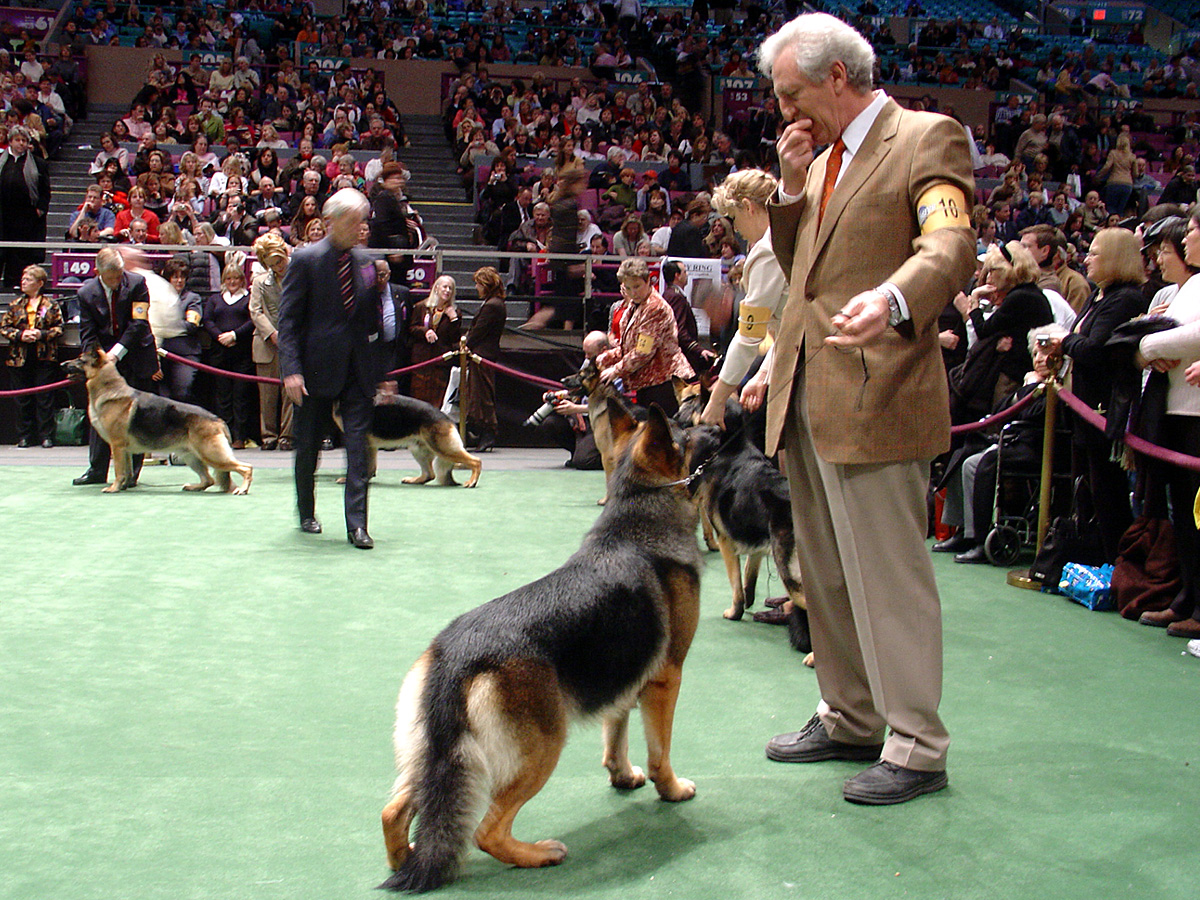
Six categories and a five-page rulebook
The general rules of the COAPA Pan American Breeding Championship run to five pages and explain almost everything. Males and females compete separately in three categories: 12 to 18 months (very young), 18 to 24 months (young) and 24 months or older, the approved adults. That makes six categories, and the normal-coat and long-coat varieties compete in separate classes with separate scores.
To reach VA (*Vorzüglich Auslese*, Excellent Select), the top grade, an adult dog has to meet a list that has little to do with looks:
- A valid breed survey (*Körung*, the breeding licence) from a COAPA club or the WUSV, with approved hip and elbow X-rays.
- Parents who were themselves approved for breeding.
- A pass in the TSB test, which includes off-leash heeling and a courage test in which the dog must release on command.
- Proof of offspring, if the dog is over three years old.
- Registered or verified DNA.
Among younger dogs the top grade is SG (*Sehr Gut*, very good), and the rules require dogs older than 13 months to show an "a" diagnosis for hips and elbows before they can take one of the top three places in their category. In plain terms, a very handsome dog with doubtful joints does not reach the podium.
The TSB test itself is run before a survey judge and a helper. The dog walks off the leash beside its handler for 18 metres, marked by a band on the ground, then must repel the staged attack with a firm bite and let go when told. It checks what Max von Stephanitz asked of the breed from the start: a working dog first, a show dog second.
How the country title is added up
Ecuador's title is calculated under an unusual rule. In each category the top ten dogs get points from 10 down to 1: 10 for the winner, 9 for second, and so on. Only dogs born in the Americas score, and each dog represents only the country where it was born. European dogs may compete and receive a grade, but they add nothing for anyone. If a European-born dog finishes first and an American-born dog second, the American dog gets the 10 points.
Then comes the clause that explains how a small country can win. So that the host gets no advantage from bringing more dogs, the rules count only each country's five best scores across the six categories. A team that brings twelve dogs and wins all six categories can reach at most 50 points, because only five placings count and the other seven do not.
If two countries tie, the rules break it by category in a fixed order: approved males of 24 months or more first, then approved females of the same age, then males and females of 18 to 24 months, and finally those of 12 to 18 months. COAPA awards the champion, runner-up and third-place teams, plus an individual prize for the champion, runner-up and third dog in each category.
That formula explains the shape of Ecuador's result. With two VA1 placings, wins in the younger classes and several seconds and thirds, what counts toward the title is the five best scores, and Ecuador's were high.
A breed with a birth date
The German Shepherd is one of the few breeds whose birth can be dated. In 1899, at a dog show, a retired cavalry captain, Max von Stephanitz, bought a dog called Hektor Linksrhein, renamed him Horand von Grafrath, and with Artur Meyer founded the SV on 22 April of that year. Horand was the first dog entered in the breed register. Von Stephanitz, born in Dresden in 1864, wanted a better working dog than the local herding types, and he put intelligence, senses and willingness to work ahead of appearance.
Twenty years after the founding, according to the biography summarised on Wikipedia, the SV published a survey book that rated dogs for breeding on body and temperament rather than show wins. That is the origin of the *Körung* now required to compete for VA.
By 1923 the society claimed 50,000 dues-paying members and more than 500 branches in Germany. After the First World War, British authorities renamed the breed "Alsatian Wolf Dog", a name that lasted five decades: registration as German Shepherd did not return in Britain until 1977. In 2010 the UK Kennel Club dropped "Alsatian" from its official name, and the FCI recognised the long-haired variety that same year. Both varieties now compete in Lima in separate classes under COAPA rules.
According to the breed entry on Wikipedia, the standard describes a dog longer than it is tall, with an ideal proportion of 10 to 8.5, 60 to 65 centimetres at the withers in males and 55 to 60 in females. A German Shepherd can sprint at about 48 kilometres an hour. In 2020 it was the third most registered breed with the American Kennel Club.

Why the rulebook insists on health checks
There is a reason the rules insist on hips and elbows. Hip dysplasia is the best-known orthopaedic problem in the breed: the Orthopedic Foundation for Animals found 19.1% of the German Shepherds it evaluated affected, and a North American study found 18.9% for hips and 17.8% for elbows. With a life expectancy of around ten years, according to studies gathered in the same entry, joints decide the quality of life of many dogs.
That is why quality breeding is largely preventive medicine with X-rays. Breeders who present a dog in Lima have already been through the vet, the working test and the DNA check before they set foot in the ring. In practice, the Pan American championship is the end of a road that starts years earlier in the kennel.
A breed with history in Ecuador
ACOA Ecuador brings together breeders, owners and handlers of the German Shepherd in the country and holds ranking shows during the year with SV judges. Its president, Roberto Caputi, has described the breed in the Ecuadorian press as a dog that is easy to train, obedient and adaptable to every climate.
"This eighth title belongs to all Ecuadorian breeders. It shows that in Ecuador we breed German Shepherds that are healthy, good-natured and of world standard."
Roberto Caputi, president of ACOA Ecuador
The association congratulated the breeders, owners and handlers who travelled to Lima. For those who follow sport in Ecuador, the result joins other good weeks, such as Independiente del Valle's back-to-back league title, La Unión de Cuenca's runner-up finish in the women's futsal Libertadores and Enner Valencia's tenth title. Two other Ecuadorian stories of patient, quiet work are the Kichwa women who guard the Napo river and Cajas National Park turning 30.
The German Shepherd has a less glamorous side too, which is work. The breed entry lists it as a rescue, guide, police and detection dog for explosives, drugs and other scents. In the end the Pan American championship measures a country's ability to keep producing dogs that can do that job.

What comes next
The next COAPA Pan American Championship will be held in Santiago, Chile, on 30 and 31 October 2027, and Ecuador will defend its title there. Dogs that are now classed as young, between 12 and 24 months, will be old enough to compete as adults, provided they first earn their breed survey, the working test and the hip and elbow X-rays the rules demand.
The detail you may not know
The SV, the association whose judge presided in Lima, was born in 1899, the same year the first German Shepherd was registered. Von Stephanitz died on 22 April 1936 in Dresden, exactly 37 years after founding it. More than a century later, the standard applied in Lima, in Santiago or in Germany still comes from that same association, headquartered in Augsburg.
Learn more
Go further
- Web · COAPAReglamento general del Campeonato Panamericano COAPA de Crianza
Las reglas de puntuación, categorías y requisitos del VA, en cinco páginas.
- Web · ExtraEl pastor alemán, mucho más que un compañero fiel
El presidente de ACOA Ecuador explica cómo es la raza y cómo se cría en el país.
- Web · WikipediaMax von Stephanitz
El fundador de la SV y su idea de un perro de trabajo antes que de exposición.





