


 Have a great day, y'all!
Bogotá cut poverty in every district: from 35% to 22% in four years
DANE's 2025 Multipurpose Survey, covering more than 80,000 households, shows income poverty in Colombia's capital fell 13.5 points since 2021, and none of its 20 districts got worse.

Four years ago, a little over a third of Bogotá's residents lived on incomes below the poverty line. A new survey by Colombia's statistics agency, DANE, released at the end of October 2026, puts that share at 21.8%. More unusual still, the decline showed up in every one of the city's 20 districts, from the wealthiest to the most rural.
- Monetary poverty in Bogotá fell from 35.3% in 2021 to 21.8% in 2025, according to the Multipurpose Survey.
- Every district improved; the steepest falls came in Sumapaz, Usme, Ciudad Bolívar, Bosa, San Cristóbal and Rafael Uribe Uribe.
- Multidimensional poverty, which tracks gaps in education, health, work and housing, dropped from roughly 5.5% to about 3%.
- The result comes as poverty is falling nationwide, while wide gaps remain for households with children and those headed by women.
What was measured, and when
The figures come from the 2025 Multipurpose Survey, a social snapshot DANE produces with Bogotá's planning department and the Bogotá-Cundinamarca Metropolitan Region. It is the fifth edition, after 2011, 2014, 2017 and 2021, and fieldwork officially began on 1 May 2025.
DANE's technical bulletin is dated 28 October 2026, and the three agencies presented the results at a regional event the following day. By city standards the sample is vast: according to the Bogotá mayor's office, more than 80,000 households in the capital and 21 neighbouring towns in Cundinamarca.
That scale is what makes district-level detail possible, down to local planning units, something national surveys cannot deliver with precision. The survey covers close to 10.3 million people, almost one in five Colombians.
District by district
The headline is a fall in income poverty of 13.5 percentage points in four years. City hall estimates this means roughly one million fewer people living below the line, and says the figure already beats the target the city had set for 2027.
The city's Social Integration Department, which published the district breakdown on 1 November 2026, reported that no district got worse. The sharpest drops came in historically poorer areas such as Usme, Ciudad Bolívar and Bosa, home to hundreds of thousands of working families on the city's southern hillsides.
Multidimensional poverty, which looks at concrete deprivations rather than income, was also cut almost in half. The share of households facing severe food insecurity stood at 2.8% in 2025, although the department itself notes that the 2021 figure used a different method, so a direct comparison should be treated with care.
A city changing shape
The survey goes well beyond poverty. It describes an urban Bogotá of 7.9 million people in 2.9 million households, plus about 26,000 rural residents. Households are multiplying faster than the population: average size slipped from 2.8 to 2.7 people, and one urban household in five is a single person, as La República noted.
Basic services improved too. 80.2% of households have internet, and in rural Bogotá connections rose from 9.4% in 2017 to 44.6% in 2025. Online banking among internet users nearly doubled, from 36.6% to 68.3%, and about 22,000 households stopped reporting housing problems between 2021 and 2025.
On health, 95.2% of urban residents are enrolled in the health system. The city is also ageing: the average age rose from 33.9 in 2017 to 36.3 in 2025, a shift that signals growing demand for care.
The policies in the background
A survey alone cannot prove what caused a change, but city hall links part of the result to two tools. The first is the Guaranteed Minimum Income (IMG), a cash-transfer system created in 2020, during the pandemic, under the previous city administration, and kept and redesigned by the current one.
Between 2020 and 2023, according to the programme's entry on the United Nations partnerships platform, 1,237,337 households received transfers from the city, the national government or both, and 78% of recipients were women. The IMG now has ten components, with dedicated support for early childhood, older people, people with disabilities, former street dwellers and people living in pagadiarios, rooms rented by the night.
In 2026 the programme was refocused on households in extreme poverty under group A of Sisbén, Colombia's welfare targeting system, and on specific groups: for instance, 190,000 pesos a month for people with disabilities, 150,000 for older adults, and a pilot route for young people that ties support to training and job-seeking.
The second tool is Bogotá Sin Hambre 2.0 (Bogotá Without Hunger), which combines transfers, community and school canteens, vouchers, food baskets and meals served through the city's social services.
The wider picture: a country also improving
Bogotá's progress is not happening in isolation. On 12 June 2026, DANE reported that monetary poverty in Colombia fell from 31.8% in 2024 to 28% in 2025, about 1.79 million fewer people, while extreme poverty dropped from 11.7% to 9.6%.
In April 2026, DANE's annual multidimensional poverty index had already shown Bogotá with the lowest rate in the country, after a one-year fall from 5.4% to 2.2%, according to city hall. Nationally that index went from 11.5% to 9.9%.
Two caveats matter. First, the 2021 baseline still carried the economic damage of the pandemic, so part of the decline reflects jobs coming back. Second, each survey has its own method, which is why DANE's main household survey puts Bogotá's 2025 monetary poverty at a somewhat different level, 17.8%. What counts is that every measure points the same way.
The survey shows how important it is to keep working to close gaps.
Luis Lota, director of the Bogotá-Cundinamarca Metropolitan Region
What still needs doing
Inequalities inside the city remain large. In households with three or more children under 12, monetary poverty reaches 74.4%, against 14.1% in households without children. It is 26.3% in households headed by women and 17.7% in those headed by men, and seven in ten people who do care work are women.
The Social Integration Department also acknowledges a limit of any household survey: it does not fully capture people living on the street, in nightly-rent rooms or in situations of abandonment, some of the most vulnerable groups of all. Reaching them requires other records.
Elsewhere in the region, good measurement has paved the way for better decisions, as with the fall in chronic child malnutrition in Ecuador or the registry that made more than a thousand Ecuadorian women entrepreneurs visible. And Barbados's record on mother-to-child HIV is a reminder that social goals are sustained by data, year after year.
The new results will be used to update the city's maps of poverty, food insecurity and health, which guide where money is spent. The planning department's online viewer lets anyone explore the figures district by district.
The detail you might not know
The survey also counted who shares a home with animals: 44% of Bogotá households have a pet, about 1.3 million. And cats are gaining ground. Households with a cat rose from 17.7% to 22.8% in four years, while those with a dog barely moved, from 26.6% to 27.8%. One more clue to a city of smaller homes, more people living alone and less space to spare.
Go further
- Web · DANEEncuesta Multipropósito
La página oficial reúne boletines, anexos y ediciones anteriores para comparar Bogotá y Cundinamarca desde 2011.
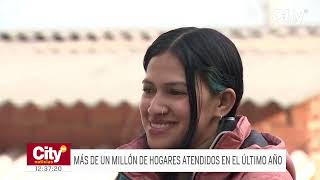 YouTube · Alcaldía de BogotáAlrededor de un millón de hogares se han beneficiado con el Ingreso Mínimo Garantizado
Muestra cómo funcionaba el programa de transferencias en sus primeros años, con voces de familias beneficiarias.
- Web · Naciones Unidas, plataforma de alianzas ODSIngreso Mínimo Garantizado
Ficha con el diseño del programa, sus principios y las cifras de cobertura entre 2020 y 2023.
- Web · PortafolioEncuesta Multipropósito 2025: qué es y por qué es clave para la región metropolitana
Explica para qué sirve la encuesta y por qué su escala permite decisiones a nivel de barrio.
- Web · Alcaldía de BogotáEl Ingreso Mínimo Garantizado llegó cuando lo necesitaba: Rosalvina Aldana
Un testimonio en primera persona de lo que significa una transferencia mensual para un hogar vulnerable.
- Web · RMBCRegión Metropolitana Bogotá-Cundinamarca
La entidad que coordina políticas entre Bogotá y sus municipios vecinos y coproduce la encuesta.
Sources
- DANE - Boletín técnico Encuesta Multipropósito 2025
- Alcaldía de Bogotá - Avances en reducción de pobreza según la Encuesta Multipropósito 2025
- Alcaldía de Bogotá / SDIS - Todas las localidades redujeron la pobreza monetaria entre 2021 y 2025
- La República - Resultados de la Encuesta Multipropósito del DANE para Bogotá y alrededores
- DANE - Comunicado de prensa Pobreza Monetaria 2025





