


 Have a great day, y'all!
A 2,500-year-old bronze cart with no Iberian equal emerges in Extremadura
Spanish archaeologists unveiled a 5th-century BC ritual cart on 24 June 2026, found at Casas del Turuñuelo in Guareña and decorated with a river god and two griffins. Its only known relatives come from ancient Etruria.
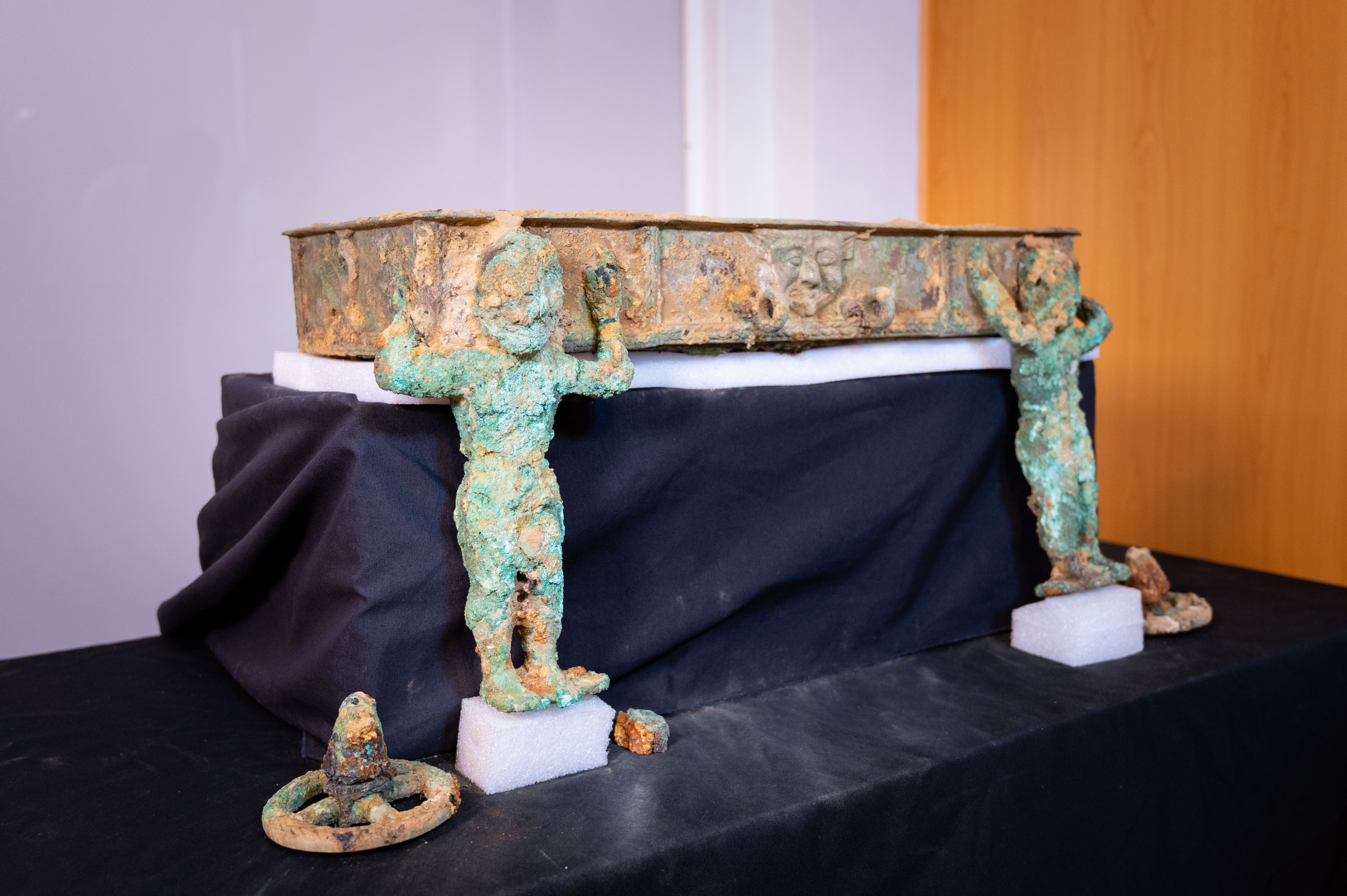
In April and May 2026, archaeologists working at Casas del Turuñuelo, outside the town of Guareña in the Spanish province of Badajoz, were clearing earth beside a room they call "the banquet room" when a bronze box began to emerge, held up by two human figures with their arms raised. On 24 June the team unveiled it at the Spanish National Research Council (CSIC) headquarters in Madrid: a ritual cart roughly 2,500 years old, with no known match anywhere in the Iberian Peninsula.
The only comparable objects come from Etruria, the heartland of the Etruscans in what is now central Italy. For now, that is the working theory about where the cart was made, according to the dig's co-directors, Esther Rodríguez and Sebastián Celestino of the Mérida Institute of Archaeology, a centre run jointly by the CSIC and the regional government of Extremadura.
- What: a decorated bronze cart from the 5th century BC, found during the site's eighth excavation season.
- Where: the Casas del Turuñuelo mound in the Vegas Altas of the Guadiana valley, a protected heritage site since 2021.
- Why it matters: alongside Greek pottery, an Egyptian vessel and eastern ivories, it strengthens the case that this inland community was plugged into Mediterranean luxury trade.
- What's next: conservation and analysis at a laboratory of the Autonomous University of Madrid.
A river god, two griffins and a pair of wheels
The body of the cart is anything but plain. Its front panel carries the face of Achelous, a river deity from Greek myth whom the team links, because of his gesture, with the underworld. Two griffins, creatures with an eagle's head and a lion's body, decorate the sides. At each end a human figure with upraised arms acts as a column and bears the weight of the structure. The whole piece sits on two wheels, which are decorated as well.
What it was for remains an open question. Celestino suggested in the CSIC statement that it may have been used in rituals tied mainly to banqueting. The clue is its findspot: right next to the room where, in the team's reading, the community held one last feast before shutting the building for good.
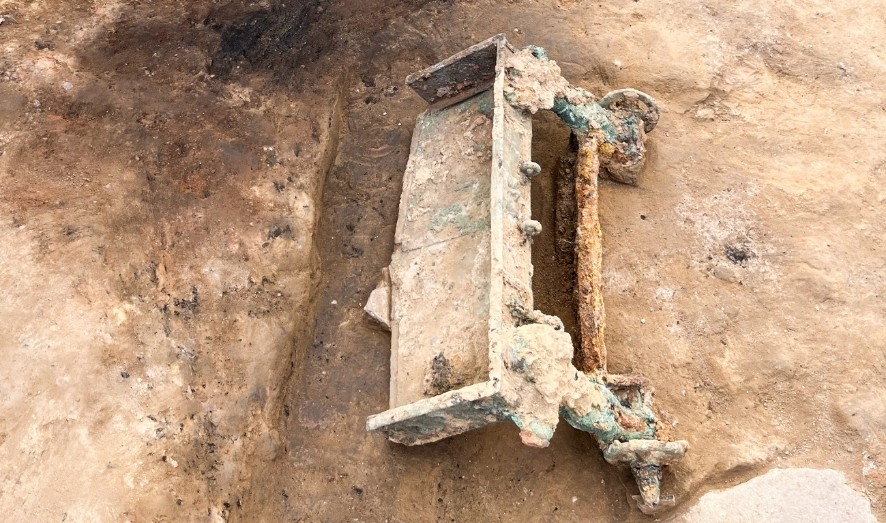
One of the most relevant finds made to date at this 5th-century BC Tartessian site.
Esther Rodríguez, co-director of the excavations
That closure is what makes Casas del Turuñuelo so unusual. Towards the end of the 5th century BC, the people who lived here deliberately buried their main building under a huge earth mound. Today the mound measures 90 metres across and six metres high, and it worked like a time capsule: mudbrick walls, staircases and objects were sealed in more or less where they stood.
This year's digging focused on the northern and southern parts of the mound. Between them lies room H-100, about 70 square metres and the largest space uncovered in the building so far. The northern sector produced two braziers and a cauldron, all bronze. Next to the cart came objects that had travelled a long way: Attic pottery from Greece, an alabaster vessel of Egyptian origin and several carved ivories showing warriors, animals and plants.
Rodríguez said the team was recording imports and one-of-a-kind pieces that help rebuild the exchange networks of the period. The excavators also noticed that far less pottery turned up than in earlier seasons, a hint that the newly opened rooms served a different purpose that has yet to be worked out.
A decade of digging up Tartessos
Tartessos is one of the most elusive cultures of Iberian prehistory. It flourished in the south-west of the peninsula between the 8th and 5th centuries BC, and for a long time it was known mainly through the writings of Greek authors rather than through physical remains. Casas del Turuñuelo has been filling that gap season after season:
- 2015: excavation of the southern sector of the main building begins.
- 2017: the largest animal sacrifice recorded in the western Mediterranean comes to light.
- 2023: the first human representations of Tartessian culture appear, the stone faces now known as the Turuñuelo faces.
- 2024: a slate plaque turns up, carved with warrior scenes and a southern Palaeohispanic alphabet.
- 2025: the team identifies the oldest Greek marble altar in the western Mediterranean, cut from stone quarried on the island of Marmara in modern Turkey, as reported by the regional government and by Archaeology magazine.
- 2026: the Etruscan-style bronze cart.
Trade is the thread running through all of it. An Egyptian vessel, pottery from Athens, ivories from eastern workshops and now a cart that may have been made in Italy point to a community deep inland that was connected to ports thousands of kilometres away. Long-distance links of this kind have turned up far from Spain too, as with the Roman glass found in Mongolia's largest Xiongnu tomb, and Egyptian alabaster travelled widely, as the collections of the Grand Egyptian Museum show.

The research programme behind the dig is called Construyendo Tarteso ("Building Tartessos"). It brings together some 30 institutions and around a hundred researchers from Spain and abroad. Funding comes from Spain's State Research Agency under the national R&D plan, together with the Junta de Extremadura, the Badajoz provincial council and Guareña town hall. The regional government says it awarded the excavation a grant of €236,000 covering July 2025 to December 2026.
CSIC president Eloísa del Pino told the audience in Madrid that Casas del Turuñuelo shows how persistence and steady, long-term backing for science end up paying off.
From the lab bench to a walk-through dome
With fieldwork over, the cart went to Madrid. Conservation, drawing and analysis are being handled by the conservation and archaeological science service (SECYR) at the Autonomous University of Madrid, which has worked with the site since its first season. The faces found in 2023 took the same route: they were restored in Madrid and can now be seen in the Protohistory gallery of the Badajoz Provincial Archaeological Museum, which reopened in May 2025 with about 400 Tartessian objects from across Extremadura, according to the regional leisure guide planVE.
Meanwhile the scenery at Guareña is changing. In February 2025 the regional government presented plans for a large metal cover to shield the mound from wind and rain, which wear away the mudbrick walls. According to the official presentation, the design by architect Carlos Albarrán measures 116 metres in diameter on the outside and nearly 20 metres in height, spans about a hectare with no central pillars, and is topped with native plants that recreate the outline of the original mound.
Inside, suspended ramps at different heights will let visitors walk over the site without anything resting on the ancient structures, and there will be exhibition rooms too. Construction began on 26 September 2025 with a budget of about €6 million, backed by EU rural development funds, and a nine-month schedule that set completion for June 2026, according to the Junta de Extremadura. The aim is to turn the site into a draw for visitors to the Vegas Altas while the research carries on.

Plenty is still unknown. The team wants to establish what the new rooms were used for, how the trade that brought these goods actually worked and what daily life looked like in the building before it was buried. Speaking to Euronews, Rodríguez stressed that the second, laboratory-based phase of any excavation is indispensable. Coverage in El Español made a similar point: the cart raises more questions than it settles.
Spanish heritage and basic science have produced a run of good news lately, from the Sagrada Família topping out its tallest tower to the fossils still emerging from the Pyrenees, such as the chameleon-tongued amphibian described in Huesca. Extremadura has now added an object that forces a redraw of the map of ancient trade in Iberia.
The detail you might not know
After more than ten years of work, only around 15% of the site has been excavated, according to the Construyendo Tarteso project website. What lies under the mound is, by the same account, the best-preserved protohistoric building in the western Mediterranean, with two storeys still standing. In other words, the bronze cart, the faces, the marble altar and the slate alphabet all came out of a small fraction of the complex. The rest is still underground in Guareña, waiting for the next digging seasons.
Go further
- Web · CSICNota de prensa del CSIC sobre el carro de bronce de Casas del Turuñuelo
El comunicado original con todos los hallazgos de la octava campaña y las declaraciones del equipo.
- Web · Proyecto Construyendo TartesoCasas del Turuñuelo: localización y antecedentes
La web del propio proyecto explica qué es el yacimiento y cuánto queda por excavar.
- Web · Junta de ExtremaduraPresentación de la cúpula del yacimiento del Turuñuelo
Medidas y detalles de la cubierta de 116 metros que protegerá el túmulo y permitirá visitarlo.
- Web · Junta de ExtremaduraHallazgos de la séptima campaña en el Turuñuelo
El anuncio de 2025 del altar griego de mármol, el antecedente directo del carro.
- Web · Archaeology MagazineOldest Greek Marble Altar in Western Mediterranean Uncovered
Cómo contó la prensa arqueológica internacional el hallazgo del altar de mármol de Mármara.
- Blog · planVEViaje a Tarteso desde Badajoz
Guía práctica para ver los rostros del Turuñuelo en la sala de Protohistoria del museo de Badajoz.
Sources
- CSIC: Hallado en Casas del Turuñuelo un carro de bronce único en la península ibérica (nota de prensa, 24/06/2026)
- Junta de Extremadura: El hallazgo en el yacimiento Casas del Turuñuelo de un carro de bronce único
- Euronews: Descubren un carro de bronce de 2.500 años que arroja luz sobre la historia de Tarteso
- El Español: Hallado un excepcional carro de bronce que evidencia el comercio de lujo entre Tarteso y el Mediterráneo
- Junta de Extremadura: inicio de las obras de la cúpula del Turuñuelo (26/09/2025)




