


 Have a great day, y'all!
Utah is now selling round-the-clock power from hot rock
Cape Station in Beaver County turns dry rock into steady power for the western U.S. grid, with new contracts, new transmission and open questions.

Milford, Utah, has about 1,600 residents, a hillside drill rig roughly 150 feet tall, and, a few miles away, a power plant that has spent weeks feeding electricity into the western U.S. grid. The plant is Cape Station, built by Fervo Energy. On November 18 the company announced a 105-megawatt transmission agreement with Longroad Energy, the latest of several announcements in under two weeks.
This is not the kind of geothermal plant the world has known for a century. It does not tap a hot aquifer that nature left in place. It builds the reservoir, and that changes where geothermal can work.
- The first 33 MW block synced to the grid on September 24, 2026, and was declared commercially operational on September 30, a day ahead of its contract deadline.
- On November 18, Fervo and Longroad signed 105 MW of additional firm transmission on the Milford Gen Lead line. Cape Station now has 505 MW of contracted capacity; the new 105 MW starts in 2028, pending regulatory approvals.
- Fervo's November 9 earnings release lists 1,054 MW under binding power purchase agreements, about $11.9 billion in contracted revenue.
- A study commissioned by Fervo from the independent firm DeGolyer and MacNaughton lifts the site's potential from 4.3 to about 8.4 GW.
- Since February 2024 the company has logged 167 "yellow" and three "red" seismic events, all barely felt in Milford.
How do you build a reservoir?
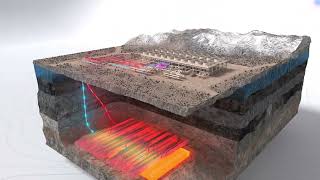
Fervo's crews drill a vertical well about 10,000 feet down into granite, according to Fortune, bend it to horizontal, and run it another 7,500 feet or so. Then they pump in water at high pressure, as in gas fields, to open a network of cracks between parallel wells. Cold water goes down one, spreads through the fractures, comes up another above 400°F and spins a turbine. The cooled water goes back down.
The concept is fifty years old. What changed is the drilling. Fervo borrows oil-field tools, including horizontal wells, and on Phase 2 its crews are drilling eight wells spaced about 15 feet apart, Deseret News reported. Roman Esqueda, who leads that drilling team, put the logic plainly: more wells on less ground means more energy.

Dawn Owens, Fervo's senior vice president of commercial markets, told Canary Media that traditional geothermal "would have never been done in southern Utah," since the area has no hot springs at the surface. She called the milestone massive for Fervo and for the industry.
Fervo explains the method in its own video, and its Ground Truth series has an episode on building Cape Station.
Cape Station is being built in phases. Phase 1 totals about 100 MW in three 33 MW blocks. Block 2 is already sending test power to the grid and block 3 is in cold commissioning; Fervo expects both to reach commercial operation by January 1, 2027. The next phase, Cape Google 400, will add about 400 MW through 2028, and drilling for it was roughly 18% done in early November.
TechCrunch counted 23 months from the September 2023 groundbreaking to the first sale of power, and reports Fervo hopes to get that down to 18 months. The first buyer is Shell Energy, a California retail provider, and Fortune names Southern California Edison as the main customer.
Fifty years of trying
Geothermal electricity is an Italian invention. On July 4, 1904, Prince Piero Ginori Conti lit five bulbs with natural steam at Larderello in Tuscany. For a century after that, the resource was always the same: steam or hot water already sitting underground, in places with volcanoes, faults or hot springs, such as Iceland, California or Nevada.

Making the reservoir yourself was first tried in the 1970s at Fenton Hill, New Mexico, where Los Alamos researchers worked on what they called hot dry rock. A European project followed at Soultz-sous-Forêts in Alsace, from the mid-1980s. Then came Basel, Switzerland, where stimulating a deep well between December 2006 and March 2007 set off earthquakes up to magnitude 3.4 that people felt in the city. The project was suspended, and the episode has shaped the debate ever since.

The modern push came from the United States. The Department of Energy has funded Utah FORGE for years, a University of Utah field laboratory near Milford where researchers test how to create and sustain a reservoir in hot rock. Its extended circulation test began August 12, 2026, designed to run 90 days and possibly 120. Officials quoted by Deseret News say that work reduced the risk of the surrounding land.
Fervo dates from 2017. According to published profiles, Tim Latimer, a former BHP drilling engineer, met Jack Norbeck, who studied geothermal reservoirs, at Stanford; Norbeck is now chief technology officer. In July 2023 they finished Project Red in Nevada: two wells about 8,000 feet deep with horizontal sections of roughly 3,250 feet, producing 3.5 MW. It showed that horizontal wells worked in an enhanced system.
Before Cape Station, Fervo had already signed sales commitments: 115 MW with Google and NV Energy for Google's Nevada data centers, and 320 MW with Southern California Edison, according to trade coverage. It went public in May 2026 and, per TechCrunch, raised $1.9 billion.
Contracts, costs and one caution
The Google deal, announced in September, is a 15-year take-or-pay contract for 396 MW across eight blocks, with first power expected in mid-2028. Fervo also committed to offer Google an option on about 600 MW more, which would take the total to nearly 1 GW. If Google accepts, that extra power could serve a data center in Beaver County directly, bypassing the grid under Utah's SB132 framework.
Cost is where the argument is. Fervo puts the first three blocks at about $7,000 per kilowatt, Cape Google 400 at a target of $5,500, and a long-term goal of $3,000. A gas plant averaged $2,157 per kilowatt in 2025, according to BloombergNEF as cited by Canary Media. Geothermal is much more expensive to build, though it burns no fuel.
PacifiCorp, the utility serving much of Utah, said at an October 14 public meeting on its resource plan that at Fervo's prices, with federal tax credits, geothermal "would be economic," and that without them it would still be competitive with gas. It will model 500 MW of enhanced geothermal from 2030, at $5,500 per kilowatt that year and $3,000 by 2036. No contract has been signed.
The Department of Energy's Pathways to Commercial Liftoff report says next-generation geothermal could supply up to 90 GW of U.S. power by 2050, at $60 to $70 per megawatt-hour by 2030. Total U.S. geothermal today is roughly 4 GW, about 0.4% of generation. The International Energy Agency, in The Future of Geothermal Energy, puts the technical potential at up to 800 GW worldwide and says geothermal could meet 15% of the growth in electricity demand to 2050 if drilling costs keep falling.
"Turn it on, run it for 30 years, and that's your project."
Tim Latimer, co-founder and CEO, Fervo Energy
Logan Mitchell of Utah Clean Energy told Deseret News that geothermal pricing "has crossed a tipping point," but noted that the 8 GW figure comes from the company and would nearly power Utah twice over on a hot afternoon "if true." He also credited a relatively good permitting environment in Utah, with BLM offices working closely with developers.
Tremors and water
Drilling and fracturing at depth produces microseismic events. Fervo tracks them with surface stations and fiber-optic cable inside the wells, and runs a traffic-light protocol: below magnitude 2.0 work continues; from 2.0 to 3.0 it pauses at least six hours; at 3.0 or more it pauses at least 24 hours and reviews before restarting.
In its November 5 report covering May to October, the company said all three red events came in September, at magnitudes 3.05 to 3.30 on its own network and between 2.6 and 3.1 in University of Utah and USGS catalogs. At the Milford station each registered Mercalli intensity I or II, the low end of what people notice. Fervo says it received no reports of injuries or damage. After those episodes it cut injection rates in the final stages, skipped the intervals nearest a fault and added tests that check each stage is isolated.
The company also notes that the region saw larger natural aftershocks in the same months, including a magnitude 5.2 near Silver Springs, Nevada, on May 1. On July 1 it hosted a workshop at Stanford where researchers from national labs and universities reviewed its data, and it is forming an independent advisory panel. Its claim about how much fluid it has injected is the company's own, and the panel's outside review is still to come.
On water, Deseret News reports that Fervo holds a non-consumptive water-use permit from the state and reuses its fluid. Mitchell acknowledges that others doubt it and says operating data will settle the question. For a dry state, Emy Lesofski of the governor's energy office called that "a really big deal."
What the town says
Milford's mayor, Nolan Davis, who has held public office for more than 30 years, told Deseret News the town "exports its kids" because mining, the railroad and a hog farm have all shrunk. He calls Fervo a "fantastic neighbor": employees coach youth baseball, and the company gave $15,000 to the library. He has not felt any tremors. What bothers him is that the valley's power gets sold in California, though he accepts that if jobs return to Main Street.
The plant is not the valley's first. PacifiCorp has run the 34 MW Blundell plant since 1984, on a fault in the Mineral Mountains, using natural steam. Utah ranks third in geothermal capacity with about 3.2% of the national total; California and Nevada together hold more than 90%.
Fervo projected 6,600 construction jobs and 160 permanent ones for Cape Station. It holds about 670,000 acres of leases and spent $256.7 million on capital projects in the third quarter, mostly at Cape. It ended September with $1.9 billion in cash, and reported an operating loss of $43.7 million for the quarter.
Other players are moving in the region too: in August the BLM authorized up to 10 temperature-gradient test wells in Iron County, and Mountain West states formed a geothermal consortium in May.
The next dates are concrete: blocks 2 and 3 by January 1, first Google power in mid-2028, and Google's decision on the extra 600 MW before June 2030. Whether costs really fall from $7,000 to $5,500 and then $3,000 per kilowatt will show up in Fervo's books, not its press releases.
Elsewhere on The Positive Way: the EU fast-tracks clean-energy paperwork, electric trucks now make up half of China's heavy-truck sales, the world's fusion map and Vermont volunteers who seal winter out of old windows.
The detail you might not know
According to an Energy Institute summary of the IEA report, up to 80% of the investment geothermal needs uses skills and equipment that already exist in oil and gas, and drilling accounts for 60 to 80% of a project's cost. Fervo's bet is not a new material but drilling faster and cheaper.
For more
- Fervo Energy and Longroad Energy execute 105 MW transmission agreement
- Fervo Energy reports third quarter 2026 results
- Fervo: October 2026 insights on seismic behavior at Cape Station
- Deseret News: Fervo's 4-gigawatt geothermal plant has big goals
- TechCrunch: world's first enhanced geothermal plant completed in 23 months
- Fervo Energy on YouTube
Go further
- Web · Fervo EnergyFervo Energy reports third quarter 2026 results
Cifras de contratos, costes, perforación y calendario de Cape Station
- Web · Fervo EnergyOctober 2026 Insights on Seismic Behavior at Cape Station
Informe sísmico con el semáforo, las magnitudes y las medidas adoptadas
 YouTube · Fervo EnergyGround Truth: Episode 5: Cape Station
Episodio de la serie de la empresa sobre la construcción de la planta
 YouTube · Fervo EnergyHow Fervo Energy's Next-Generation, Enhanced Geothermal Systems Work
Explicación en vídeo de cómo funciona un sistema geotérmico mejorado
- Web · Deseret NewsFervo's 4-gigawatt geothermal plant has big goals
Contratos, costes y la visión de Utah Clean Energy y PacifiCorp
- Web · Agencia Internacional de la EnergíaThe Future of Geothermal Energy
Potencial mundial y costes de la geotermia de nueva generación
- Web · U.S. Department of EnergyFORGE: Creating Pathways for Geothermal
El laboratorio de campo de Utah que probó la tecnología cerca de Milford
Sources
- Fervo Energy and Longroad Energy Execute 105 MW Transmission Agreement
- Fervo Energy Reports Third Quarter 2026 Results
- October 2026 Insights on Seismic Behavior at Cape Station
- In global first, a next-gen geothermal plant goes live at utility scale (Canary Media)
- Fervo Energy (Wikipedia)
- Fervo's 4-gigawatt geothermal plant has big goals (Deseret News)
- Fervo next-gen geothermal power (Fortune)
- The West's next energy frontier is beneath a Utah small town (Deseret News)
- Pathways to Commercial Liftoff: Next-Generation Geothermal Power (DOE)
- World's first enhanced geothermal power plant completed in 23 months (TechCrunch)
- FORGE: Creating Pathways for Geothermal (DOE)
- The Future of Geothermal Energy (IEA)







