


 Have a great day, y'all!
No fuel on board: the world's largest electric ship now links Uruguay and Argentina
Since 22 October, Buquebus's China Zorrilla has crossed the River Plate on more than 40 MWh of batteries, recharged in Colonia from a Uruguayan grid that is 98% renewable.
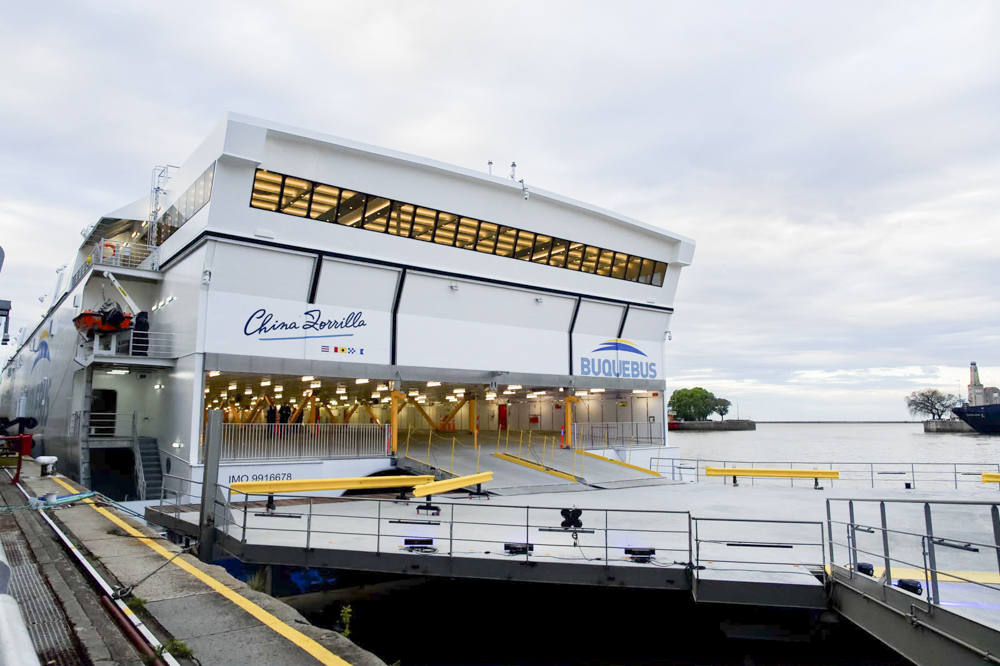
On Thursday 22 October 2026, a 130-metre catamaran pulled away from the Buquebus terminal in Buenos Aires' Puerto Madero, bound for Colonia del Sacramento in Uruguay, and burned no fuel at all on the way across. She is called China Zorrilla, after the Montevideo-born actress, and since that day she has crossed the River Plate on battery power alone. Her builder, Australia's Incat Tasmania, says she is the largest electric vessel in commercial service anywhere.
For Uruguay, the story has an extra layer. The ship tops up in Colonia from a grid that was 98% renewable in 2025. In other words, wind from turbines in the interior, water from dams on the Negro and Uruguay rivers and biomass from the forestry industry end up, as kilowatt-hours, carrying 2,100 passengers and 225 cars between two capitals.
- First commercial crossing: 22 October 2026, Buenos Aires to Colonia, roughly 55 kilometres in about 90 minutes.
- Capacity: 2,100 passengers and 225 vehicles, more than twice the people carried by the company's previous largest ship.
- Batteries: over 40 MWh and over 250 tonnes, feeding eight electrically driven waterjets.
- Investment: about US$200 million for the ship and charging infrastructure, backed by a US$107 million loan from Santander Uruguay, partly guaranteed by the World Bank's IFC.
- Expected savings: 37,545 tonnes of CO₂ equivalent a year, according to the IFC.
A ship that was meant to run on gas
The China Zorrilla did not start life as a battery ship. In May 2019 Buquebus ordered a fast aluminium ferry from Incat with dual-fuel engines burning liquefied natural gas and diesel. At the time that counted as the cleaner option: lower emissions than heavy fuel oil, but still a fossil fuel.
In January 2023, with the hull already taking shape in Hobart, Tasmania, the two companies tore up the plan and redesigned the vessel to run purely on electricity. The space set aside for gas engines became four insulated battery rooms, filled with lithium cells made by Corvus Energy in Norway and integrated by Finland's Wärtsilä, which also supplied the propulsion.
The hull first touched the water of the River Derwent on 2 May 2025. Incat chairman Robert Clifford said the day mattered not just for the shipyard but for the future of maritime transport. According to The Maritime Executive, the installation of more than 40 MWh was four times larger than any battery system previously fitted to a ship.
To put that in perspective, the Spanish motoring site Motorpasión compared the battery bank to that of around 800 electric cars. It weighs more than 250 tonnes and powers eight waterjets, which push fast catamarans along in place of propellers. Cruising speed is around 25 knots.

Getting her to South America took patience. A battery ferry cannot sail across the Pacific under her own power, so she had to ride on the deck of a semi-submersible heavy-lift ship. The voyage planned for March 2026 slipped when the transport vessel was held up in the Persian Gulf. A replacement, the Black Marlin, left South Africa in early June.
In September, after more than 15,000 kilometres across the Pacific, through the Strait of Magellan and up the South Atlantic, the carrier ballasted down off Nueva Palmira, in Uruguay's Colonia department, so the ferry could float off on her own. Two tugs then took her to Colonia del Sacramento for several weeks of trials and tuning with the shore charging system.
Colonia's mayor, Guillermo Rodríguez, told the trade site MundoMarítimo that local people regard the Buenos Aires route as their own, and that the ship would bring work to the area.
The plug is in Colonia
A battery ship this size is useless without a socket to match, and that part was sorted out on the Uruguayan shore years in advance.
In July 2024 Uruguay's transport ministry signed the agreement with Buquebus that cleared the ferry for the route. At the signing, the National Ports Administration (ANP) reported investments of more than US$27 million to adapt the Colonia terminal. On 22 November that year the ANP and the state power company UTE agreed to build, run and maintain a metering station and an underground cable down to the quay.
Colonia will become the first green port in South America.
Juan Curbelo, then president of Uruguay's National Ports Administration
The work followed what UTE described as a "mixed model", Montevideo Portal reported in October 2025. Buquebus built and paid for the chargers, which it owns, and UTE credits those costs against the company's future electricity bills. The state utility laid the underground cable and the ANP paid for the substation. On the Argentine side, the distributor Edesur built an equivalent station at Puerto Madero.
The technical record compiled on Wikipedia) lists two 15 MW Wärtsilä chargers and an operating pattern of two round trips a day, with a recharge between each crossing. Buquebus says sailings will be added gradually as the ship beds in, and the rest of its fleet keeps its usual timetable.
Why the Uruguayan kilowatt-hour matters
An electric ship is only as clean as the grid that charges it. That is where Uruguay becomes an interesting case.
Preliminary figures from the National Energy Directorate, reported by Montevideo Portal in January, show the country generated 13,040 GWh of electricity in 2025, and 98% of it came from renewable sources: 46% hydro, 34% wind, 14% biomass and 4% solar. Only 2% came from fossil-fuelled plants, and 8% of output was exported to neighbouring countries. Average emissions came to 11.2 tonnes of CO₂ per GWh, a small fraction of what a coal or gas-heavy grid produces.
None of that happened by accident. The energy regulator Ursea traces the path: a 1997 law that opened generation to private companies, a 2006 decree allowing UTE to buy its first 60 MW of renewables, a wind programme in 2007, and a long-term energy policy approved in 2008 and endorsed across parties as state policy in 2010. Around US$8 billion has been invested since then, according to the same Montevideo Portal report.
The global trend points the same way: in 2025 renewables overtook coal in world electricity generation for the first time in a century, as we reported here.
Uruguay's unfinished business is not in the grid but in fuel tanks. The latest National Energy Balance, presented by the Ministry of Industry, Energy and Mining at the end of July, shows that transport produces 63% of the country's CO₂ emissions, against 17% from industry. That is why the government now talks of a "second energy transition" focused on electrifying cars, buses and industrial processes.
Electric mobility is no longer an emerging phenomenon.
Arianna Spinelli, Uruguay's national director of energy, presenting the 2025 National Energy Balance
The numbers back her up. In 2025, for the first time, electricity used for transport exceeded the combined consumption of the leather and textile industries, and it now equals about 70% of what the cement industry draws. The light-vehicle fleet grew 5%, and three of those five points were electric and hybrid cars. By July 2026, 276 electric buses were in service, officials told the congress of the Uruguayan Renewable Energy Association.
The same shift is showing up elsewhere. Electric cars now displace 1.2 million barrels of oil a day worldwide, and in 2025 Norway reached its goal of 95.9% electric new-car sales. A 2,100-seat ferry takes that logic onto the water, where transport has usually lagged behind.
Private money, public guarantee
The financing also caught bankers' attention. In July 2024 Buquebus, through its company Los Cipreses, signed a US$107 million loan with Santander Uruguay. The International Finance Corporation (IFC), the World Bank Group's private-sector arm, provided a partial guarantee of up to US$67 million, about 63% of the loan.
According to the World Bank, it was the first blue loan in Uruguay and the first for electric mobility in Latin America and the Caribbean. "Blue" loans are tied to goals that protect water and oceans, such as cutting pollution from shipping.
Investing in electric transport is essential to cut millions of tonnes of emissions.
Alfonso García Mora, IFC vice president for Europe, Latin America and the Caribbean
The totals depend on who is counting. The IFC said in 2024 that Buquebus would add US$14 million for the two charging stations, the World Bank cited a total investment of US$184 million, and the company rounded it to US$200 million at launch, including the ship and the energy infrastructure.
Launch day
The official unveiling took place on Wednesday 21 October at Puerto Madero, with officials from both countries. Uruguay sent a delegation that included vice president Carolina Cosse, presidential secretary Alejandro Sánchez and foreign minister Mario Lubetkin, along with the ambassador in Buenos Aires.
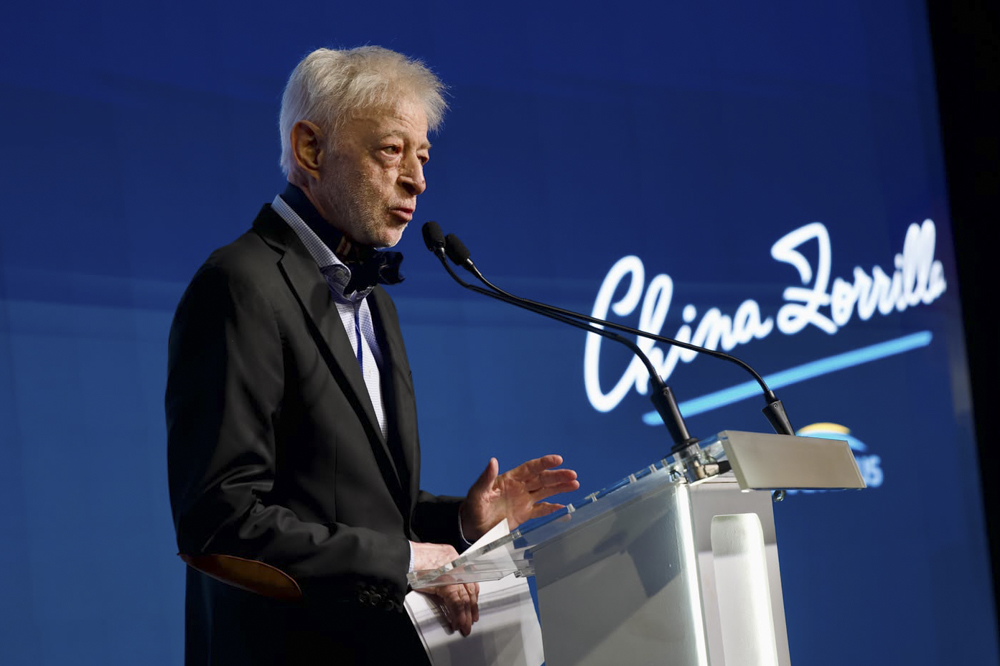
The host was Juan Carlos López Mena, the businessman who founded Buquebus and has spent decades linking the two shores. "We are very happy to have reached this moment," he said, as quoted by iProfesional.
Inside, the ship has three classes (Tourist, Business and First), satellite internet and a duty-free floor of about 2,300 square metres. The largest ship in the fleet until now carried 1,008 people and 135 vehicles. Incat says passengers will not feel the usual engine noise or vibration.
Back in Hobart, Clifford put it simply in remarks reported by gCaptain: "This ship proves that large, high-capacity commercial vessels can operate on electric power." The same yard is already building three more battery ferries for a Danish operator.
A Uruguayan actress on the bow
The name was chosen with care. Concepción Matilde Zorrilla de San Martín, known as China Zorrilla, was born in Montevideo on 14 March 1922 and died there on 17 September 2014, aged 92. She moved to Buenos Aires in 1971 and built a career of more than 50 films, among them Esperando la carroza, La tregua and Elsa y Fred.

With Emily, a one-woman play about the poet Emily Dickinson, she returned to the Montevideo stage in 1984 after a decade in which the dictatorship had barred her from performing. She was named an Illustrious Citizen of both Montevideo and Buenos Aires and a knight of France's Legion of Honour. Naming the ship that links her two cities after her was Buquebus's way of nodding to that shared River Plate identity.
What still needs solving
The launch does not settle every question. The first is operational: a ship that relies on fast top-ups at both ends needs both grids to deliver every time, and the company itself says sailings will build up slowly. The second is scale: the rest of the Buquebus fleet still runs on fossil fuels.
In Uruguay, the grid will also have to keep pace with rising demand. At its 114th anniversary in October, UTE announced its first two battery parks for storing renewable power, one of them in Colonia, and the government has set a target of at least 500 MW of new solar capacity over this term. Cheaper storage helps; we recently explained how sodium-ion batteries are nearing the cost of lithium.
For now, the fact on the water is concrete. A crossing that for decades meant burning fuel now runs on electricity that, on the Uruguayan side, comes almost entirely from wind, water and wood. And the ship carries the name of an actress who spent her life going back and forth between the two shores.
Further reading
- Presentation of the all-electric ferry: photos and video from Uruguay's Presidency (Spanish)
- IFC press release on the China Zorrilla financing
- World Bank: the electric ferry changing navigation on the River Plate (Spanish)
- Ursea: how Uruguay transformed its electricity mix (Spanish)
- Uruguay's 2025 National Energy Balance (Spanish)
- Renewables are growing where they were needed most: the IEA's 2026 report
Go further
 YouTube · ABC News (Australia)Building the world's biggest electric ferry
Reportaje desde el astillero de Hobart que muestra cómo se montó el banco de baterías del China Zorrilla.
 YouTube · Everything ElectricEntrevista con Incat sobre el ferry eléctrico
Los ingenieros del astillero explican por qué cambiaron el gas por baterías a mitad de obra.
 YouTube · Presidencia de UruguayActo por la presentación del primer ferry eléctrico (2024)
El acto de 2024 en el que Uruguay y Buquebus firmaron el acuerdo para sumar el barco a la ruta Colonia-Buenos Aires.
- Web · Presidencia de la RepúblicaInauguración de ferry 100% eléctrico que unirá Uruguay y Argentina
Fotos y videos de libre uso del estreno en Puerto Madero.
- Web · Banco MundialChina Zorrilla: el ferry eléctrico del Río de la Plata
Cómo funciona el primer préstamo azul de Uruguay y qué emisiones busca evitar.
- Web · IFCBuquebus, Banco Santander and IFC sign financing for the world's largest electric ferry
El detalle del financiamiento y la estimación de 37.545 toneladas de CO2 evitadas al año.
- Web · UrseaLa revolución silenciosa: cómo Uruguay transformó su matriz eléctrica
La cronología de leyes y decretos que llevaron a una red casi 100 % renovable.
- Web · WikipediaChina Zorrilla (ship)
Ficha técnica completa del buque, con su historia de construcción y traslado.
Sources
- Inauguración de ferry 100% eléctrico que unirá Uruguay y Argentina (Presidencia de Uruguay)
- Buquebus, Banco Santander and IFC sign financing for the world's largest electric ferry (IFC)
- Balance Energético Nacional 2025 (MIEM)
- Buquebus lanzó el ferry eléctrico más grande del mundo (El Economista)
- World's largest battery-electric ship begins commercial service in South America (gCaptain)
- Ya empezó a operar el China Zorrilla (iProfesional)
- Uruguay alcanzó un 98 % de generación eléctrica renovable en 2025 (Montevideo Portal)
- China Zorrilla presentado en Nueva Palmira (MundoMarítimo)
- World's largest battery-electric ship launched by Incat (The Maritime Executive)








