


 Have a great day, y'all!
Farmers mowed from the centre out, and Ireland's corncrakes rose by more than half
As the five-year Corncrake LIFE project closes, the bird's national population is up 55%. A new €4.35 million programme now carries the work on in Donegal, Mayo and Galway.

On a still night in late May, a single male corncrake in a meadow in Mayo or Donegal can call up to 10,000 times before dawn. The sound is a dry, two-part rasp, crex crex, which gave the bird its Latin name. For much of the twentieth century it was the background noise of an Irish summer. By the early 2000s, most of the country had gone quiet.
That is now changing in the west. When the Department of Housing, Local Government and Heritage announced on 7 May 2026 that the five-year Corncrake LIFE project was coming to an end, it put the gain at a 55% increase in the national population over the life of the project. The work is not stopping: a new programme, Natura Communities for Birds, will spend €4.35 million over an initial three years in counties Donegal, Mayo and Galway.
- The 2025 national survey recorded 281 corncrake territories, the highest number in 25 years and 48 more than in 2024.
- In the core breeding areas, territories are 70% above the 2018 baseline.
- About 250 farmers and landowners manage close to 1,500 hectares for the birds.
- Calling males have been confirmed again outside the core counties, in Kerry, Cork and Waterford.
A bird that hides in tall grass
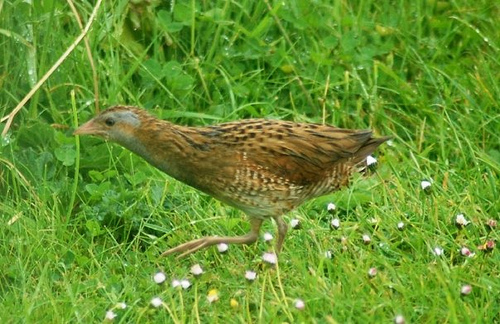
The corncrake is a secretive, slightly built relative of the moorhen. It spends the winter in Africa and arrives in Ireland in April, looking for tall vegetation where it can stay out of sight. It nests in hay and silage meadows, which is what made it so vulnerable when farming changed.
According to figures cited by the Connaught Telegraph, breeding pairs fell from about 4,000 in the 1970s to around 900 in the 1980s, and to roughly 150 to 200 in recent years. Earlier and faster mowing, more intensive grassland management, more generalist predators and disturbance all played a part. Silage cut in late May or June, with machines working from the field edge inwards, could trap chicks in the last strip of standing grass.
The species still lives in only a sliver of its old Irish range. Dr John Carey, who managed the LIFE project, pointed out in 2025 that corncrakes remain absent from about 90% of the places they once bred.

What farmers changed
The recovery was not achieved on nature reserves. It happened on working farms, through small changes paid for by targeted grants and agreed field by field. The NPWS lists the main measures:
- Cover: planting or keeping patches of nettles and crops so that birds arriving in April have somewhere to hide before the grass grows.
- Later mowing: delaying the cut until mid-August, after most chicks can run.
- Centre-out mowing: working from the middle of the field outwards so birds can escape to the margins.
- Flushing bars: fitting mowers with bars that scare birds clear ahead of the blades.
Agricultural contractors, who do much of the mowing in the west of Ireland, were brought into the project too. So were schools and local communities. The project was coordinated by the NPWS and funded by the EU's LIFE programme, with support from the Department of Agriculture, Food and the Marine, Fota Wildlife Park, Atlantic Technological University and Údarás na Gaeltachta. It worked across eight core areas.
When the 2025 survey results came out in September, Carey did not hide his surprise.
"Witnessing a 50% increase in the population of a species over a five-year period is simply astounding."
Dr John Carey, Corncrake LIFE project manager, September 2025
In the same statement he added a caution: "Corncrakes are still very vulnerable, and will need specialist support here in Ireland for some time to come."
Counting a bird you cannot see
Corncrakes are heard far more often than seen, so counting them is mostly about listening. Between 2021 and 2024, researcher Dr Andrea Parisi used acoustic recorders and drones with thermal cameras in Galway, Mayo and Donegal. Her work, published in Conservation Science and Practice and Global Ecology and Conservation, found that calling peaks between 10pm and midnight, especially on bright nights around the full moon, with most activity in late May and early June. Individual males can be told apart by their calls with some confidence, which makes surveys more accurate.
"I'm hopeful, as there's been a tide turn in the past few years," Parisi told the Connaught Telegraph. She credited farmers who "came on board" and described corncrakes as part of "the fabric and culture of old Ireland".
The next three years
Natura Communities for Birds was announced jointly by Minister of State for Nature Christopher O'Sullivan and Minister for Agriculture Martin Heydon. It starts with nine key sites, all designated as Special Protection Areas, and is part of a wider Natura Communities scheme backed by €10 million in Shared Island funding for 2026 to 2030, matched by €5 million from the NPWS. The Corncrake LIFE project formally ends on 30 June 2026.
"The Corncrake LIFE Project has been an incredibly successful and hopeful story of nature conservation in Ireland."
Christopher O'Sullivan, Minister of State for Nature, Heritage and Biodiversity
Heydon described the project's impact as "heartening to see". Carey said the day marked "a new era". Suzanne Nally, the NPWS director of nature conservation, described the model as "locally led teams working in cooperation with the NPWS and landowners to deliver for nature and people".
The approach also points beyond one species. Officials say the lessons will feed into the ACRES Cooperation scheme, a results-based agri-environment programme run by the Department of Agriculture, and into a "corncrake habitat scorecard" for farmers.
Not every bird is so lucky
The same western meadows once rang with the call of the curlew, which is now down to about 100 breeding pairs in Ireland. Its plight inspired a song that won twice at the RTÉ Folk Awards. Research we reported this year suggests small populations can recover when they get targeted help: most species reduced to fewer than 50 animals bounced back. New Zealand's kākāpō, up from 51 birds to 325, is one of them.
The fact you might not know
A corncrake lives only two to four years. That means the 281 territories counted in 2025 belong to birds that hatched, almost all of them, after the LIFE project began in 2021.
Further reading
Go further
- Web · NPWS and partnersCorncrake LIFE / Traonach LIFE
The project's own site, with field updates, farmer stories and the schools programme.
- Web · Corncrake LIFECorncrake end of project report 2026
The final report of five years of work, for readers who want the maps and the numbers.
- Web · BirdWatch IrelandCorncrake species profile
How to recognise the bird, where it lives and why it vanished from most of the country.
- Web · The Irish TimesGive me a crash course in the return of the corncrake
A short explainer on the bird's decline and the farming changes behind the recovery.
- Web · Atlantic Technological UniversityCorncrake numbers up thanks to conservation measures
The university research behind acoustic recorders and thermal drones used to count the birds.





