


 Have a great day, y'all!
An El Oro farmer spotted a rare orchid, and now the species carries his name
More than ten years ago Mario Aguilar found about fifteen plants near Balsas, in southern Ecuador. On 23 April 2026 the journal PhytoKeys confirmed they belong to a new species, _Dracula aguilarii_, and the same study traced the wild home of another orchid known only from a plant grown in Sweden.
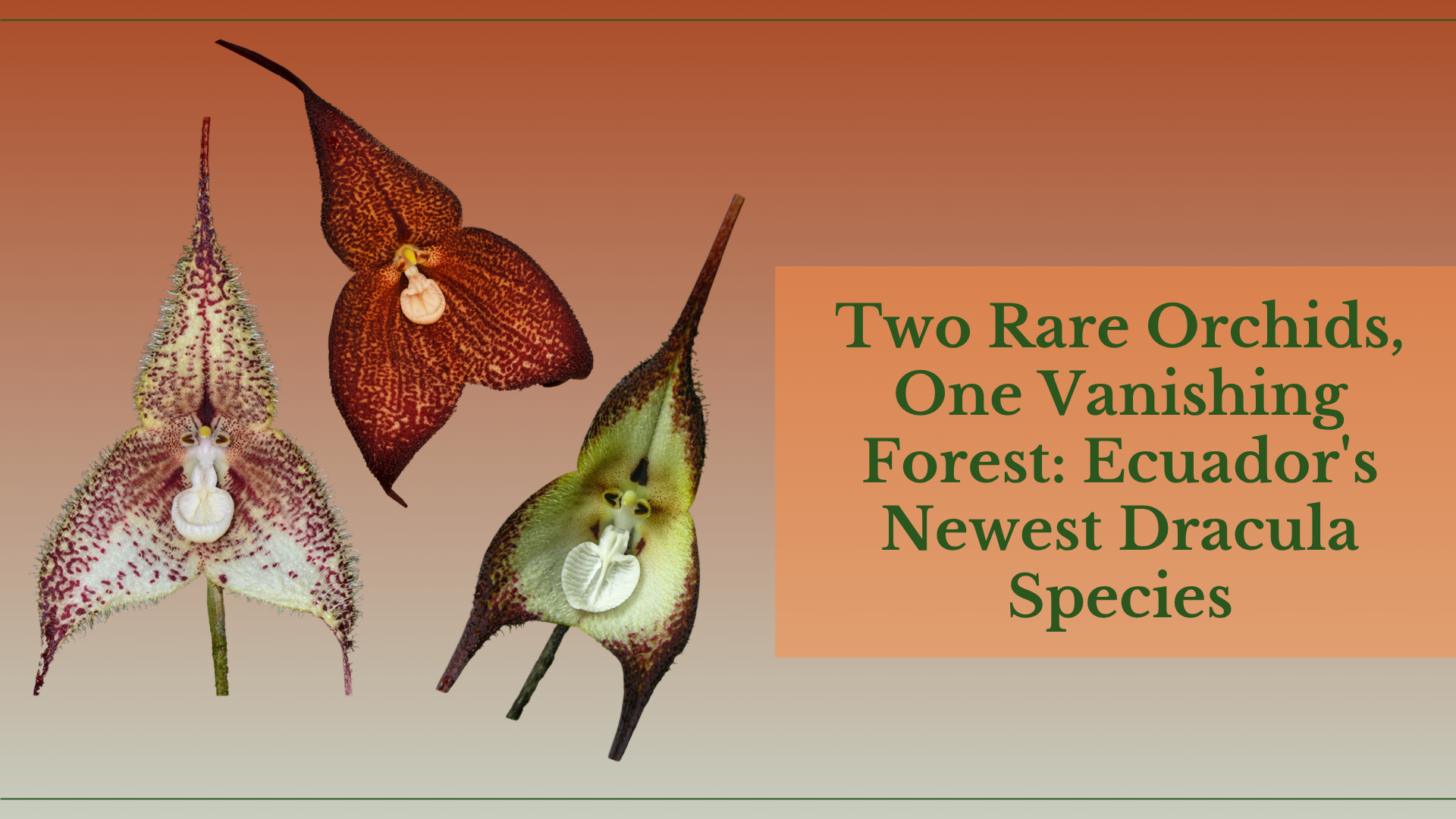
Mario Aguilar stopped in front of an old, moss-covered tree in a scrap of forest near Balsas, in Ecuador's El Oro province. That was more than ten years ago. He counted about fifteen plants of an orchid that did not quite match any he knew, took a photograph and went on his way. The picture turned out to be the first record of a species science had never catalogued.
On 23 April 2026, the journal PhytoKeys published the formal description of the plant. It is called _Dracula aguilarii_, after the man who spotted it first. The authors, orchid specialist Luis E. Baquero, Marco M. Jiménez and Gabriel A. Iturralde of the Universidad de Las Américas in Quito, spell out the reason in the paper's etymology note.
"Named for Mario Aguilar, farmer, and orchid enthusiast from El Oro, with an extraordinary talent for finding rare orchids in nature, who first spotted the new species in the field."
Etymology of Dracula aguilarii, PhytoKeys 273 (2026)
- A Dracula orchid from El Oro is new to science and carries the surname of farmer Mario Aguilar.
- Only three populations are known, between 900 and 1,200 metres above sea level, in an area of roughly 12 km².
- The same study located the wild home of Dracula soennemarkii, described in 2012 from a plant grown in Sweden.
- The authors propose listing the new species as Endangered and the second one as Critically Endangered.
The story reached a wider audience in July. On the 21st, the publisher Pensoft featured the find on its science blog, and on 27 July the Guayaquil daily Expreso told it to Ecuadorian readers. By early August it was running in Brazilian outlets too.
From a farmer's photo to the national herbarium
A photograph is not enough to name a species. It takes reference specimens, comparisons and fieldwork. On 13 April 2017, Baquero collected near Balsas, at 1,212 metres, the plant that now serves as the type specimen. It is held at Ecuador's National Herbarium (QCNE) in Quito. The next day he gathered another along the road to Piñas, at 957 metres, which later bloomed in cultivation.
Nine years passed between that fieldwork and the journal. That is a normal pace in botany: describing a species means checking collections, ruling out look-alikes and measuring every part of the flower. The research was funded through a Universidad de Las Américas project, and the collecting was done under a research permit from Ecuador's Ministry of Environment, Water and Ecological Transition.
According to the taxonomic treatment published on Zenodo, the plant is an epiphyte up to 30 centimetres tall that grows on old, mossy trees, from the base of the trunk to about four metres up. Its narrow, blunt-tipped leaves measure 20 to 27 centimetres. The flowers hang from a stalk 15 to 20 centimetres long and open one after another.
Each flower is large and cream-coloured with a brownish-red wash, covered in short, dense hairs. The sepals fuse into a cup 8 millimetres deep and end in "tails" of 3.4 to 6 centimetres. The lip, the part that draws insects in, is under a centimetre long and carries three orange ridges.
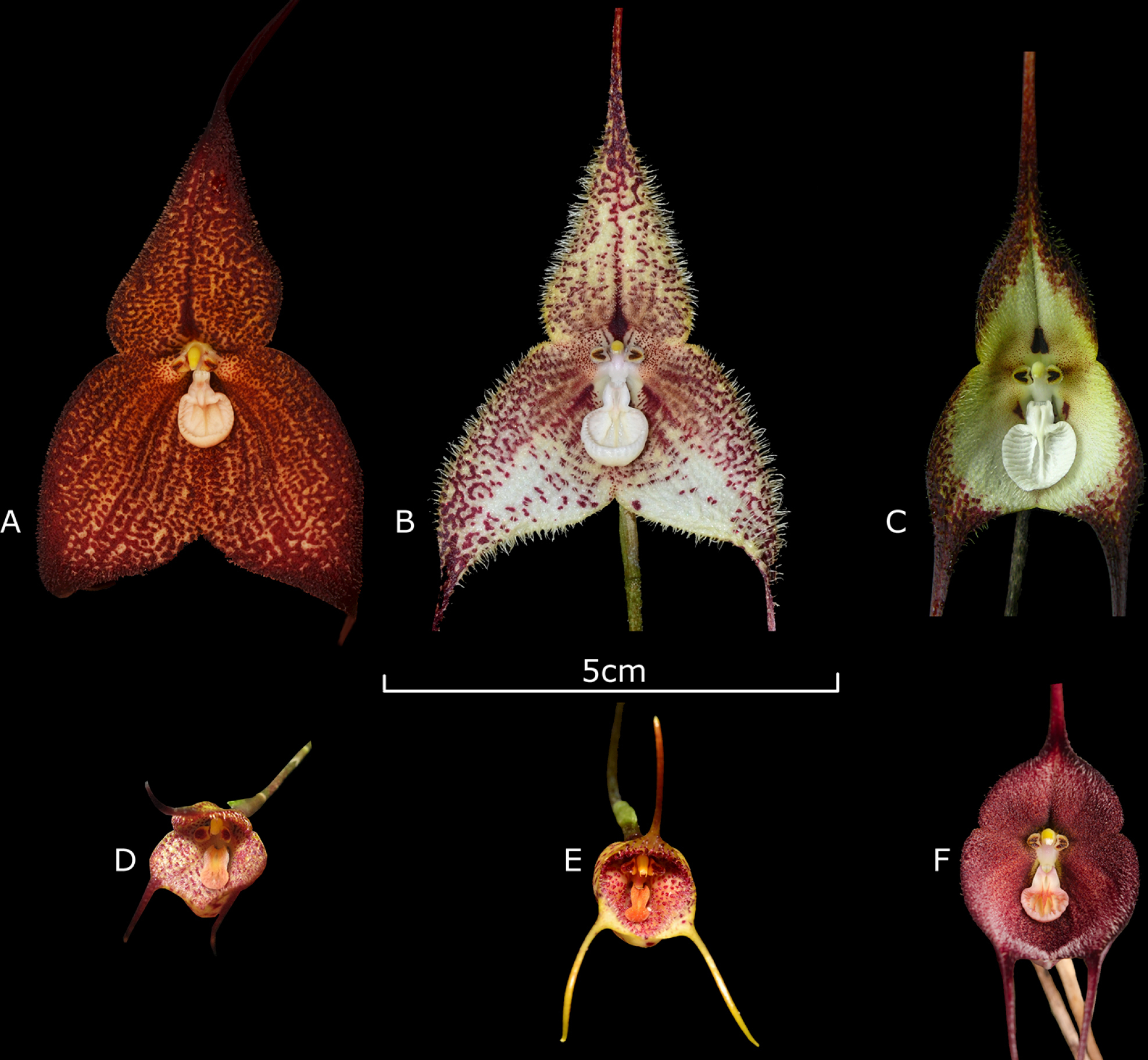
Its closest look-alike is Dracula hirtzii. The newcomer stands apart for its blunt-tipped leaves, the broad, rounded cup formed by its sepals and its shorter tails. It shares the forest with two other Dracula, D. cordobae and D. woolwardiae, and with tiny orchids such as Platystele alucitae and Specklinia colombiana.
In the acknowledgements, the authors thank Aguilar and José Bustamante, another local enthusiast, for guiding them to the wild populations and for letting them use their photographs. Bustamante found the third population, south of Balsas. Aguilar took the photo showing the species' colour variation and the one of D. soennemarkii in its habitat. He is not listed as an author, but his images are on the plates.
One more detail about the name. The international plant-names index, IPNI, records that another El Oro orchid, Epidendrum marioi, described in 2021, honours an orchid grower called Mario Aguilar from Marcabelí. The record does not say whether it is the same person, and the news reports place the Dracula find at Balsas. It does suggest that local residents have been helping botanists in the province for years.
A Swedish orphan finds its forest
The study carries a second piece of news. In 2012, botanists Carlyle Luer and Stig Dalström described Dracula soennemarkii from a plant that a Swedish grower, J. Sönnemark, had bought from an Ecuadorian nursery in Gualaceo, Ecuagenera, labelled as a different species, D. woolwardiae. It flowered in Halmstad, Sweden, in July 2011. Nobody knew which forest it came from.
For fourteen years it was a species without an address. It was grown, sold and exported, and collectors knew it well, but no wild population had been confirmed. Baquero, Jiménez and Iturralde found a young, flowerless plant in El Oro, collected it on 13 April 2017 at 1,271 metres and grew it until it bloomed. The cupped flowers, the short hairs on the sepals and the small lip with narrow teeth settled the identification.
The good news has a catch. Only one site is known, of about 4 km², and the authors propose Critically Endangered. For D. aguilarii they propose the IUCN category Endangered under criteria B1ab(iii)+2ab(iii). In plain terms: a very small range and a habitat that keeps getting worse.

Little dragons of the mist
The genus name has nothing to do with Transylvania. Dracula means "little dragon". American botanist Carlyle Luer coined it in 1978 because several species are blood-red and their sepals end in long, strange tails, according to Wikipedia). The genus now holds more than 130 species, nearly all in the northern Andes of Colombia and Ecuador. The authors of the study count 62 in Ecuador.
These orchids live where mist wets the trees almost every day. They do not rely on bees but on tiny flies of the genus Zygothrica, drawn to a lip that imitates the smell and shape of a mushroom. It was long assumed the flies mistook the flower for a place to lay eggs, but a recent study of Dracula erythrochaete recorded no egg-laying during long visits, so the exact mechanism is still open.
A recent global assessment, led by botanists from Colombia and Ecuador together with the University of Oxford and the IUCN's Orchid Specialist Group, evaluated 133 Dracula species and found that nearly seven in ten are threatened. Diogo Veríssimo, Amy Hinsley and Baquero himself summarised it in Popular Science. Many species survive in tiny forest fragments, some at one or two sites. Veríssimo, a researcher at Oxford, put it this way in a note from the university's Environmental Change Institute:
"For a plant that may exist in populations of just a few dozen individuals, a single collecting trip can be disastrous."
Diogo Veríssimo, University of Oxford
That pressure is why the authors of D. aguilarii list illegal collection next to forest clearing among the threats. They point to steady demand for new species among collectors in Ecuador.
A forest that keeps shrinking
El Oro covers a little over 5,000 km², from mangrove to páramo; the study's authors count 19 ecosystems between sea level and 3,900 metres. It is also one of the most heavily altered provinces. According to the daily El Comercio, after 460 years of gold mining and settlement it keeps only 31% of its original natural vegetation and loses about 6,254 hectares of forest a year, based on Ministry of Environment figures. Montane forest between 1,800 and 2,600 metres covers barely 160 km².
The orchid paper is gloomier still: citing the province's 2019 development plan, it says only about 6% of the territory holds humid forest in moderately good condition. The orchids' forests are small patches ringed by pasture and cropland, and most of what is left is young or selectively logged. A single clearing for pasture would hit nearly every plant in a patch.
Mario Yépez, executive director of the Ecuadorian Museum of Natural Sciences, told El Comercio that the province has a "historical information deficit" and that it may hold two ecosystems not yet described. In less than a decade, researchers have described three Pristimantis frogs, one snake, two lizards and four bats there. Among birds, 12.4% of the province's species are endemic.

Some brakes are in motion. A planned ecological corridor, Guayacán-Buenaventura-Cerro Azul, aims to join the remaining fragments. Close to Piñas, the Buenaventura Reserve, run by the Jocotoco Foundation, protects more than 360 bird species, 34 of them local endemics, including the El Oro parakeet and the El Oro tapaculo. The old trees of a forest like that are what epiphytes need.
Ecuador has shown that protecting land brings results. In 2026, Podocarpus National Park grew by 15,108 hectares, and with it the home of 14 frogs new to science. In Imbabura, the Íntag valley now counts almost 9,000 hectares under sustainable farming and ranching. And in the north, the Dracula Reserve, which Popular Science says shelters at least ten species of the genus, features in our story on a new frog in Carchi.

Southern Ecuador keeps yielding plants nobody had described. Not long ago, a spiny, red-flowered tree in Zapotillo turned out to be a new species, in neighbouring Loja. And in Azuay, Cajas marked 30 years as a national park with the rangers who look after its 28,544 hectares.
Something you might not know
The orchid lost in Sweden illustrates a problem botanists know well: plants that move through nurseries and collections with no record of the forest they came from. To describe and protect a species, you need to know where it grows in the wild. That is why finding the wild population of D. soennemarkii, fourteen years after it was described, finally makes it possible to assess its status and plan how to look after it in its own forest.
There is also a quiet note about credit. The official description carries three academic names, but the authors state in the text that two local enthusiasts, Aguilar and Bustamante, guided them to the wild plants.
Further reading
Go further
- Blog · PensoftTwo Rare Orchids, One Vanishing Forest: Ecuador's Newest Dracula Species
La nota de la editorial reúne fotos de la nueva especie y un resumen del hallazgo.
- Web · Luis E. Baquero, Marco M. Jiménez y Gabriel A. IturraldeDracula aguilarii (Orchidaceae, Pleurothallidinae), a new species from southwestern Ecuador
El artículo científico completo, en acceso abierto, con la descripción y la evaluación de amenaza.
- Web · Plazi / ZenodoDracula aguilarii Baquero, M. M. Jimenez & Iturralde 2026, sp. nov.
La ficha taxonómica con los ejemplares, la etimología y la ecología de la orquídea.
- Web · Diogo Veríssimo, Amy Hinsley y Luis Baquero (Popular Science)Famous monkey-face 'Dracula' orchids are vanishing in the wild
Resume la evaluación mundial de 133 especies de Dracula, casi siete de cada diez amenazadas.
- Web · Environmental Change Institute, Universidad de OxfordViral monkey-face orchids are at risk in the wild
Explica cómo una sola excursión de recolección puede ser desastrosa para poblaciones de pocas decenas de plantas.
- Web · El ComercioEl Oro, una provincia biodiversa y amenazada
Cifras de pérdida de bosque y de especies nuevas en la provincia, con voces de científicos.
- Web · World Land TrustBuenaventura Reserve
Ficha de la reserva de Piñas con sus aves amenazadas y el trabajo de la Fundación Jocotoco.
- Web · Mongabay LatamConservación de orquídeas en Ecuador: la Reserva Drácula
Cómo una reserva del norte de Ecuador protege el género Dracula, útil para entender el reto de El Oro.
Sources
- PhytoKeys 273: Dracula aguilarii, a new species from southwestern Ecuador (Baquero, Jiménez e Iturralde, 2026)
- Expreso: Descubren en Ecuador una nueva orquídea que la ciencia nunca había registrado
- Pensoft: Two Rare Orchids, One Vanishing Forest
- El Comercio: El Oro, una provincia biodiversa y amenazada
- Oxford ECI: Viral monkey-face orchids are at risk in the wild
- Zenodo/Plazi: Dracula aguilarii, tratamiento taxonómico
- Popular Science: Famous monkey-face Dracula orchids are vanishing in the wild
- IPNI: Epidendrum marioi




