


 Have a great day, y'all!
9,274 illegal guns seized in nine months: what Ecuador's security data shows
Seizures of illegal weapons rose 11.7% between January and September while homicides fell 8%. What happens to every seized gun, what voluntary surrender schemes have achieved, and what experts say is still needed to measure progress.

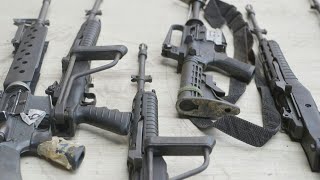
In 2023, rifles, shotguns, carbines and submachine guns made up just under ten of every hundred illegal weapons that Ecuador's police and armed forces took off the street. In the first nine months of 2026 they accounted for more than eighteen. The figure comes from the Interior Ministry and was published on 16 November by El Universo, putting guns back at the centre of the country's security debate.
There are two ways to read it, and both are true. The weapons in circulation are more powerful. And since comparable records began in 2017, never have so many been removed in so short a time.
- From January to September 2026, 9,274 illegal weapons were seized, 970 more than in the same period of 2025 (8,304), a rise of 11.7%.
- Long guns rose from 9.79% of seizures in 2023 to 18.37% in 2026.
- Over the same nine months, intentional homicides fell by 8%, from 6,838 to 6,286, according to the Interior Ministry.
- The improvement is uneven: Guayas, Los Ríos and Santo Domingo are down sharply; El Oro and Azuay are up.
- Seized guns that are unfit for official use are cut up and melted down in steelworks. In May alone, 1,399 were destroyed.
What the numbers say
The provincial breakdown was published by the newspaper Extra, using Interior Ministry data. Guayas accounts for the largest share, with 3,196 weapons. It is followed by Los Ríos (1,372), Manabí (907), El Oro (679), Pichincha (624) and Santo Domingo de los Tsáchilas (260). By type, 35% were pistols, 23% revolvers, 18% shotguns and 14% rifles and machine guns.
Rear Admiral Marco Rocafuerte, logistics director of the Armed Forces Joint Command, told the paper that 70% were seized in joint military and police operations against organised crime groups. The rest belonged to people who lacked the required permits.
A data investigation by Gabriela Quiroz for El Comercio, based on the ministry's security statistics office, adds perspective. Between January and August, 8,290 illicit weapons were recorded, the highest figure in a series that begins in 2017. That is about 34 a day, and 158% more than nine years earlier.
What is being seized has changed too. The revolver was the most commonly seized weapon for seven years before the pistol overtook it in 2024. Factory-made pistols went from 392 in 2017 to 2,534 in 2026. And more than half of this year's haul, 52%, was homemade: mostly shotguns built in clandestine workshops, an activity banned in Ecuador since 2012.
That share explains why each weapon matters. According to the records cited by El Comercio, pistols were used in 4,007 of the 4,994 firearm homicides in that period, eight in every ten.
The operations continue. During the curfew from 1 to 10 November in Guayas, Los Ríos, El Oro, Manabí and Esmeraldas, the Interior Ministry reported 249 firearms and 2,431 rounds of ammunition seized, and the Defence Ministry a further 12 weapons. A month earlier, on 10 October, the army found 54 weapons and some 30,700 primers in a warehouse in Monteserrín, in northern Quito, according to the magazine Vistazo. The tip came from military intelligence.
On 11 November, President Daniel Noboa linked the rise in long guns to violence in Manabí. "We have to understand the impact that has on violence," he said, according to El Universo.

Every figure in these tables ends its journey in a furnace. Seized guns go before a judge first, because they are evidence in criminal cases. Once a court authorises their disposal, military technicians sort them. Those of the right calibre and in good condition can be handed to the police or the armed forces, as the so-called Solidarity Law allows; the rest are destroyed.
In practice, most are melted down. In July 2025 Rocafuerte told Extra that only three in ten meet the conditions for official use. "Many of these weapons are in poor condition or use calibres that are not compatible with official ones," he said at the time.
On 21 May 2026 the armed forces disabled 1,399 firearms and 719 accessories at a steel company's premises, according to El Diario. Each was first cut with precision machinery so that no part could be reused, then sent to the furnace. In 2025, 2,558 weapons were destroyed the same way, and in the five years to July 2025 more than 32,000 had been rendered useless, according to the Joint Command.
X@armada_ecuadorVer publicación en X ↗Ecuador's navy shared this post about the destruction carried out on 13 November 2025, when some 22,000 weapons, rounds and accessories seized in the second half of that year were eliminated. According to the broadcaster Teleamazonas, the material went into the furnaces of a steelworks in southern Guayaquil. The news agency AFP filmed one of these destructions.
Handing a gun in before it is found
Taking guns out of circulation does not depend only on raids. Ecuador has tried the voluntary route before. On 5 August 2020, the police and the Joint Command launched a campaign in Guayaquil for the voluntary surrender of domestically made weapons. By December, 2,497 homemade revolvers and shotguns had been collected at arms-control centres in 23 provinces, according to Expreso. Fourteen private security companies handed in every weapon of that kind they held.
Fausto Salinas, then the police director of citizen security, summed up the aim in a few words: to "take weapons out of circulation". The guns received were stored and later destroyed.
Elsewhere in the region there is a longer-running example. Argentina has run its National Voluntary Firearms Surrender Programme since 2007, designed so that anyone can give up a gun without going through criminal proceedings. According to the Argentine government, more than 450,000 firearms have been destroyed since the disarmament law (Law 26,216) was passed, 62,606 of them between 2020 and 2023.
How many guns do civilians hold in Ecuador? There is no public official figure. The most widely cited estimate, reported by El Comercio, comes from the Swiss-based Small Arms Survey: about 402,000 in 2017, 58% of them unregistered. That was 2.4 per 100 inhabitants, the lowest rate in Latin America by that measure, below Colombia (10.13) and Chile (12.12).
The legal market has changed as well. In April 2023, Executive Decree 707 relaxed the rules on owning and carrying guns. Imports of pistols and revolvers rose from US$1.2 million in 2023 to US$4.74 million in 2024 and US$4.5 million in 2025, according to central bank figures cited by the outlet Primicias. Imports are currently suspended, and Defence Minister Gian Carlo Loffredo told El Comercio the measure would be reviewed at the end of the year.
The other half of the problem lies beyond the border. Asked by El Comercio where the weapons come from, Loffredo pointed to three routes: exchanges on the high seas, shipping containers at the ports, and land borders. In the north, smuggling crosses from Colombia through Esmeraldas and Sucumbíos, including along the Aguarico and Napo rivers. In the south it comes from Peru through Tumbes, in small quantities.
That is why cooperation carries as much weight as raids. On 10 November, Ecuador's Attorney General's Office and the FBI signed a memorandum to share information and run parallel investigations into transnational groups; arms trafficking is among the crimes covered, Primicias reported. "This memorandum expands our joint capacity," said Lawrence Petroni, chargé d'affaires at the US Embassy. Ecuador's Anti-Mafia Law, in force since 11 November, adds tools to follow these networks' money.
A regional comparison shows how far there is to go. According to InSight Crime's annual round-up, the median homicide rate in Latin America and the Caribbean was 17.6 per 100,000 people in 2025, down 5% on the previous year. The think tank put Ecuador at 50.9, the highest on record for the country. Colombia stood at 25.8, Brazil at 19.2, Peru at 10.7 and Chile at 5.4.
Colombia is also going through a period of high seizures. Its army said 2025 ended with the largest haul of weapons in a decade: 919 rifles, 2,320 pistols and revolvers and 63 machine guns, according to the newspaper El Heraldo.
Globally, the latest study by the UN Office on Drugs and Crime (UNODC) counted about 550,000 firearms seized in 2016 and 2017 across 81 countries, with pistols dominating seizures in the Americas. Its executive director, Ghada Waly, described firearms trafficking as "an enabler and multiplier of violence and crime".

What independent experts say
From January to September 2026 there were 552 fewer homicides than in the same period of 2025. The national rate fell from 37.8 to 34.5 per 100,000 people.
The Interior Ministry figure, published by Extra, matches a tally by Radio Pichincha. It follows 2025, the most violent year on record, with 9,284 homicides. The steepest falls came where killings had been most frequent: Guayas, home to four in ten of the country's homicides, is down 19%; Los Ríos 26%; Bolívar 37%; and Santo Domingo de los Tsáchilas 39%. Using open data up to August, Primicias calculated drops of 18% in Guayaquil and 41.8% in Durán.
The south is moving the other way. In El Oro, homicides rose 63% and its rate, 116.9 per 100,000, is the highest in the country. Azuay, Napo and Sucumbíos are also up, though from much lower numbers. It is the same province that is home to the stone city of Yacuviña and to Machala's free student residence: a place with far more to it than its crime figures.
Analysts quoted in the Ecuadorian press agree on one point: seizures are good news, but they are not a complete measure.
"The more weapons circulate, the harder it becomes to trace them."
Fernando Guerrero, security and organised crime specialist, to Extra
Guerrero wants closer monitoring of a legal gun's entire path inside the country, from import to possible diversion. The experts cited by Extra add that seizure numbers cannot reveal how many guns remain in circulation, and that success should also be measured by the ability to map supply networks and identify suppliers.
The researcher Carla Álvarez Velasco reached similar conclusions in Paradise lost?, her 2024 report for the Global Initiative Against Transnational Organized Crime. In her analysis, high-powered factory-made weapons are concentrated among the big players in drug trafficking and illegal mining, while homemade guns are left to common criminals. Firearms were involved in roughly nine in ten violent deaths in 2023.
Other specialists look at the map. "Violence does not disappear, it changes place," the academic Gabriel Lozano told the newspaper Expreso. In the same report, Mario Pazmiño, a former head of army intelligence, argued that state pressure can fragment the groups "but not necessarily dismantle them". The Ecuadorian Organised Crime Observatory recommends reading homicide data as absolute numbers and as rates per population at the same time, so that a small canton is not mistaken for a national trend.
There is also a call for more data. El Comercio found that the public database of seized weapons, which until 2024 recorded each gun's calibre and the associated crime, no longer includes those columns in 2026; the paper asked the Interior Ministry about the change and received no reply. For researchers, that detail is what allows them to trace where weapons come from.
Complaints of illegal arms trafficking filed with the Attorney General's Office offer another clue: they rose from 55 in 2015 to 604 in 2024, fell to 489 in 2025 and reached 523 between January and September 2026.
For people living in Ecuador, a few practical steps are within reach:
- If you see weapons or know where they are kept, call ECU 911. Reports can be anonymous.
- If you own a legal firearm, keep its permit up to date and lock it away: the diversion of legal guns is one of the routes experts worry about.
- Check figures on the government's open data portal before forwarding a number in a group chat.
At the last furnace in May, each of those 1,399 guns went under a saw before it went into the fire. None of them will be fired again.
Further reading
- Long-gun seizures over the past four years, El Universo (Spanish).
- Ecuador seizes 34 illicit weapons a day, data analysis by El Comercio (Spanish).
- Paradise lost? Firearms trafficking and violence in Ecuador, Carla Álvarez for GI-TOC.
- InSight Crime's 2025 homicide round-up (Spanish edition).
- Ecuador's anti-mafia law: what changed on 11 November, The Positive Way.
- A steel bridge reconnects northern Esmeraldas, The Positive Way.
Go further
- Web · El UniversoAumentan los decomisos de armas largas
La serie de cuatro años del Ministerio del Interior y los operativos recientes.
- Web · El ComercioEcuador incauta 34 armas ilícitas al día
El análisis más detallado de la base de armas incautadas desde 2017: tipos, provincias y rutas.
- Web · ExtraDecomisos de armas en Ecuador
Desglose por provincias y la visión de expertos sobre la trazabilidad.
- Web · ExtraLos homicidios bajan, pero no en todas las provincias
Las cifras de enero a septiembre provincia por provincia.
- Web · PrimiciasReducción de homicidios en Guayaquil y Durán
Análisis por cantones con datos abiertos del Ministerio del Interior.
- Web · Carla Álvarez / GI-TOC¿El paraíso perdido? Tráfico de armas de fuego y violencia en Ecuador
Informe independiente que explica de dónde vienen las armas y quién las usa.
- Web · InSight CrimeBalance de InSight Crime de los homicidios en 2025
Para comparar la tasa de Ecuador con la del resto de América Latina.
 YouTube · AFP EspañolFuerzas Armadas de Ecuador destruyen miles de armas
Cómo se cortan y funden las armas incautadas antes de que puedan volver a circular.
Sources
- El Universo: aumentan los decomisos de armas largas
- Extra: decomisos de armas en Ecuador
- Extra: homicidios enero-septiembre 2026
- Primicias: reducción de homicidios en Guayaquil y Durán
- El Comercio: Ecuador incauta 34 armas ilícitas al día
- El Diario: FF. AA. destruyen 1.399 armas de fuego
- Extra: solo tres de cada diez armas incautadas sirven (Ley de Solidaridad)
- Teleamazonas: FF. AA. destruyen 21.200 armas y municiones
- Armada del Ecuador en X: destrucción de unas 22.000 armas, municiones y accesorios
- Expreso: campaña de entrega voluntaria de 2.497 armas artesanales (2020)
- Gobierno de Argentina: más de 62.000 armas destruidas
- El Comercio: ¿cuántas armas tienen los civiles en Ecuador? (Small Arms Survey)
- Primicias: importaciones de pistolas 2023-2025
- Primicias: memorando FBI-Fiscalía
- InSight Crime: balance de homicidios 2025
- El Heraldo: el Ejército de Colombia y la mayor incautación de armas en 10 años
- UN News: UNODC Global Study on Firearms Trafficking 2020
- GI-TOC: Paradise lost? Firearms trafficking and violence in Ecuador
- Expreso: los homicidios bajan y la violencia se desplaza
- Vistazo: 54 armas en una bodega de Monteserrín, Quito





