


 Have a great day, y'all!
Green turtles leave the endangered list after 43 years
On 10 October 2025 the IUCN downgraded the green turtle from Endangered to Least Concern: its global population has grown by about 28% since the 1970s, thanks to guarded beaches, safer nets and trade limits.

On 10 October 2025, at a conference centre in Abu Dhabi, the International Union for Conservation of Nature changed one line of its Red List. The green turtle, Chelonia mydas, left the Endangered category it had occupied since 1982 and moved straight to Least Concern.
That is a jump of two steps. The species skipped Vulnerable and Near Threatened altogether, because nesting data from beaches around the world showed its global population has grown by roughly 28% since the 1970s, according to the IUCN's official release.
- The green turtle moved from Endangered to Least Concern in the IUCN Red List update announced on 10 October 2025.
- It had been listed as threatened for 43 years.
- Its global population has grown by about 28% since the 1970s.
- Ascension Island, Brazil, Mexico and Hawai'i lead the recovery.
- Illegal take, fisheries bycatch, coastal development and heat on nesting beaches remain serious problems.
The announcement came inside an update that was otherwise grim. The hooded seal moved from Vulnerable to Endangered, bearded and harp seals became Near Threatened, and more than half of the world's bird species now have shrinking populations. The list covers 172,620 species, of which 48,646 face a risk of extinction.
Against that backdrop, the green turtle stood out. IUCN Director General Grethel Aguilar said in her statement that the species' recovery shows conservation works when people act with determination and unity.
From admiralty soup to 24,000 nests a year
The clearest example sits on a volcanic speck in the middle of the South Atlantic. On Ascension Island, a British territory roughly halfway between Africa and Brazil, passing ships used to take live turtles aboard as food. Those that reached Britain ended up, according to historical accounts gathered by the University of Exeter, on the tables of the Lords of the Admiralty, who were said to be fond of turtle soup.
Harvests shrank as fewer females came ashore each year. The island gave its turtles legal protection in 1944, and none have been taken since the 1950s.
The payoff took decades. A study led by biologist Sam Weber and released by the University of Exeter in 2014 found that nesting had risen by more than 500% since records began in the 1970s. Back then, about 30 turtles might come up the main beach on a given night. In 2013, more than 400 females nested in a single evening.
"The increase has been dramatic," Weber said at the time. The same work estimated up to 24,000 nests a year on the main beaches, making Ascension the second-largest green turtle colony in the Atlantic.

Ascension is not alone. The IUCN also points to Brazil, Mexico and Hawai'i, where some subpopulations are approaching the numbers they had before commercial exploitation. The methods are similar everywhere: night patrols on beaches, nests guarded or moved to hatcheries, work with coastal communities to end the sale of eggs and meat, limits on international trade, and trawl nets fitted with turtle excluder devices, a grid that lets the animal escape before it drowns.
In Mexico, the US-based Oceanic Society gave a 2025 grant to Campamento Tortuguero Ayotlcalli, one of many local groups that walk the beaches during nesting season. Their work rarely makes headlines, yet it underpins much of this reclassification. The same pattern of patient, local protection runs through other recoveries we have covered, from the monarch butterflies of a Michoacán ejido to the Iberian lynx in Castilla-La Mancha.
Who decides a species is no longer endangered
The new assessment was led by the IUCN Species Survival Commission's Marine Turtle Specialist Group, a worldwide network of scientists. Its co-chair, Roderic Mast, is also president of Oceanic Society, which runs the State of the World's Sea Turtles programme, a global database of nesting counts used in assessments like this one.
"Sea turtles cannot survive without healthy oceans and coasts, and humans can't either."
Roderic Mast, co-chair of the IUCN Marine Turtle Specialist Group
Red List criteria largely measure how much a population has changed over three generations. For an animal that takes decades to mature, that means reading very long data series, which is why the reclassification arrives now even though many protections date from the 1970s and 1980s.
The name, incidentally, has nothing to do with the shell, which is usually brown or olive. It comes from the turtle's greenish body fat, a result of a mostly plant-based diet of seagrass and algae, as Oceanographic magazine notes. By grazing, green turtles keep seagrass meadows short and healthy, and those meadows in turn shelter young fish and store carbon.

What is still unsolved
The IUCN is clear that Least Concern does not mean plenty. Green turtles remain far less abundant than before European colonisation and large-scale hunting. In some regions adults and eggs are still taken, fishing gear still kills turtles by accident, and coastal building still wipes out nesting beaches.
The biggest worry is in Australia. The Southwest Pacific subpopulation nests on Raine Island, on the Great Barrier Reef, home to the world's largest green turtle rookery. It has seen several years of poor hatchling production because of beach erosion and flooded nests, problems scientists link to climate change. Sand temperature also sets the sex of the hatchlings: warmer nests produce more females.
What has happened since
In the months after the announcement, new tools appeared against one of those threats. A trial in Mexico in late 2025 tested fishing nets fitted with solar-powered flashing green lights and cut turtle bycatch by nearly two-thirds, as Mongabay reported in its World Turtle Day round-up in May 2026. Researchers think the lights help turtles see the nets in dark water.
Oceanic Society updated its report on the species on 3 February 2026, and the green turtle's Red List entry remains the reference. Protection of the open ocean is moving too: the High Seas Treaty entered into force in January 2026, and the WTO deal against subsidies for illegal fishing has now been in effect for more than a year.
The green turtle joins another slow, measurable marine comeback, that of the Antarctic blue whales, which have grown from a few hundred to a few thousand in half a century.
Something you might not know
Only seven species of sea turtle survive today, and two of them are critically endangered. Female green turtles return to nest in the region where they hatched, sometimes after crossing thousands of kilometres of ocean. Because the species takes decades to reach maturity, turtles that hatched on guarded beaches in the 1970s and 1980s may be the very ones now coming back to lay their eggs there.
Further reading
Go further
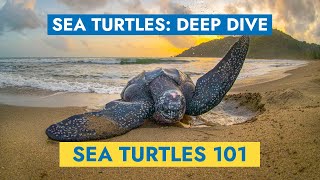 YouTube · Oceanic SocietySea Turtles 101: Learn All About Sea Turtles – Deep Dive
Un repaso visual de las siete especies de tortugas marinas, de la organización que preside el grupo que reevaluó a la tortuga verde.
- Web · SWOT / Oceanic SocietyGreen Turtle – State of the World's Sea Turtles
Mapas y datos de anidación de la tortuga verde en todo el mundo.
- Web · UICNChelonia mydas – Lista Roja de la UICN
La ficha oficial con la evaluación completa y sus criterios.
- Web · UICNComunicado de la UICN sobre la actualización de la Lista Roja
El anuncio en español, con el contexto de focas y aves.
- Web · UICNIUCN-SSC Marine Turtle Specialist Group
La red científica que evalúa el estado de las tortugas marinas.
- Podcast · Speak Up For BlueGreen Sea Turtle Conservation: How One Species' Recovery Gives Hope Amid a Sea of Decline
Conversación sobre qué explica la recuperación y qué amenazas persisten.
Sources
- IUCN: Arctic seals threatened by climate change, birds decline globally – IUCN Red List (10/10/2025)
- Oceanic Society: Green sea turtle status improvement 2025
- University of Exeter / EurekAlert: Major turtle nesting beaches protected on Ascension Island (2014)
- Oceanographic: Green sea turtle saved from extinction in major conservation victory
- Mongabay: World Turtle Day – conservation wins (mayo 2026)





