


 Have a great day, y'all!
It began in a Vanuatu classroom: the world court says protecting the climate is a legal duty
On 23 July 2025, all 15 judges of the International Court of Justice found that states have legal obligations on climate change. Ten months later, the UN General Assembly endorsed the opinion with 141 votes.

In 2019, 27 law students at the University of the South Pacific set themselves a goal that sounded like a seminar exercise: take climate change to the highest court in the world. Six years later, on 23 July 2025, the president of the International Court of Justice, Japanese judge Iwasawa Yuji, stood in the Peace Palace in The Hague and read out a 133-page opinion that proved them right.
The finding was unanimous. All 15 judges agreed that states have legal obligations to protect the climate system, and that breaching them can amount to an internationally wrongful act with consequences, including reparation for the harm caused.
- The International Court of Justice delivered its climate advisory opinion on 23 July 2025, unanimously.
- The obligations come from the climate treaties and from general international law, so they also bind countries that never signed them.
- Holding warming to 1.5°C is, in the court's words, the primary temperature goal.
- On 20 May 2026, the UN General Assembly endorsed the opinion with 141 votes in favour.
- In January 2026, a court in The Hague had already relied on it to order more protection for the island of Bonaire.
What exactly did the court say?
The question the General Assembly sent to The Hague in March 2023 had two parts: what obligations states have to protect the climate, and what the legal consequences are when they fall short. The answer was unusually direct for a court that weighs every word.
According to the UN Regional Information Centre (UNRIC), the judges said states must prevent significant harm to the environment and cooperate in good faith to curb climate change. The UN Framework Convention, the Kyoto Protocol and the Paris Agreement are binding. Customary law imposes equivalent duties even on countries outside those treaties.
Experts quoted by Carbon Brief highlighted several further points:
- The 1.5°C limit is the Paris Agreement's "primary temperature goal".
- National climate plans (NDCs) are not a free choice: taken together, they must be capable of meeting that goal.
- Fossil fuel production and consumption, exploration licences and subsidies may constitute a wrongful act.
- Rising seas do not, on their own, extinguish a state or its maritime zones.
That last point matters enormously to countries such as Tuvalu and Kiribati, whose land could be under water within decades.
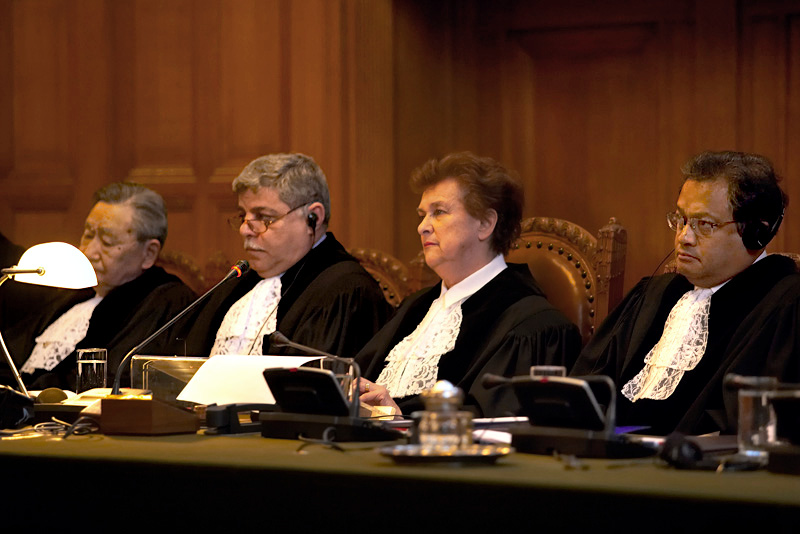
An advisory opinion is not a judgment between two parties and does not, by itself, bind states the way a ruling would. It does bind UN bodies, though, and it carries great legal and moral weight: national and regional courts routinely cite such opinions to interpret the law. That is exactly what has started to happen.
How did a case like this reach The Hague?
It started with students. In 2019 they founded Pacific Islands Students Fighting Climate Change and persuaded the government of Vanuatu, an archipelago of around 300,000 people battered by ever stronger cyclones, to take the idea to the United Nations.
Vanuatu spent years building a diplomatic coalition. On 29 March 2023, the General Assembly adopted the request to the court by consensus, with 105 co-sponsoring countries, according to Carbon Brief. Written submissions followed, and in December 2024 came two weeks of hearings in which large and small states, as well as international organisations, took the floor.
The students' leader, Cynthia Houniuhi of Solomon Islands, attended those hearings. Her fellow campaigner Belyndar Rikimani put it simply to Global Voices:
"It started with students who have the heart to see change for our islands and for our people."
Belyndar Rikimani, Pacific Islands Students Fighting Climate Change
In Port Vila, Vanuatu's capital, the news arrived in the run-up to Independence Day and was celebrated with a march. Climate change minister Ralph Regenvanu warned that a victory in the world's highest court was "just the beginning".

UN Secretary-General António Guterres called it a "historic advisory opinion" and summed up its reach in one line: it made clear that all states are obliged under international law to protect the global climate system.
What has happened since?
The first sign that the opinion would not stay on paper came from the Netherlands. On 28 January 2026, The Hague District Court ruled in favour of Greenpeace Netherlands, which had sued on behalf of the people of Bonaire, a Caribbean island under Dutch sovereignty. According to an analysis published on Mondaq, the court drew on the world court's opinion, and on a parallel opinion from the Inter-American Court of Human Rights, to order the government to set legally binding emission targets to 2050, disclose its remaining share of the global carbon budget and draw up an adaptation strategy that includes the island. The ruling can still be appealed.
The second step came in New York. On 20 May 2026, the General Assembly adopted a resolution, again led by Vanuatu, endorsing the court's opinion. Al Jazeera reported 141 votes in favour, 8 against and 28 abstentions. Those voting against included the United States, Russia and Saudi Arabia.
"Climate change is a matter of law, justice, and human rights."
Ralph Regenvanu, Vanuatu's climate change minister, after the vote
Lawyers such as Maria Antonia Tigre of Columbia University's Sabin Center expected the opinion to add pressure on countries to raise their targets before the next Paris Agreement global stocktake. Others, including Harj Narulla, counsel for Solomon Islands in the proceedings, said it opens a legal path for developing countries to seek reparations, although the court made clear that the causal link between emissions and a specific harm must be proven case by case.
Plenty remains open. The opinion sets no emission numbers and no automatic penalties, and the biggest emitters keep wide discretion over how to comply. But courts now share a common text to turn to, signed by 15 judges without a single dissent.
It fits a wider pattern in international law, from the high seas treaty that took effect in January 2026 to the WTO deal against subsidies for illegal fishing. And it lands as the economy shifts on its own: in 2025 renewables overtook coal in global electricity, and electric cars now avoid burning 1.2 million barrels of oil a day.
The detail you may not know
The court also answered a question that haunts Pacific atolls: if the sea swallows the land, does the country cease to exist? Its answer was that sea-level rise does not necessarily end statehood, and that countries are not obliged to redraw their maritime boundaries as coastlines retreat. For nations such as Tuvalu, whose highest point is barely four metres above sea level, that sentence protects their waters, their fisheries and their seat at the UN.
Further reading: the full case file on the court's website, the video of the reading on UN Web TV and Carbon Brief's explainer.
Go further
- Web · Corte Internacional de JusticiaObligations of States in respect of Climate Change (expediente oficial)
Aquí están la opinión completa de 133 páginas, las declaraciones de los jueces y todos los escritos de los Estados.
- Web · UN Web TVLectura de la opinión consultiva en La Haya
El vídeo íntegro de la sesión del 23 de julio de 2025, con la lectura del presidente Iwasawa.
- Web · IISD – Investment Treaty NewsLa Corte Internacional de Justicia emite una opinión consultiva sobre el cambio climático
Un análisis en español de lo que la opinión implica para tratados de inversión y proyectos fósiles.
- Web · Carbon BriefICJ: What the world court's landmark opinion means for climate change
La guía más completa, con valoraciones de una docena de juristas y científicos.
- Blog · EJIL:Talk!From Opinion to Action: The General Assembly Votes to Operationalize the ICJ's Climate Advisory Opinion
El blog de referencia en derecho internacional explica qué cambia con la resolución de mayo de 2026.
- Web · Global VoicesPacific communities celebrate World Court's Advisory Opinion on climate change
Cómo vivieron la decisión en Vanuatu y las Islas Salomón los estudiantes que la impulsaron.
Sources
- Obligations of States in respect of Climate Change – International Court of Justice
- ICJ: What the world court's landmark opinion means for climate change – Carbon Brief
- Climate: Historic ICJ opinion on the obligations of States – UNRIC
- UN adopts resolution supporting international court's climate ruling – Al Jazeera





