


 Have a great day, y'all!
Water across 70% of central Milagro: what is happening and who is responding
Three rivers over their banks, two shelters open and a pump that has already removed 84,000 cubic metres of water: the verified facts on the flooding in Milagro, Ecuador, and what people can do.
The essentials in 30 seconds
- El Niño rains pushed the Milagro and Venecia rivers and the San Miguel estuary over their banks between 13 and 16 November. The Guayas provincial government estimates water now covers about 70% of Milagro's urban centre.
- Two schools, Teniente Hugo Ortiz and 17 de Septiembre, are working as shelters, with Health Ministry doctors on site around the clock.
- Firefighters from Guayaquil, Samborondón and Simón Bolívar, using 15 boats coordinated by Ecuador's risk management agency, have moved hundreds of people to safety. One high-capacity pump has already drained 84,000 cubic metres of water from the Bellavista neighbourhood, and a second is on its way.
- If you live in the area: follow official alerts, stay out of flooded streets and call ECU 911 in any emergency.
During one of this month's floods, at one in the morning and with water coming through the door, Melinda Zea got her four children out of their home in Milagro. She cannot swim, so she put her daughter in a plastic tub to keep her afloat until firefighters arrived by canoe. She told the story to the Ecuadorian news site Primicias, which met her later in one of the town's shelters. Versions of that night are playing out across dozens of streets in this canton of Guayas province.
Milagro is where El Niño's rains are being felt most in Ecuador right now. This piece sets out what is known from official figures, who is responding and what people can do, without alarm and without repeating numbers for effect.
What happened
The heavy rain began on Friday 13 November. That night Ecuador's National Risk Management Secretariat counted 12 rivers and estuaries over their banks in Guayas, Los Ríos and Santa Elena provinces. Three were in Milagro: the Milagro river, the Venecia river and the San Miguel estuary.
X@Riesgos_EcVer publicación en X ↗The water did not drop over the weekend. In neighbourhoods such as Bellavista, Margaritas 2, Las Avispas and Ciudadela Unida Norte it rose above a metre, and in places reached rescuers' chests, according to the daily El Universo. At 07:00 on Monday 16 November the agency recorded 20 overflowing waterways in five provinces, 12 of them in Guayas, according to the tally published by Qué Noticias.
The Guayas provincial government puts the flooded share of the town centre at around 70% and estimates some 2,000 families affected in Bellavista alone. In Guayaquil, authorities reported two deaths during the weekend's rain. Nationwide, El Niño has been linked to 14 deaths since the season began, according to the figure cited by Primicias.

Who is responding
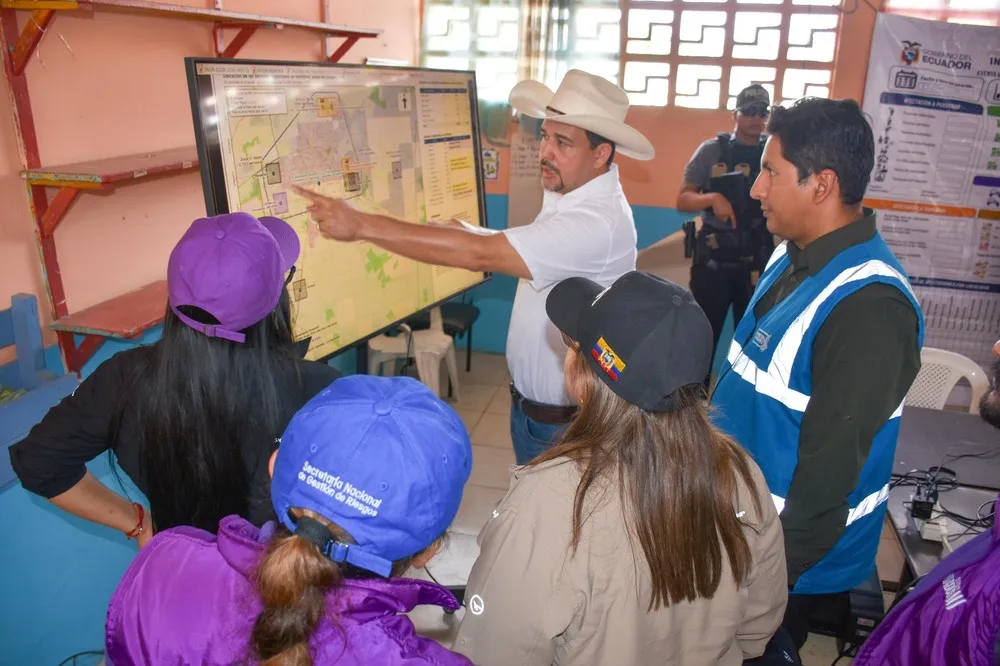
The response is run from a unified command post set up on Friday at 18:17, bringing together the risk agency, the provincial and municipal governments, fire services, police and national ministries. What each has done so far:
- Rescue. The risk agency is coordinating 80 rescuers and 15 boats. Guayaquil's fire service sent three units and 20 rescuers; Samborondón's sent 15 people and two boats, evacuating 60 residents and several pets on Saturday night. Simón Bolívar's firefighters joined later.
- Shelter. The Teniente Hugo Ortiz school was housing 295 people according to the local emergency committee, and the 17 de Septiembre school 149 families. Across the country more than a thousand people are in temporary shelters, according to the risk agency.
- Health. The Public Health Ministry has a fixed team of doctors and nurses in the main shelter, plus mobile brigades touring the neighbourhoods, El Universo reported.
- Drainage. A high-capacity pump ran non-stop for two days in Bellavista and removed about 84,000 cubic metres of standing water; the command post has agreed to install a second, according to Metro Ecuador. Provincial machinery is clearing rubbish from the San Miguel and Las Damas estuaries so the water can flow.
- Supplies. The risk agency, the Labour Ministry, the social security institute IESS and the provincial governor's office have delivered food, hygiene kits, clothes and boots to families in Las Piñas, San Miguel and Carlos Vega; the provincial government has supplied more than 200 families in Las Avispas.
Seguimos firmes en la línea de respuesta ("We remain firmly on the response front line").
Carolina Lozano, head of Ecuador's National Risk Management Secretariat, speaking in Milagro
Why Milagro, and what can be done better
Milagro lives between rivers. The town grew with sugar cane and with the railway that once ran down its main street, on a low plain where the Milagro and Venecia rivers and several estuaries meet before heading for the Guayas. When a lot of rain falls quickly, the water is slow to leave.

One detail keeps coming up in local coverage: rubbish. Residents quoted by El Universo complained about waste piled up in the San Miguel estuary, which slows the flow. Clearing it is one of the quickest ways to bring street levels down, and it is where every household can help: no dumping in channels or estuaries, in the dry season either.
The other lesson is preparation. Since September, Ecuador's weather service Inamhi had been warning that El Niño would bring more rain to the coast, as Vistazo reported, and we covered what is known about El Niño and how households can prepare. That meant shelters were already identified, mattresses were moved in from Manabí with help from the armed forces, and rescue teams were ready in neighbouring cantons. Once the water recedes, the provincial government plans fumigation and preventive health brigades, a less visible phase aimed at stopping mosquito-borne outbreaks.
What readers can do
If you live in Milagro or another flood-prone area of Guayas or Los Ríos:
- Follow alerts from the risk management agency and Inamhi. For Monday, Inamhi forecast rain in Guayas, Los Ríos, Manabí and Santa Elena, according to Teleamazonas.
- Do not walk or drive through flooded streets: you cannot see the ground or open drains. Switch off the power if water gets into your home.
- In an emergency, call ECU 911. If you need shelter, ask the canton's emergency committee or the risk agency's teams.
- Boil or chlorinate drinking water and wash your hands often.
- If the rains have cut your income and you have a loan, you can ask to defer repayments, as we explained in how to request El Niño debt relief.
If you want to help from elsewhere: before donating, ask the canton's emergency committee or organisations with a steady presence in the area what is actually needed, because needs change from day to day. And if you are travelling over the 20 November long weekend, check road conditions first, as we set out in what opens and how to travel in the rain.
X@inamhi_ecVer publicación en X ↗Susana Mejía, 59, reached the shelter from the Unidad Oeste area. Her cane-walled house had flooded two years ago too, when, by her estimate, the water rose to 2.4 metres. This time she again saved nothing, she told Primicias. At the Teniente Hugo Ortiz school, where she is spending these nights, doctors and nurses are on permanent duty.
To understand it better
- "Save my children first": families leaving Milagro, Primicias' report from the shelters (Spanish).
- The Guayas provincial government's update on pumps and machinery (Spanish).
- Cocoa yields have doubled: why Ecuador's farms face this El Niño better prepared than in 1998.
Go further
- Web · Gobierno de EcuadorSecretaría Nacional de Gestión de Riesgos
Informes de situación oficiales con ríos desbordados, albergues y personas atendidas.
- Web · Instituto Nacional de Meteorología e HidrologíaPronósticos del Inamhi
El pronóstico diario de lluvias por provincia, la fuente que usan los COE.
- Web · Secretaría Nacional de Gestión de RiesgosRiesgos Ecuador en X
Cortes horarios de la emergencia, útiles para saber qué ríos siguen fuera de cauce.
- Web · Primicias«Primero salve a mis hijos»
Crónica desde los albergues de Milagro con testimonios de las familias.
Sources
- Prefectura del Guayas: Graves inundaciones en Milagro
- El Universo: Quince botes para evacuar a familias en Milagro
- Primicias: Primero salve a mis hijos
- Primicias: lluvias del 13 de noviembre
- Metro Ecuador: drenan 84.000 metros cúbicos
- El Universo: atención médica en Milagro
- Qué Noticias: ríos desbordados en Guayas y Los Ríos





