


 Have a great day, y'all!
Monarchs took up 64% more forest in Mexico, and half settled in one Michoacán ejido
Monarch butterfly colonies covered 2.93 hectares in winter 2025-2026, a second straight rise, while forest loss inside their reserve also fell.

In the El Rosario ejido, high in the mountains of eastern Michoacán, monarch butterflies blanketed 1.62 hectares of fir forest this past winter. That single colony accounted for more than half of all the forest the species occupied in Mexico during the 2025-2026 season, a total of 2.93 hectares, up 64% on the year before.
The figures were presented in Mexico City on 17 March 2026. They come from the annual survey run by Mexico's National Commission of Natural Protected Areas (CONANP) and WWF Mexico, written up this year by researchers from WWF, the management of the Monarch Butterfly Biosphere Reserve and Danaidas, a conservation group based in the town of Zitácuaro.
- The area covered by overwintering colonies rose from 1.79 hectares in 2024-2025 to 2.93 hectares in 2025-2026.
- It is the second rise in a row: in 2023-2024 the count was just 0.9 hectares.
- Surveyors found nine colonies, three in Michoacán and six in the State of Mexico.
- Forest loss in the reserve's core zone fell from 3.73 to 2.55 hectares in a year.
How do you count millions of insects?
You don't, at least not one by one. Since the 2004-2005 season, CONANP and WWF have measured something else instead: the area of forest where the butterflies gather for winter, hanging in dense clusters from the trunks and branches of sacred fir trees, known locally as oyamel. That area works as a proxy for the size of the eastern North American population, which flies south each autumn from southern Canada and the northern and central United States.
According to the technical report for 2025-2026, field teams set out in December 2025 to visit all 13 known overwintering sanctuaries in the so-called Monarch Region, which straddles the border between Michoacán and the State of Mexico. At each colony they logged a GPS position and then walked the perimeter tree by tree, recording bearing and distance from the highest tree on the slope. The resulting outlines were processed in a geographic information system.
Seven colonies were measured in the second half of December and two more, Crescencio Morales and Ojo de Agua, in early January 2026. The team also measured a tiny colony at Joya Redonda in Atlautla, next to Iztaccíhuatl-Popocatépetl National Park. It covered 0.002 hectares and was left out of the total because it sits outside the reference region.

Where the nine colonies settled
Michoacán held almost two thirds of the total. Besides El Rosario, in the Sierra Campanario sanctuary, there were colonies on state-owned land at Sierra Chincua (0.13 hectares) and in the Crescencio Morales ejido at Lomas de Aparicio (0.11).
In the State of Mexico the butterflies spread across six sites. The largest was in the San Antonio Albarranes ejido, in the Palomas sanctuary, at 0.45 hectares. Then came La Mesa (0.25), the communal lands of San Pablo Malacatepec at Cerro Pelón (0.16), Ojo de Agua at Peña Ahumada (0.14), San Mateo Almomoloa at Piedra Herrada (0.04) and, smallest of all, San Francisco Oxtotilpan in the Cerro del Amparo sanctuary, at 0.031 hectares.
Five colonies lay inside the biosphere reserve, adding up to 2.27 hectares. The other four, totalling 0.66 hectares, formed outside its boundaries. That matters because monarchs do not always pick the best-protected stands, so the forests around the reserve count as much as those within it.
A milder summer and better-guarded forests
Why the rebound? Specialists point to two things. The first is weather on the breeding grounds. Speaking to the Mexican newspaper El Imparcial, Eduardo Rendón, head of WWF Mexico's terrestrial ecosystems programme and lead author of the report, said the 2025 drought was less severe than in 2023-2024, which helped eggs, caterpillars and chrysalises through the summer.
Climate change was not as drastic with them.
Eduardo Rendón, WWF Mexico
Autumn 2025 also brought more humidity along the migration route. Flowering plants lasted longer, giving the butterflies more chances to feed and store the energy they need for a journey of up to 4,500 kilometres.
The second factor lies in Mexico's own forests. A separate study, coordinated by WWF with technical support from the Institute of Biology at the National Autonomous University of Mexico (UNAM), used high-resolution imagery to track the reserve's core zone, which covers 13,554 of its 56,259 hectares. Between February 2024 and February 2025, 2.55 hectares were damaged, down from 3.73 in the previous period.
Illegal logging remained the main cause, at 1.85 hectares, but it too declined. A fire damaged 0.58 hectares and drought 0.12. The worst-hit property was the Hervidero y Plancha ejido, in the municipality of Angangueo, with 0.72 hectares affected.

Despite environmental challenges, today's announcement shows promising signs of recovery for the eastern migratory monarch butterfly population.
María José Villanueva, director general of WWF Mexico
Villanueva credited much of the result to the communities living inside the reserve. According to WWF's announcement, the organisation backs tree nurseries that supply reforestation and bring income to local ejidos, alongside sustainable tourism projects.
What still needs doing
One good winter does not reverse the long decline. In 1996-1997 monarchs covered 18.19 hectares, six times today's figure. The low point came in 2013-2014, at 0.67. CONANP head Pedro Álvarez Icaza noted at the presentation, as reported by Expansión, that the numbers rise and fall from year to year but trace a downward curve over the long run.
The threats are spread along the entire route. The technical report lists the loss of milkweed, the only plant monarch caterpillars eat, to heavy herbicide use on North American farmland; changes in land use; and extreme weather on the breeding grounds. In Mexico, illegal logging and tourism that does not always respect the sanctuaries remain concerns.
At the same press conference, Environment Secretary Alicia Bárcena called for a much greater effort against illegal logging, according to Excélsior, and proposed raising the species' protection in talks with the United States and Canada.
Conservationists often point to other animals pulled back from the brink: Antarctic blue whales, which have gone from 418 to around 4,000, or the Iberian lynx, now past a thousand animals in Castilla-La Mancha alone. In both cases recovery took decades of steady work, not a single season.

A forest that also waters the capital
The reserve's forests shelter more than butterflies. They are one of the main catchment areas for the Cutzamala System, which supplies water to more than five million people in Mexico City and its metropolitan area. They are also home to 132 bird species, 56 mammals, 432 vascular plants and 211 fungi, according to WWF.
That double role explains why the fate of the fir trees matters well beyond biology. As in Ecuador's Íntag valley, where almost 9,000 hectares are now farmed sustainably, the ejidos of the monarch region combine conservation with income from tourism and nurseries. And as with the expansion of Podocarpus National Park, protecting a mountain forest ends up protecting the water of people living downstream.
The reserve, added to UNESCO's World Heritage List in 2008, draws visitors from around the world each winter. The next count will measure the colonies of winter 2026-2027, once the butterflies that flew south from Canada and the United States this autumn have settled in.
Something you might not know
None of the monarchs that reached Michoacán this winter had ever been there before. According to UNESCO, four successive generations are born and die over the course of the round trip, so the butterflies returning to the same fir trees are descendants, several generations removed, of those that left in spring. How they find their way back remains an open question for science.
Go further
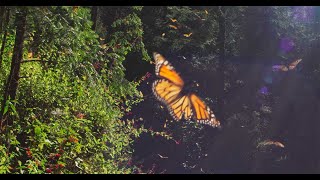 YouTube · WWF MéxicoConservando la migración de la mariposa monarca y sus bosques
Muestra el trabajo con viveros y comunidades de la reserva que hay detrás de las cifras del monitoreo.
- Web · WWF México, CONANP y DanaidasSuperficie forestal ocupada por las colonias de mariposas monarca en México durante la hibernación de 2025-2026
El informe técnico original, con la tabla de las nueve colonias y la serie histórica desde 1993.
- Web · WWF México e Instituto de Biología de la UNAMAnálisis del cambio forestal en la zona núcleo de la Reserva de la Biosfera Mariposa Monarca (2024-2025)
Detalla predio por predio dónde y por qué se perdió bosque en la zona núcleo.
- Blog · Monarch WatchMonarch Population Status
El programa de la Universidad de Kansas que sigue la migración publica la gráfica de toda la serie histórica.
 YouTube · alanxelmundoSantuario Mariposa Monarca - México
Un recorrido completo por el santuario El Rosario, la colonia más grande de esta temporada.
- Web · UNESCOMonarch Butterfly Biosphere Reserve
La ficha de Patrimonio Mundial explica la geografía de la reserva y el ciclo de generaciones de la migración.
Sources
- Superficie forestal ocupada por las colonias de mariposas monarca en México durante la hibernación de 2025-2026 (WWF México / CONANP)
- Aumenta 64% la población de mariposas monarca (WWF)
- Ocupación de la mariposa monarca en México crece 64% en la temporada 2025-2026 (Expansión Política)
- Mariposa monarca ocupó 2.93 hectáreas, 64% más que el año pasado (Excélsior)
- Análisis del cambio forestal en la zona núcleo de la RBMM 2024-2025 (WWF / UNAM)





