


 Have a great day, y'all!
Eight nights, 30,388 olive ridleys: inside Nicaragua's sea turtle nesting season
This year's second mass nesting event brought 30,388 olive ridley females ashore at La Flor, in Rivas, over eight nights, with more than 16,500 nests under guard. Up north, the mangroves of Padre Ramos remain the main stronghold of the Eastern Pacific hawksbill.

For eight nights in a row, the beach at La Flor Wildlife Refuge, in the municipality of San Juan del Sur on Nicaragua's southern Pacific coast, seemed to crawl. Olive ridley turtles were coming out of the surf in waves. By the time the season's second mass nesting event was over, Nicaragua's Ministry of the Environment and Natural Resources (Marena) had logged 30,388 nesting females and 16,561 nests guarded directly on the sand, figures reported in early September by Canal 6 and Nueva Ya and later carried by the independent outlet Divergentes.
Another 85 nests, roughly 7,650 eggs, were moved to the hatchery at the refuge's biological station. Rangers estimated about 52 days of incubation, which put the first emergences from that late-August, early-September arribada at the end of October. That is the busy heart of a season that runs on this coast from July to January.
- Nicaragua is home to two of the world's seven arribada beaches: La Flor (Rivas) and Río Escalante-Chacocente (Carazo).
- The second arribada of 2026 lasted eight days and brought 30,388 olive ridleys ashore at La Flor, according to Marena.
- Hatcheries at Chacocente released 3,321 hatchlings in late August and another 968 on 14 September.
- Up north, the mangrove estuaries of Padre Ramos and Aserradores hold about half of all known nesting by Eastern Pacific hawksbills.
The 2026 season started early. Between 1 August and the small hours of 3 August, 3,785 olive ridleys nested at La Flor and Chacocente, according to a report by 100% Noticias based on ministry data. Marena publishes a calendar of expected arrivals every year, because arribadas tend to fall around the new or full moon.
In late August, while the second wave was building in Rivas, the Chacocente hatcheries sent 3,321 hatchlings into the sea, as Infobae reported using official figures distributed by the EFE news agency. On 14 September another 968 left the same refuge in Carazo, according to Divergentes.
On 13 October the newspaper La Prensa reported a fresh mass arrival at San Juan del Sur. Numbers for that October wave have not yet appeared in a consolidated public tally.
Past seasons give the September count its scale. In October 2024, La Flor received 12,321 females over four nights. In September 2025, Chacocente logged 8,385. This year's event was nearly two and a half times the larger of those two.

The yearly totals show the longer trend. The 2022-2023 cycle closed with 162,763 nestings and 781,608 hatchlings nationwide. The 2025-2026 cycle, presented in March, counted 150,015 turtles protected and 723,304 hatchlings released. Between 1 and 11 January this year alone, the two southern refuges released 188,417 hatchlings. By mid-May, the running total for 2026 had passed 440,000 hatchlings across the four species that nest on Nicaragua's Pacific coast, as Noticias Ambientales reported.
How an arribada works
The olive ridley, known locally as paslama, golfina in Mexico and lora in Costa Rica and Panama, is one of the smallest sea turtles. Adults can reach 70 centimetres in shell length and about 40 kilos. What sets the species apart is how it breeds. Hawksbills and leatherbacks come ashore alone and scattered. Olive ridley females synchronise and leave the sea together, by the thousand, for three to eight days running.
A turtle specialist interviewed by Divergentes said scientists call it an arribada when more than a thousand turtles reach the same beach. Each female digs a nest about 40 centimetres deep with her rear flippers, lays up to a hundred eggs, covers them and heads back to the water. She may repeat the process up to seven times in a single season, and researchers suspect younger females return more often than older ones.
Clutch sizes vary from species to species. According to the figures gathered by Divergentes, an olive ridley nest holds up to 100 eggs, a hawksbill nest about 120, a green turtle nest around 90 and a leatherback nest about 70. The leatherback, the giant of the group, digs the deepest chamber of all, close to 90 centimetres down. When conditions on a beach are wrong, too much light, too many people or the wrong kind of sand, females often simply turn around, the biologist told Divergentes, and try again another night or on another beach.
Heat decides what happens next. Incubation takes between 45 and 90 days depending on species and sand temperature, and the same temperature sets the sex of the hatchlings. Around 29°C produces a balanced mix; warmer sand tips the clutch toward females.
When turtles hatch, they acquire a kind of "imprint" of the place where their life began.
A biologist quoted by Divergentes
That imprint is why the beaches matter so much. The hatchlings now scrambling toward the water in Rivas and Carazo will spend roughly fifteen years at sea before returning, if they survive, to the same strip of sand where they broke out of the shell.
Two refuges in the south
Río Escalante-Chacocente Wildlife Refuge, in the municipality of Santa Teresa about 82 kilometres from Managua, protects more than 4,600 hectares of tropical dry forest, according to The Tico Times. Nests are spread over about 1,500 metres of beach, and rangers move eggs left exposed or in flood-prone spots to hatcheries.
La Flor, further south in the department of Rivas, is the country's other big arribada beach. Ministry rangers, army personnel and volunteers from nearby communities work there together, patrolling at night with red lights so the females are not disoriented.
Tourist interest grows every year, and so do the rules. Divergentes put together the basics for watching without causing harm: enter only authorised areas and go with a licensed guide, skip the flash and white torches, never touch turtles or eggs, never block a female's path between the sea and her nest, and leave pets, horses and vehicles off the beach.
Taking or selling olive ridley eggs is banned in Nicaragua, and Marena has kept all sea turtles under an indefinite ban for 2026. In August the ministry also warned of a high rate of salmonella in turtle eggs, La Prensa reported. EFE has documented that illegal sales continue in some markets, which is why night patrols remain the backbone of every season.

The hawksbills of the mangroves
In the far north-west, in the department of Chinandega, a quieter story unfolds. Estero Padre Ramos Natural Reserve, protected since 1983, covers about 92 square kilometres of mangrove, lagoon and beach. It is one of the two main strongholds of the Eastern Pacific hawksbill, a critically endangered population.
Until a little over fifteen years ago, very little was known about hawksbills on this side of the Americas. In the late 2000s the Eastern Pacific Hawksbill Initiative (ICAPO), a network of researchers, non-profits and coastal communities stretching from Mexico to Peru, found previously unknown nesting beaches in Nicaragua and El Salvador. The discovery also overturned an old assumption about the species: here, hawksbills live in mangroves rather than on coral reefs.
A 2017 study in the Latin American Journal of Aquatic Research, with Alexander Gaos and Jeffrey Seminoff among its authors, pulled together records from nine sites across the region. Padre Ramos came top with an average of 213 nests a year, and the neighbouring Aserradores estuary ranked third with about 100. The authors cautioned that much of the rise in records reflected the fact that someone was finally counting, and that the population still needed protection.
The British charity Fauna & Flora, active in Nicaragua since 1998, has run a marine turtle programme there since 2002. According to a 2026 project summary from the Nando and Elsa Peretti Foundation, which funds its 2025-2027 cycle, community teams have protected 32 kilometres of beach and more than 6,000 nests, and released over 360,000 hatchlings. The same document spells out why the patrols matter: on unguarded beaches, egg poaching reaches almost every nest.
Fauna & Flora estimates that more than 90% of the leatherbacks nesting in Nicaragua are now under protection. That comes with a caveat, because nesting by the world's largest turtle has fallen to the lowest levels on record in the Pacific. A biologist quoted by Divergentes recalled a night of observation, some years ago, when only one leatherback came up to nest.

Guardians who used to sell eggs
Elsewhere on the Pacific coast, the conservation group Paso Pacífico runs a community ranger programme that patrols six green turtle and hawksbill nesting beaches day and night. Some of those rangers, the organisation says, used to be egg collectors. Over ten years they have protected more than 50,000 eggs, including hawksbill and leatherback clutches, and trained coastal hotels to look after four more beaches on their own.
There is a track record for this approach on the other side of the country. In the Pearl Cays, off Nicaragua's Caribbean coast, the Wildlife Conservation Society (WCS) launched a project with local communities in 2000, when almost every hawksbill nest was being raided. By 2014 it counted 468 nests, up from 154 at the start, and poaching had dropped to around 5%.
These recent nest counts show that by working with local communities, we can save sea turtles from extinction.
Caleb McClennen, WCS executive director of marine conservation, in 2014
The groups broadly agree on what is still missing: more staff to cover arribadas of tens of thousands of females, less artificial light on nesting beaches, fishing gear that does not trap turtles, and tourism that keeps its distance. The biologist interviewed by Divergentes said current staffing cannot cover every arrival, and that unmanaged visits can put nests at risk. Across the region, from Monteverde's cloud forest to the Amazon rivers where river turtles are returning to the Aguarico, the gains that last tend to come when the people living beside a resource are the ones looking after it.
The wider picture helps. In 2025 the IUCN moved the green turtle off the endangered list after decades of beach protection, and a recent study found that six in ten species helped from fewer than 50 individuals went on to recover. Further north, in the Upper Gulf of California, the vaquita is still having calves.
The detail you might have missed
Olive ridleys stage arribadas on only a handful of beaches worldwide, and two of them are on Nicaragua's Pacific coast. If the fifteen-years-at-sea rule holds, many of the females that hauled out at La Flor this September hatched on that same sand around 2011. And the hatchlings leaving the hatcheries of Rivas and Carazo in these weeks will not set flipper on it again until the early 2040s.
Further reading
- The journey of an olive ridley: its arribada and how to watch without putting it at risk, Divergentes (Spanish).
- La Flor receives more than 30,000 olive ridleys in eight days, Nueva Ya (Spanish).
- Paso Pacífico's sea turtle programme.
- Living on the Edge: hawksbill nesting along the Eastern Pacific Rim, Gaos et al., 2017.
- Five sea turtle success stories of the 2010s, SEE Turtles.
Go further
- Web · Catalina Fabbri, DivergentesEl viaje de una tortuga paslama: su arribada y cómo observarlas sin ponerlas en riesgo
La guía más completa en español sobre cómo funciona una arribada y cómo verla sin molestar a las tortugas.
 YouTube · ICAPOHawksbill mangrove rescue in Nicaragua
Muestra el trabajo con la carey en los manglares del norte de Nicaragua, donde anida la mitad de su población del Pacífico oriental.
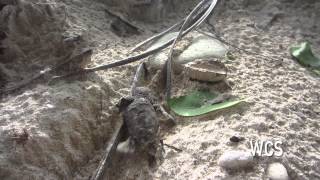 YouTube · Wildlife Conservation SocietyHawksbill Sea Turtle Numbers in Nicaragua Explode
El caso de los Cayos Perlas, en el Caribe, donde los nidos de carey se triplicaron con ayuda de las comunidades.
 YouTube · Fauna & FloraA baby turtle's journey to the sea (360 VR)
Un vídeo en 360 grados para acompañar a una cría desde el nido hasta las olas.
- Web · Paso PacíficoSaving Sea Turtles
Explica el programa de guardaparques comunitarios, algunos de ellos antiguos recolectores de huevos.
- Blog · SEE Turtles5 Sea Turtle Success Stories of the 2010's
Repasa cómo se descubrió la carey del Pacífico oriental y otras recuperaciones de tortugas en la región.
- Web · Wildlife Conservation SocietySea Turtles Roar Back: WCS reports highest reported nest counts in Nicaragua
Los datos originales del proyecto de carey en los Cayos Perlas, de 154 a 468 nidos.
Sources
- Divergentes: El viaje de una tortuga paslama, su arribada y cómo observarlas sin ponerlas en riesgo
- Canal 6: Tortugas marinas continúan llegando a La Flor (datos de MARENA)
- Nueva Ya: La Flor recibe más de 30 mil tortugas paslama en ocho días
- 100% Noticias: Casi 3,800 tortugas paslama llegan a desovar a playas de Nicaragua
- Infobae: Más de 3,000 tortuguillos paslama llegan al Pacífico
- Nando and Elsa Peretti Foundation: Supporting Fauna & Flora in protecting threatened marine turtle populations in the Nicaraguan Pacific
- Gaos et al. 2017, Living on the Edge: Hawksbill turtle nesting and conservation along the Eastern Pacific Rim
- WCS: Sea Turtles Roar Back in Nicaragua





