


 Have a great day, y'all!
A cloud-forest mouse from Ecuador's Quijos valley now bears the rebel Jumandi's name
INABIO scientists described the Jumandi mountain mouse in January 2026, a new species known only from the Quijos valley in Napo, which in August joined Ecuador's official list of 484 native mammals.

On the night of 14 October 2024, a trap set on the damp floor of the Yanayacu Biological Station, 2,220 metres up in Ecuador's Quijos canton, caught an adult male mouse with dark brown fur and a black tail. Fifteen months later, on 9 January 2026, that animal became the reference specimen of a species new to science: Oreoryzomys jumandi, the Jumandi mountain mouse.
The name reaches back into the history of Napo province. It honours Jumandi, the Quijos leader who in 1578 led one of the first Indigenous uprisings against Spanish conquistadors in the Amazon. A small rodent from the cloud forests of his homeland now carries his name in the world's mammal catalogues.
- What: a new Andean mouse species, Oreoryzomys jumandi, described in the journal PeerJ on 9 January 2026.
- Where: cloud forests of the Quijos River valley in Napo province, between 1,980 and 2,500 metres above sea level.
- Who: a team led by biologist Jorge Brito of Ecuador's National Biodiversity Institute (INABIO), with scientists from Ecuador, Argentina and Germany.
- What changes: the genus Oreoryzomys, long thought to hold a single species, now has three.
- What came next: on 18 August 2026, Ecuador's Official Mammal List added the Jumandi mouse to the country's 484 native mammal species.
A genus with only one name
For more than a century, zoologists treated Oreoryzomys as a genus with just one species, Oreoryzomys balneator, described in 1900 by the British zoologist Oldfield Thomas. It is an inconspicuous mouse of foothill and cloud forests in eastern Ecuador and north-western Peru, and very little studied.
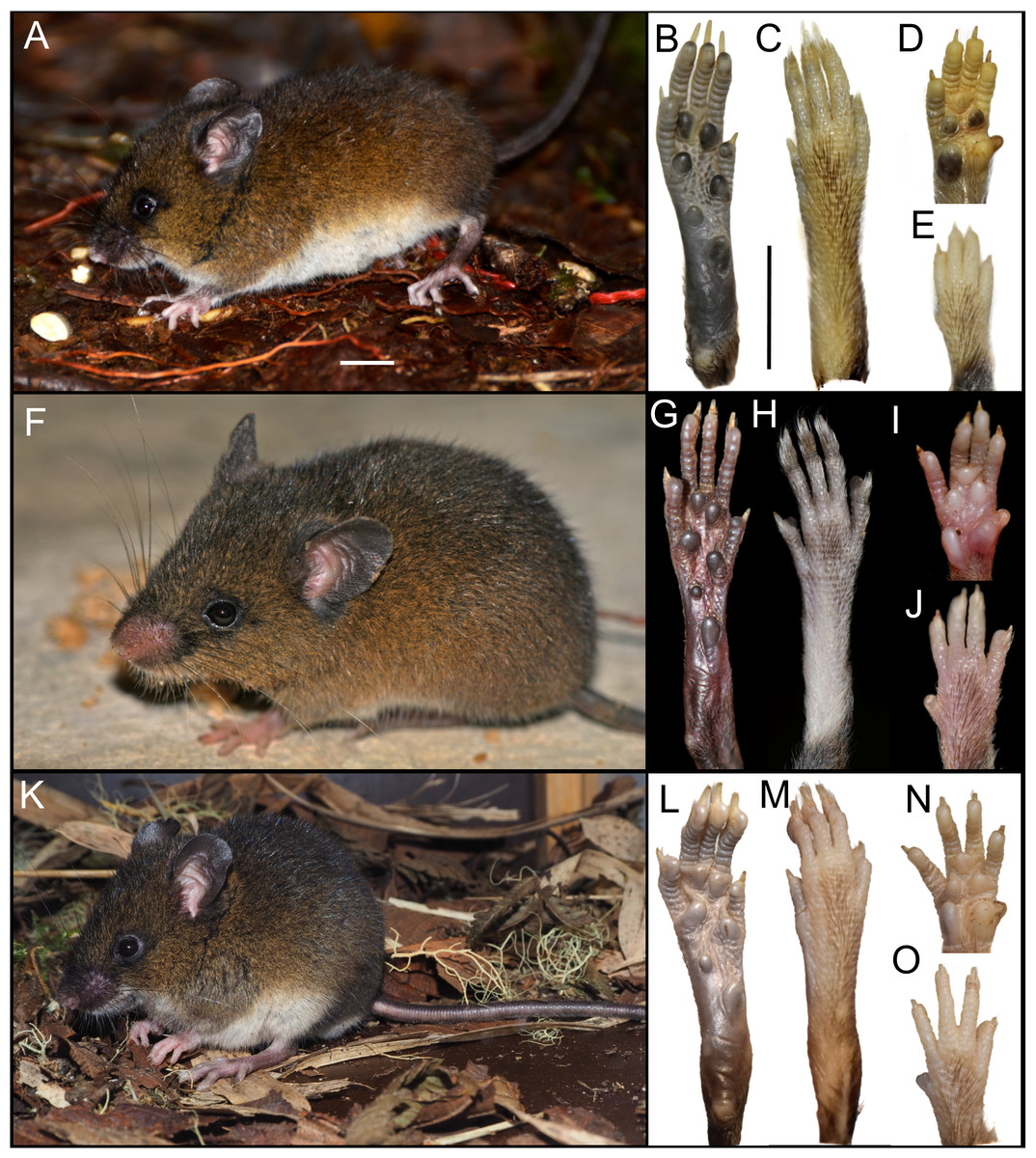
The paper in PeerJ, titled Mountains of diversity, brought together recent field collections and museum specimens. The team compared skulls, teeth, fur and internal anatomy, and sequenced two genes, one mitochondrial and one nuclear. The family tree was redrawn. O. balneator stays in central and south-eastern Ecuador, with records in Morona Santiago and Tungurahua. O. hesperus, previously treated as a variant, is raised to a full species found in Azuay, El Oro, Zamora Chinchipe and Cajamarca in Peru. And the populations of Napo form a third, separate species.
To get there, the team examined 33 specimens of the new species and logged 12,800 trap-nights in the field. Alongside Jorge Brito, the authors are R. Vargas, N. Tinoco, R. García, J. C. Carrión-Olmedo, Claudia Koch, R. Wistuba, C. Nivelo-Villavicencio and the Argentine mammalogist Ulyses Pardiñas. According to the Ecuadorian newspaper El Oriente, the institutions involved were INABIO, the Instituto de Diversidad y Evolución Austral, Fundación Cóndor Andino, Dosel Ecuador, the Pontifical Catholic University of Ecuador and Germany's Museum Koenig.
The finding shows that the diversity of small mammals in the Ecuadorian Andes has been underestimated.
The study's authors, as quoted by El Oriente
The Jumandi mouse has a dark brown back, with hairs 7 to 8 millimetres long that are grey at the base and whitish at the tip. Its rounded ears are covered on the outside with short blackish hairs, and its single-coloured dark tail measures 110 to 124 millimetres. What really sets it apart lies inside: a V-shaped suture on the skull, a long, pointed bony process near the ear, and details of the molars visible only under magnification or in a scan. The team ran micro-CT scans on four skulls; according to the paper, no photographs of the genus's skull or teeth had been published before.
Bamboo, orchids and steep ravines
The species is known only from Napo. Specimens come from Sierra Azul and the area around Yanayacu, in the Quijos valley, a mountain corridor that drops from the páramo grasslands of the eastern Andes towards the Amazon lowlands. The researchers describe the habitat as a patchwork of primary cloud forest, secondary forest, abandoned pasture and stands of Chusquea bamboo, on steep slopes cut by small streams. The trees are heavy with orchids, ferns and bromeliads.
Almost every individual was caught at ground level; one turned up on a fallen log. It shares these slopes with another tiny rodent, Microryzomys minutus.
Yanayacu Biological Station covers some 2,000 hectares of cloud forest near the village of Cosanga. A paper in the Journal of Insect Science places it at 2,200 metres and notes that its position gives access to habitats ranging from páramo at 3,800 metres down to lowland rainforest. Since 2001 it has hosted a long-running project that rears caterpillars to learn which plants they eat and which wasps parasitise them.

The find adds to a run of discoveries on the eastern slopes of Ecuador's Andes. In recent months The Positive Way has reported on a spiny, scarlet-bellied frog from the forests of Baños, a two-centimetre frog from Cerro Plateado and two tree-dwelling tarantulas, one named after Dayuma, in Orellana.
Why Jumandi
According to the history of the colonial Governorate of Quijos, on 29 November 1578 Jumandi and other leaders, among them Beto, Huambi and Imbate, led a revolt that destroyed the Spanish settlement of Ávila and attacked Archidona soon afterwards. Spanish forces halted the advance at Baeza, the governorate's capital, and the rebels were jailed and executed at San Blas in Quito.
More than four centuries later, on 29 November 2011, Ecuador's National Assembly declared Jumandi a Great National Hero and Symbol of Anti-Colonial Resistance, as the newspaper El Comercio recalls. In Archidona his memory is still very present: each year Kichwa organisations and the local council choose a "Yaya Jumandi" after contests that include a barefoot run through the forest, blowgun shooting, spear throwing and fishing. The winner then represents Napo's Kichwa culture for a year.
The study records that history in the species' etymology and gives it common names in Spanish and English: ratón montano de Jumandi, the Jumandi Mountain Mouse. It is not the first time this team has used taxonomy to talk about the country. In 2022, Brito and his colleagues described five new mice of the genus Chilomys and named two after Olympic medallists Richard Carapaz and Neisi Dajomes, the magazine Vistazo reported.
From journal paper to the official list
The description reached a second milestone seven months later. On 18 August 2026, INABIO and partner institutions released version 2026.1 of Ecuador's Official Mammal List, which puts the country's native species at 484. According to Primicias, the update added two species new to science: the Jumandi mountain mouse and the Sangay porcupine, Coendou sangay. It also recognised Oreoryzomys hesperus as a valid species.
In the international Mammal Diversity Database, used by zoologists worldwide, the species is already listed with its holotype, specimen MECN 8278 held in Quito, and its type locality at Yanayacu. Its conservation status has not yet been assessed by the International Union for Conservation of Nature (IUCN).
That is the next step. Known from a single province and a band of altitude roughly 500 metres wide, the Jumandi mouse depends on the Quijos cloud forests staying standing. The valley lies within the wider landscape of the Sumaco Biosphere Reserve and Sumaco Napo-Galeras National Park, a Key Biodiversity Area. The authors call for taxonomic surveys to be built into national policy.
Napo has had other good environmental news this year: in Archidona, a 2,459-hectare forest now protects the water supply of 36,705 people.
The detail you might not know
The reference specimen of the Jumandi mouse did not come from a remote summit but from a trap at a research station beside Cosanga, on the road between Baeza and Tena. More than a century after Oldfield Thomas described its relative in 1900, the genus Oreoryzomys tripled its species count in a single paper.
Go further
- Web · Brito et al., PeerJ (2026)Mountains of diversity: a systematic revision of the Andean rodent genus Oreoryzomys
El artículo original, en acceso abierto, con las fotos, los mapas y el árbol genético de las tres especies.
- Web · American Society of MammalogistsOreoryzomys jumandi en la Mammal Diversity Database
La ficha internacional de la especie, con su holotipo y su localidad tipo en Yanayacu.
- Blog · NovaTaxaOreoryzomys jumandi: a new species from the Quijos River valley
Resumen en inglés con las láminas comparativas de los tres ratones del género.
- Web · INABIOInstituto Nacional de Biodiversidad (INABIO)
La institución pública ecuatoriana que lidera la descripción y publica la lista oficial de mamíferos.
- Web · Key Biodiversity Areas PartnershipSumaco-Napo-Galeras National Park, Key Biodiversity Area
Ficha técnica del parque nacional que rodea los bosques del Quijos y Sumaco.
- Web · Journal of Insect ScienceEstudio sobre orugas y parasitoides en la Estación Biológica Yanayacu
Para conocer la estación de bosque nublado donde se capturó el ejemplar tipo y la investigación que alberga desde 2001.
Sources
- Brito et al. (2026). Mountains of diversity: a systematic revision of the Andean rodent genus Oreoryzomys. PeerJ 14:e20515
- El Oriente: Nueva especie de roedor fue descrita en Napo (14-01-2026)
- Primicias: lista oficial de mamíferos del Ecuador 2026.1 (18-08-2026)
- Mammal Diversity Database: Oreoryzomys jumandi





