


 Have a great day, y'all!
The HPV test that finds 98% of cervical precancers gets cheaper across the Americas
PAHO has secured its first region-wide deals for molecular HPV tests, with estimated savings of 30% to 70% for countries in Latin America and the Caribbean, where cervical cancer kills more than 40,000 women a year.

Latin America and the Caribbean have known for years which test finds cervical cancer before it starts. The Pan American Health Organization has recommended it since 2013. What held the region back was the bill. On 11 November, PAHO said it had secured its first region-wide access agreements for molecular HPV tests, letting every country in the Americas buy them at preferential prices, with estimated savings of 30% to 70%.
- PAHO signed its first regional access agreements for molecular HPV tests through its Regional Revolving Funds.
- Countries are expected to save between 30% and 70% on purchases, according to PAHO's own estimate.
- The deal bundles equipment, training, maintenance and technical support, not just the test kits.
- Unitaid will fund roll-out in El Salvador, Guatemala, Grenada, Saint Vincent and the Grenadines, and Saint Lucia.
- Cervical cancer kills more than 40,000 women a year in the Americas.
What exactly changed?
Until now each health ministry bargained with manufacturers on its own. A small Caribbean island buying a few thousand tests a year had little leverage over a global supplier, and the region ended up paying, as PAHO's announcement puts it, some of the highest HPV test prices in the world.
The new agreements change who sits at the table. Purchases go through the Regional Revolving Funds, the pooled procurement system PAHO uses to buy vaccines, medicines and equipment on behalf of dozens of countries as if they were a single customer. Terms are harmonized, so a country of 100,000 people gets the same conditions as one of 100 million.
The package goes beyond reagents. It adds the molecular HPV tests recommended by the World Health Organization to the Funds' catalogue, along with access to laboratory equipment, staff training, maintenance and technical assistance. A ministry does not end up with boxes of tests and no machine to run them.
"Through PAHO's Revolving Funds, countries now have access to high-quality HPV testing under more favorable conditions."
Dr Jarbas Barbosa, PAHO Director
For a sense of scale, the HPV product list PAHO published in September shows molecular tests priced between $10.68 and $17.85 per test, depending on the supplier and the type of sample, with a minimum order of 25,000 tests per instrument per year for at least two years. One option includes a $2.89 self-collection kit. Those are the Funds' reference prices; PAHO has not published the figures for each individual contract.

Unitaid covers the start-up costs in five countries
Cheaper tests do little for a health system that has never used them. That is where Unitaid comes in. The agency, set up in 2006 to speed up access to health products in low- and middle-income countries, will pay to introduce or expand screening in El Salvador, Guatemala, Grenada, Saint Vincent and the Grenadines, and Saint Lucia. The focus is twofold: getting tests to women, and making sure those who test positive get follow-up care.
Unitaid's cervical cancer work in Latin America is funded by the Government of Japan. Its other core donors include Brazil, Chile, France, the Gates Foundation, Norway, Portugal, the Republic of Korea, Spain and the United Kingdom. The agency says it has helped bring more than 150 health products to market since 2006, reaching over 300 million people a year.
Executive Director Dr Philippe Duneton said the initiative extends "favorable pricing to countries that have historically been excluded from such arrangements" and helps build "a more equitable and sustainable market for screening technologies."
El Salvador already has a head start. A World Bank project on non-communicable diseases had offered HPV testing to more than 80,000 women aged 30 to 59 there. It is also the country that in 2025 became the first in Central America to eliminate trachoma, which says something about how its primary-care network handles elimination targets.
Why a DNA test rather than the classic Pap smear?
For decades the standard tool was cytology, the Pap smear. Cells are scraped from the cervix, spread on a slide and examined under a microscope by a trained reader looking for abnormal shapes. It works, but results lean heavily on the reader, the sample and the lab.
The molecular test asks a different question. It does not look at cells at all. It detects the genetic material of high-risk types of human papillomavirus, which cause almost every case of cervical cancer. No virus means a very low risk for years to come. A positive result sends the woman on to a second assessment.
The gap was measured in the region itself. The ESTAMPA study, led by the International Agency for Research on Cancer (IARC), recruited about 42,500 women aged 30 to 64 at twelve centres in Argentina, Bolivia, Colombia, Costa Rica, Honduras, Mexico, Paraguay, Peru and Uruguay between 2012 and 2021. In an analysis of 30,606 women who had both tests, published in 2023 in The Lancet Regional Health – Americas, cytology picked up 48.5% of serious precancers and cancers. HPV testing caught 98.1%.
The spread between sites was even more telling. Cytology's sensitivity ranged from 32% to 88% depending on the centre; the HPV test's ranged from 96.7% to 100%. In other words, how well a Pap smear worked depended a great deal on where a woman lived. The HPV test barely cared. The authors wrote that the findings support switching to HPV-based screening if Latin America is to meet global elimination targets.

Women can take the sample themselves
There is a second advantage that matters in a region of mountains, rainforest and scattered islands. Molecular tests accept self-collected samples. A woman uses a swab or brush in private, at home or at a community post, and the sample travels to the lab. No pelvic exam, no clinic appointment, and one fewer reason to stay away.
Africa already has numbers on this. A study funded by Unitaid and run by the Clinton Health Access Initiative with health ministries in Malawi, Nigeria, Rwanda, Zambia and Zimbabwe screened more than 14,600 women through community self-sampling. Some 21% tested positive, 94% received their results and 85% came back for further assessment, often after a single call or visit.
Mexico has just moved in the same direction. On 5 November, the country's National Center for Gender Equity and Reproductive Health and its National Institute of Public Health presented self-sampling to health coordinators from all 32 states, who signed a National Pact for the Elimination of Cervical Cancer, the newspaper Crónica reported. The centre's director general, Teresa Ramos Arreola, said the priority was to reach more women and close gaps in access.
How far is the region from elimination?
Elimination has a precise meaning here. The WHO global strategy, adopted by the World Health Assembly in 2020, defines cervical cancer as eliminated once a country falls below 4 cases per 100,000 women a year. To get there, it sets three targets for 2030, known as 90-70-90:
- 90% of girls fully vaccinated against HPV by age 15.
- 70% of women screened with a high-performance test by 35 and again by 45.
- 90% of women with precancer treated, and 90% of invasive cancers properly managed.
The November agreements go straight at the middle number, the one furthest behind. According to PAHO, 16 countries and territories in the region have already added HPV testing to their programmes, but cost has kept coverage low. In many places the test exists on paper and reaches a small share of the women who should get it.
The baseline shows why it matters. In 2022, nearly 79,000 women in the Americas were diagnosed with cervical cancer and 40,135 died of it, according to PAHO. Death rates in Latin America and the Caribbean are about three times those in North America. Worldwide, about 350,000 women died that year, roughly 94% of them in low- and middle-income countries, WHO says.

A model the region already knows
PAHO has used its Revolving Funds for decades to buy in bulk what many countries could never have negotiated alone. For HPV, the Funds already offered bivalent, quadrivalent and nonavalent vaccines, as well as colposcopes, thermal coagulators for treating lesions and cancer drugs. The missing piece was the one in the middle: the test that decides who needs treatment.
In September, PAHO and Roche Diagnostics signed a strategic agreement to support access to HPV DNA tests in Latin America through the Revolving Funds, News in America reported. The November announcement extends that path to harmonized terms across the whole region; PAHO has not said which manufacturers are party to each contract.
The logic is the one that has lowered the price of other public-health tools in recent years, from the twice-yearly HIV prevention jab to medicines made by public labs such as the University of Antioquia's. When many small buyers club together, price stops being a wall.
What is still unsolved
A purchasing deal is not a screened woman. The agencies say as much: the job now is for countries to use the agreements, set aside budgets, keep labs running and make sure every positive result leads to a colposcopy and, where needed, treatment. In CHAI's African study, that return visit was the step that took the most effort.
ESTAMPA also tested that second step. Of the women in the study, 4,499 tested HPV-positive and were sent for colposcopy, a magnified examination of the cervix. With a standardized protocol, colposcopy detected the most serious lesions with 91.2% sensitivity, according to results published in The Lancet Global Health in 2023. Among those HPV-positive women, investigators found 300 moderate lesions, 616 severe precancers and 53 cancers, all of them in women who had come in for screening.
The 30% to 70% savings are a PAHO estimate and will depend on what each country was paying before. The 2030 targets remain distant for much of the region. Still, the barrier PAHO itself named as the main one, price, has just come down in a way that can be measured, and the region has a recent example of what happens when an elimination goal is taken seriously: Barbados stopped mother-to-child HIV transmission.
Something you might not know
The proof that a virus lies behind almost all cervical cancers came from German virologist Harald zur Hausen, who won the 2008 Nobel Prize in Physiology or Medicine for it. He shared the prize with Françoise Barré-Sinoussi and Luc Montagnier, the discoverers of HIV. The two lines of research still meet today: according to Unitaid, women living with HIV are six times more likely to develop cervical cancer, which makes them a priority group for HPV screening.
Further reading
- PAHO's announcement on the regional HPV testing agreements (11 November 2026).
- WHO Cervical Cancer Elimination Initiative: the 90-70-90 targets and the elimination threshold.
- ESTAMPA results on cytology versus HPV testing, from IARC.
- Community HPV self-sampling in five African countries, from the Clinton Health Access Initiative.
- Unitaid's cervical cancer page.
Go further
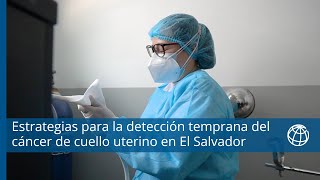 YouTube · Banco MundialEstrategias más efectivas para la detección temprana del cáncer de cuello uterino en El Salvador
Muestra cómo funciona en la práctica el tamizaje con prueba de VPH en uno de los cinco países que apoyará Unitaid.
- Web · Organización Mundial de la SaludCervical Cancer Elimination Initiative
Explica las metas 90-70-90 y el umbral de 4 casos por 100.000 mujeres que define la eliminación.
- Web · IARCCitología frente a prueba de VPH en América Latina: análisis del estudio ESTAMPA
El estudio latinoamericano que midió por qué la prueba molecular encuentra el doble de lesiones graves.
- Blog · Clinton Health Access InitiativeCommunity HPV self-testing in Africa
Datos reales de autotoma en cinco países africanos, útiles para imaginar cómo podría funcionar en zonas rurales de América.
- Web · UnitaidCervical cancer prevention and screening
Resume las herramientas que financia la agencia, desde la autotoma hasta la ablación térmica.
- Web · Nobel PrizeHarald zur Hausen, Premio Nobel de Medicina 2008
La historia del científico que demostró que un virus está detrás del cáncer de cuello uterino.
Sources
- PAHO secures first-ever region-wide access agreements for HPV testing across Latin America and the Caribbean
- OPS, con apoyo de Unitaid, logra primeros acuerdos de acceso a escala regional para pruebas de VPH
- PAHO - Cervical cancer
- PAHO Revolving Funds - HPV products catalogue (Sept. 2026)
- IARC - Cytology and HPV testing in Latin America (ESTAMPA)
- IARC - Standardised colposcopy for HPV-positive women (ESTAMPA)
- WHO Cervical Cancer Elimination Initiative
- CHAI - HPV self-testing in Africa
- Crónica - Impulsan autotoma para ampliar detección de cáncer cervicouterino
- News in America - Acuerdo OPS y Roche para pruebas de VPH-ADN
- Banco Mundial - Detección temprana del cáncer de cuello uterino en El Salvador
- Unitaid - Cervical cancer
- Nobel Prize - Harald zur Hausen





