


 Have a great day, y'all!
One more foot of water: the Panama Canal returns to full draft and adds a crossing
Since 9 November, the largest ships can transit the Neopanamax locks at a 50-foot draft, and the waterway now offers 34 daily slots. The recovery comes in an El Niño year that, this time, did not force the deep cuts of 2023.

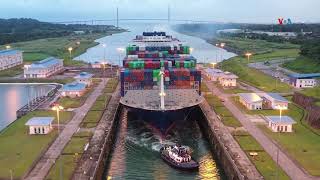
A single foot does not sound like much. At the Agua Clara and Cocolí locks it means hundreds of containers a ship can keep on board instead of leaving them on the dock. Since Monday 9 November, the Panama Canal Authority (ACP) has again allowed Neopanamax vessels to transit at a draft of 15.24 metres, or 50 feet, the maximum the expanded locks were built for.
The change came in an advisory to shipping that also brought more capacity: the canal moves from 33 to 34 daily reservation slots. The official reasoning fits in a sentence. The lakes that feed the canal have recovered, and hydrological forecasts for the coming months look favourable.
- The maximum Neopanamax draft returns to 50 feet (15.24 metres) from 9 November 2026, in force "until further notice".
- Daily capacity rises to 34 slots: 24 at the Panamax locks and 10 at the Neopanamax locks.
- Gatun Lake stood at 87.1 feet on 9 November, about 6.6 feet higher than on the same date in 2023.
- Rainfall in the basin was 34% below the historical average between May and August, yet the canal avoided the severe cuts of the last major drought.
The comparison with three years ago is the heart of the story. In 2023, with El Niño at full strength, the canal fell to 22 daily transits and a 44-foot draft. In 2026 the phenomenon came back and the rain fell short again. This time, capacity barely dipped below 32 slots.
For Panamanians, the numbers matter twice over. The same lakes that lift the ships also fill the taps of more than half the country.
From the driest year to 87 feet
The timeline explains the relief. According to the maritime outlet DataPortuaria, rainfall in the basin between May and August 2026 was 34% below average, and river flows were 44% below normal. The ACP responded step by step: from 15 September it cut daily slots to 32, and by the end of that month the Neopanamax draft stood at 49 feet.
In August, the ACP's hydrometeorology manager, Erick Córdoba, summed up the start of the rainy season for the Panamanian broadcaster TVN: June 2026, he said, was one of the driest Junes recorded in the canal basin since 1950.
Rain in recent weeks changed the arithmetic. On 15 October the canal restored a tenth Neopanamax slot, taking capacity to 33. Three and a half weeks later, with Gatun Lake at 87.1 feet, close to its operating maximum of 87.5, came slot number 34 and the full draft.
That year is the yardstick. In December 2023, Ilya Espino de Marotta, then deputy administrator, described 2023 as the driest year on record for the waterway, with October the driest month in the basin's history. Rainfall that month came in 41% below forecast, the lowest since 1950, according to the ACP. Gatun Lake dropped below 80 feet in mid-2023, and as many as 160 ships queued to cross, the EFE news agency reported. The initial hit to toll revenue was estimated at US$800 million.
Recovery took almost a year. In August 2024, Jorge Pitti, general supervisor of the Cocolí locks, announced it plainly to reporters: the canal would handle 35 transits a day from that day on.

Why one foot matters
Draft is the distance between the waterline and the lowest point of the hull. The heavier a ship is loaded, the deeper it sits. When the canal lowers the permitted draft, shipping lines have two options: carry less, or go another way. During the 2023 and 2024 drought both happened, and some cargo ended up on longer routes, as the maritime site gCaptain recalled this week.
Between 3% and 5% of world maritime trade passes through the canal. It links 180 routes and 1,920 ports in 170 countries, and its main customers are the United States, China and Japan, according to EFE figures published by the Panamanian daily Crítica.
The expanded locks, opened in 2016, turned ten this year. According to the ACP, cargo volume has grown from 268 million tonnes before the expansion to more than 511 million, and the Neopanamax locks now generate over half of the canal's revenue. Ships able to carry 17,000 containers have passed through them.
How to save a lake
The canal runs on fresh water. Every ship raised and lowered through the locks uses water from Gatun Lake, which ends up in the sea. That is why managing each litre decides how many ships can cross each day.
The ACP has added measures since the last drought. At the Neopanamax locks, water-saving basins, stepped pools beside each chamber, hold back part of the water from one lockage to reuse in the next. Combined with other manoeuvres, they can save up to 50% of the water, the Authority explained in 2023. At the older Panamax locks, operators use cross-filling, moving water from one chamber to another instead of releasing it to the sea, a saving equal to six transits a day. When size allows, two ships share a chamber in what is called tandem lockage.

Since late 2025, the canal has added extra pumping to the Miraflores water treatment plant, auxiliary pumps at treatment plants and a desalination plant for local communities, TVN reported. The goal is not only to move ships. Gatun and Alhajuela lakes supply drinking water to more than half of the country's 4.2 million people.
In a report by La Estrella de Panamá, administrator Espino de Marotta credited the improvement to the canal having markedly strengthened its operational water-saving measures since 2024. The paper puts those savings at about 1.2 billion litres a day and reports that the ACP expects 10,750 deep-draft transits in fiscal year 2027.
Her predecessor, Ricaurte Vásquez, had already pointed to where the pressure lies. At a 2025 conference quoted by Revista E&N, he said the canal uses no more water today than it did 20 years ago, and that the strain comes from urban consumption.
"The canal uses no more water today than 20 years ago. The pressure on water comes from urban consumption."
Ricaurte Vásquez, then administrator of the Panama Canal (translated from Spanish)
The question of how to store rainwater for the dry months is being asked across the region, at very different scales. In Ecuador, Manglaralto stores rain beneath its river and supplies 40,000 people. In Mexico, the mountains that water Jalisco's coast are now protected. And in northern Colombia, 30,000 Wayuu people in La Guajira now have drinking water from wells and solar panels.

An engineer at the helm
The recovery coincides with a change at the top. Ilya Espino de Marotta, a marine engineer who graduated from Texas A&M University and has spent 35 years at the canal, is the first woman to run it. She had been deputy administrator since January 2020 and led megaprojects including the US$5 billion expansion, according to the Associated Press. President José Raúl Mulino appointed her this year to a seven-year term.
In her first speech as administrator, reported by La Estrella de Panamá in September, she named water for the population and for shipping as her main task. And she pointed west of the canal, calling Río Indio the most important project the country has right now.
Río Indio, the bet for 2032
Good rains let the canal breathe, but the ACP does not consider drought beaten. Its long-term plan is a new reservoir in the Río Indio basin, west of the waterway. According to figures presented by the Authority, the lake would cover about 4,600 hectares, 8% of the basin. A tunnel 9 kilometres long and 5 metres wide would carry the water to Gatun. The cost is estimated at about US$1.5 billion, and the extra water would be worth between 11 and 15 daily transits.
La Estrella de Panamá puts the start of construction in 2028 and operations in 2032. With the reservoir, according to the administrator, the canal could sustain between 36 and 40 transits a day while continuing to guarantee drinking water for the population.
The project is moving in stages. In April the ACP awarded two roads of 9.5 and 5.6 kilometres in the area, and this week it awarded the third access road, with field work due to start in the coming dry season. With that third stretch, the new road network in the project area will total 25.6 kilometres. The first phase of dialogue included more than 200 meetings in 38 communities and produced a compensation framework covering housing, land, livelihoods and sociocultural needs.
John Langman, vice president of the ACP's Water Projects Office, described it in 2025 as a key solution to guarantee Panama's water security for the next 50 years.
What comes next
The new limits apply "until further notice". The ACP keeps monitoring the basin and will announce any adjustment. The extra slot is being released in stages: transit dates from 12 to 17 November through auction; from 18 to 23 November in a special competition period; and from 24 November through the regular system. The Authority reminds shipowners that its reservation system is the only way to guarantee a transit date, and that ships without a booking may wait much longer.
In July, Espino herself warned that climate change is the waterway's main challenge, and the ACP had considered a 44-foot draft for the summer of 2027. Today the canal heads into the dry season with its lakes almost full.
It is not the only Panamanian story we have covered this year: in September, the country approved a "right to be forgotten" for cancer survivors, so that a cancer overcome no longer counts against them for insurance and loans.
Something you may not know
The future Río Indio lake would have a surface area ten times smaller than Gatun, which covers 470 square kilometres. Even so, it would hold a similar volume of water, because it would be much deeper.
Further reading
Go further
 YouTube · La Prensa (Panamá)'Río Indio es el proyecto más importante ahora': Ilya Espino de Marotta
La primera mujer al frente del canal explica en sus propias palabras por qué el nuevo embalse es su prioridad.
 YouTube · Voz de AméricaRío Indio, la solución a la crisis hídrica del Canal de Panamá
Reportaje en español que muestra la cuenca del río Indio y el plan para llevar su agua hasta Gatún.
 YouTube · Wendover ProductionsThe World's Shortcut: How the Panama Canal Works
Una explicación visual, en inglés, de cómo funcionan las esclusas y por qué el agua dulce es el combustible del canal.
- Podcast · Stuff You Should KnowHow the Panama Canal Works
Un episodio ameno, en inglés, sobre la historia y la ingeniería de la vía interoceánica.
- Web · Autoridad del Canal de PanamáProyecto Río Indio
La página oficial del embalse, con documentos, mapas y avances del diálogo con las comunidades.
- Web · Autoridad del Canal de PanamáAvisos a las navieras
Aquí se publican los cambios de calado y de cupos diarios; útil para seguir la evolución en tiempo real.
Sources
- Canal de Panamá aumenta a 34 los tránsitos diarios y eleva el calado autorizado en las esclusas Neopanamax (ACP)
- Canal de Panamá aumenta capacidad de tránsito y eleva a 34 los cupos diarios (La Estrella de Panamá)
- Panama Canal raises daily transit capacity as water conditions improve (gCaptain)
- Canal de Panamá eleva a 34 los tránsitos diarios y el calado Neopanamax a 50 pies (DataPortuaria)
- Canal de Panamá eleva a 34 los tránsitos diarios y recupera su máximo calado (Crítica / EFE)
- El Niño 2026: Canal de Panamá refuerza ahorro de agua (TVN)
- Canal de Panamá adjudica construcción de nuevas carreteras en área del proyecto en Río Indio (ACP)
- A veteran Panama Canal engineer becomes first woman to lead the interoceanic waterway (AP)








