


 Have a great day, y'all!
Honduras gets its first Gates Cambridge Scholar: a neuroscientist from a small town
Rose León-Alvarado, an Earlham College neuroscience graduate, is the first person from Honduras chosen in the 25-year history of Gates Cambridge, which is funding her master's degree at the University of Cambridge.
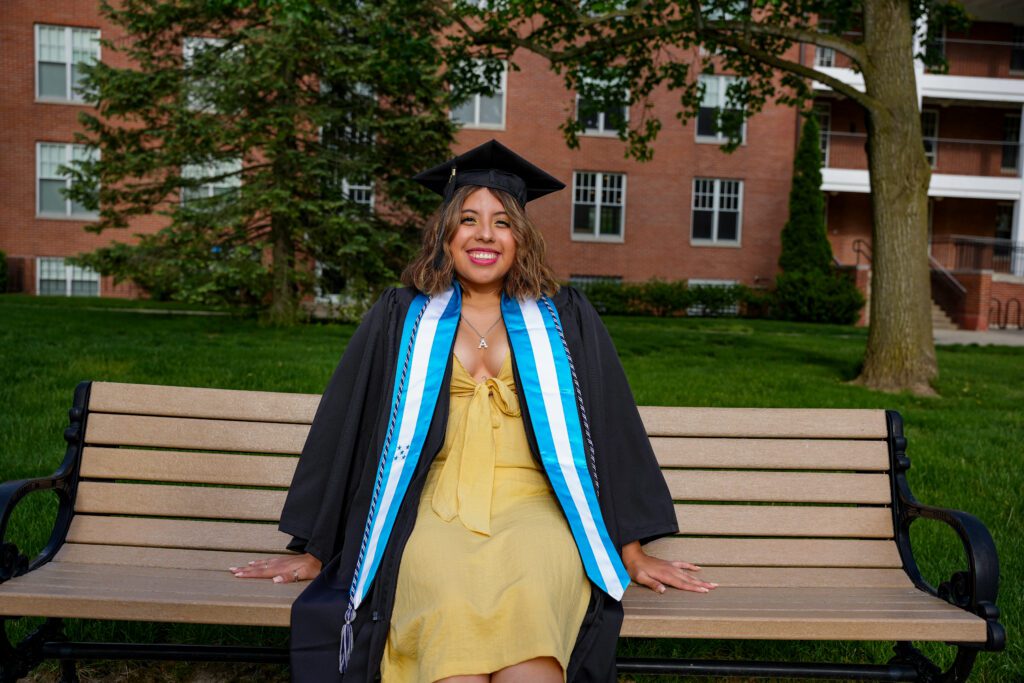
In the official photo released by her college, Rose León-Alvarado sits on a wooden bench on the Earlham campus in Richmond, Indiana. She wears a black gown and mortarboard, and around her neck hangs a blue-and-white stole in the colours of the Honduran flag. The picture was taken before she graduated in neuroscience in 2024. Two years later, on 16 April 2026, her name appeared on a list that no one from her country had reached before: the new class of Gates Cambridge Scholars.
That day the programme, one of the most selective postgraduate awards in the world, announced its Class of 2026: 68 people from 25 countries. The Gates Cambridge Trust singled out two geographical firsts in its announcement, the first scholars from Botswana and from Honduras. The Honduran is León-Alvarado, who has a fully funded place on the Master of Philosophy (MPhil) in Basic and Translational Neuroscience at the University of Cambridge.
Earlham College, where she studied, confirmed the news in a release published the same day. It was a first for the small liberal arts college too: none of its graduates had won the scholarship before. Back in Honduras, the news site TuNota ran the story in October under a headline that was hard to argue with: a Honduran woman had made history at Cambridge.
- Rose León-Alvarado is the first person from Honduras selected as a Gates Cambridge Scholar since the programme began in 2001.
- She will take an MPhil in Basic and Translational Neuroscience at Cambridge, with fees, living costs and flights covered.
- Her class has 68 scholars from 25 countries: 51 will pursue PhDs and 17 an MPhil.
- Before leaving for England she worked as a research technician in a neurology lab at Washington University in St. Louis that studies recovery after stroke.
A scholarship with 25 years of history and 2,299 names
The numbers behind the programme explain why the appointment matters. Gates Cambridge was created in 2000 with a $210 million gift from what was then the Bill & Melinda Gates Foundation to the University of Cambridge, an idea championed by Bill Gates Sr. The first scholars arrived in 2001.
Since then, according to the programme's own figures, 2,299 scholarships have gone to people from 112 countries, drawn from almost 800 universities. Roughly 80 students from outside the United Kingdom are chosen each year. The award pays the full cost of study: university fees, accommodation and living expenses, and return flights at the start and end of the course.
Selection is not only about grades. Earlham explains that committees look at four things: intellectual ability, the reasons for choosing a particular field, a commitment to improving the lives of others, and leadership potential. That mix tends to filter out plenty of brilliant transcripts whose owners cannot say what the degree is for.
The 2026 class is slightly smaller than usual: 68 scholars, 51 of them doctoral students and 17 on research master's degrees. Their subjects range from engineering and chemistry to digital humanities, history, theoretical physics and population health. The announcement, written by Mandy Garner and published on the University of Cambridge website, mentioned research as far apart as the history of the Crimean Tatars and gravitational waves.
I'm delighted to announce our new cohort of 68 Scholars.
Eilís Ferran, Provost of the Gates Cambridge Trust
The other first in the class is the engineer Lengwe Sinkala, Botswana's first Gates Cambridge Scholar, whose story was featured by Cambridge's Department of Engineering. Two countries joining the list in the same year says something about the programme's effort to find talent beyond the usual universities.

From a small Honduran town to a stroke lab in St. Louis
León-Alvarado grew up in a small town in Honduras, she told Earlham. The college does not name the place and she has not made it public, but she has explained what pulled her towards the brain. Where she grew up, mental health problems were not seen as a legitimate subject of study. Learning that they had a biological basis changed her direction.
At Earlham I discovered that there is a scientific basis for mental health conditions.
Rose León-Alvarado, quoted by TuNota (translated from Spanish)
She arrived at Earlham planning to study biochemistry. An introductory psychology class taught by Professor Rachael Reavis steered her towards neuroscience instead. She graduated in 2024 with departmental honours in neuroscience and minors in public health and chemistry. Along the way she did research in campus labs and, during summer internships, in labs run by Earlham alumni.
Earlham is a college with Quaker roots, far smaller than Harvard or Stanford, and listed among the top 100 national liberal arts colleges by U.S. News & World Report. Four mentors helped her prepare the application, according to the college: Beth Mechlin, her academic adviser; Nate Eastman, who directs the honours and first-year programmes; Peter Blair, director of the Center for Global Health; and Maria Haworth, adviser to the Latinx and Caribbean Student Association, a group León-Alvarado helped found.
Public health was never just another module for her. Through Earlham's Epic Journey programme she joined health campaigns in underserved communities in Peru and Costa Rica. In Richmond, the Indiana city that is home to the college, she supported local clinics and Covid-19 vaccination efforts aimed at the Hispanic community. She also danced with the Dance Alloy group and played in the Jazz Ensemble.
I know how hard it can be to get medical care in remote areas.
Rose León-Alvarado, on what drives her (translated from Spanish)
After graduating she joined the Albertson Lab as a research technician, in the Department of Neurology at Washington University School of Medicine in St. Louis. The group, led by the neurocritical care physician Asher Albertson, opened in autumn 2023. It studies what happens in the brain after a stroke: the molecular, neuronal and network mechanisms that decide how much tissue is lost and how much function comes back, with a particular interest in ageing and plasticity.
Daily work in a lab like this is unglamorous. Mouse brain sections are cut, damaged areas are identified, astrocytes (star-shaped cells that support neurons) are stained and examined, and proteins are measured with techniques such as western blotting. The long-term aim, according to the lab's website, is to turn that knowledge into treatment targets that improve outcomes after acute brain injury.

The Cambridge MPhil is a research degree run by Cambridge Neuroscience, the network that links the university's brain-science departments and institutes. Now in its eighth year, it is co-directed by Elisa Galliano of Physiology, Development and Neuroscience, David Bulmer of Pharmacology and Andrea Greve of Psychology. Each student picks a project in one of the research groups and combines it with training in specific neuroscience topics, advanced data analysis and statistics. The word "translational" in the title is there for a reason: it means carrying what is learned at the bench towards treatments for patients.
Her plans go further. Earlham says she intends to do a PhD and become an independent scientist and professor while continuing to communicate science. TuNota adds a detail that links back to where she started: she wants to bring science education to vulnerable communities that struggle to get medical care.
What it means for a country that spends little on science
The scholarship lands in a country with a small research system. The most recent figure for Honduran spending on research and development held by the UNESCO Institute for Statistics dates from 2017: 0.04% of GDP. That is four dollars in every ten thousand the economy produces, and it goes a long way to explaining why many Hondurans who want to do research end up doing it abroad.
The roll of Honduran scientists with careers overseas is short but distinguished. The pharmacologist Salvador Moncada, born in Tegucigalpa, did landmark work on nitric oxide in the United Kingdom. The microbiologist María Elena Bottazzi, who trained in Honduras, co-led the development at Baylor College of Medicine in Texas of Corbevax, a patent-free Covid-19 vaccine designed for low- and middle-income countries, and was nominated for the Nobel Peace Prize in 2022.
The same point about talent that exists but needs backing was made at the end of October by the Honduran researcher Mary Vallecillo, who works on neonatal immunology at Harvard Medical School. She said it during a talk with students at the Catholic University of Honduras in San Pedro Sula, reported by La Prensa.
Honduras has talent, but science needs a push.
Mary Vallecillo, researcher at Harvard Medical School (translated from Spanish)
León-Alvarado's story echoes those of other Latin Americans recognised this year for scientific work done without big budgets, such as the four researchers honoured in Venezuela or the Bolivian biologist Luis Aguirre, who joined the World Academy of Sciences. In applied neuroscience, the Argentine team behind a 3D brain map for epilepsy surgery is another example of what the region can produce.
Her path also says something about scholarships as a policy tool. In Central America, Guatemala has just turned its national scholarship fund into law, with 1,174 awards and almost half going to Indigenous students. León-Alvarado relied on funding at every stage, from the college in Indiana to the public health trip to Peru, and her record shows how far a person can go when each door opens at the right moment.
Earlham, for its part, adds a name to a recent run of top international awards. In the same release it recalled Summia Tora, class of 2020, the first student from Afghanistan to win a Rhodes Scholarship to Oxford, and Cyrus Buckman, who won a Knight-Hennessy scholarship to Stanford. For a college in Richmond, a graduate saying she would not have got this far without it is probably the best recruitment pitch it could ask for.
Hondurans are used to cheering compatriots abroad in sports stadiums. This month, San Pedro Sula's Mauricio Dubón won his third Gold Glove in Major League Baseball. León-Alvarado's achievement happens far from the cameras, among microscopes and journal papers, but it shares something with baseball: it opens a path others can follow. Since April, any Honduran student weighing up a Gates Cambridge application knows that someone from their country has already done it.
The detail you might not know
The scholarship León-Alvarado won is open every year to anyone from outside the UK applying for a full-time postgraduate degree at Cambridge. Applicants do not need a famous university behind them: since 2001, scholars have come from almost 800 different institutions, and León-Alvarado herself comes from a small college in Indiana. What counts, beyond the transcript, is being able to explain which problem you want to solve and for whom. She had that answer from the town where she grew up: understand the brain so that mental health stops being something nobody talks about.
Further reading
- Official announcement of the Gates Cambridge Class of 2026, with the figures for this year's round.
- Earlham College's release on Rose León-Alvarado.
- The MPhil in Basic and Translational Neuroscience at Cambridge Neuroscience.
- The Albertson Lab, where she worked on recovery after stroke.
- The story in TuNota, the Honduran outlet that reported it in Spanish.
Go further
- Web · Gates Cambridge TrustGates Cambridge announces Class of 2026
El anuncio oficial con las cifras de la promoción en la que entra la primera becaria hondureña.
- Web · Earlham CollegeRose León-Alvarado ’24 becomes first from Honduras selected for prestigious Gates Cambridge Scholarship
El relato de su universidad, con su paso por los laboratorios y los programas de salud pública.
 YouTube · GatesCambridgeCambridge Colleges for postgraduate applicants
Guía en vídeo del propio programa para quien se plantee solicitar un posgrado en Cambridge.
 YouTube · Cambridge UniversityThe Postgraduate Application Process at Cambridge
Cómo funciona paso a paso la solicitud de posgrado en Cambridge, útil para futuros candidatos hondureños.
- Web · Washington University School of MedicineAlbertson Lab
El laboratorio de San Luis donde investigó la recuperación del cerebro tras un ictus.
- Podcast · Jessica Chomik-MoralesMi Última Neurona
Pódcast en español con entrevistas a neurocientíficos latinoamericanos, nacido en el MIT.
- Web · Cambridge NeuroscienceMPhil in Basic and Translational Neuroscience
La página del máster que cursará, con su estructura y sus directores.
Sources
- Earlham College: Rose León-Alvarado ’24 becomes first from Honduras selected for prestigious Gates Cambridge Scholarship
- Gates Cambridge: Gates Cambridge announces Class of 2026
- University of Cambridge: Gates Cambridge Class of 2026
- TuNota: Hondureña hace historia al ganar prestigiosa beca de la Universidad de Cambridge
- Albertson Lab, Washington University School of Medicine
- La Prensa: Mary Vallecillo: Honduras tiene talento, pero falta impulsar la ciencia





