


 Have a great day, y'all!
Sagrada Família reaches 172.5 metres and becomes the world's tallest church
The last piece of the cross on the Tower of Jesus Christ went up on 20 February 2026, 144 years after the first stone was laid; the tower was inaugurated on 10 June, the centenary of Gaudí's death.

One hundred and forty-four years after its first stone was laid, Barcelona's Sagrada Família reached its final height on 20 February 2026: 172.5 metres. That morning the top arm of the cross crowning the Tower of Jesus Christ went up, completing the piece that makes the basilica designed by Antoni Gaudí the tallest church in the world, according to Guinness World Records. Four months later, on 10 June, with Pope Leo XIV in Barcelona, the tower was blessed and inaugurated before thousands of people, on a day timed to the centenary of the architect's death.
THE KEY FACTS
- On 20 February 2026 the last piece of the cross on the Tower of Jesus Christ was installed, taking the basilica to 172.5 metres.
- The Sagrada Família overtook Ulm Minster's spire in October 2025 and is now the world's tallest church.
- The cross is 17 metres tall and 13.5 metres wide, and was lifted in seven pieces made in Germany and Catalonia.
- On 10 June 2026 the tower was blessed before some 8,000 people, on the centenary of Gaudí's death.
- Funding comes almost entirely from ticket sales; the Glory façade is the phase still ahead.
Seven pieces for 172.5 metres
The piece installed in February is the top arm of a three-dimensional, four-armed cross measuring 4.5 by 4.5 metres and 4.9 metres high, according to the basilica's official statement. It closed off the exterior of the central tower and, with it, all six great towers at the heart of the building. The full cross stands 17 metres tall and 13.5 metres wide. It was made in Germany in 2025 and assembled almost entirely on site, using white glazed ceramic, stone and glass produced in workshops across Catalonia. It arrived in modules pre-assembled on a platform 54 metres above the central nave and was raised in seven pieces — the lower arm, the central core, four arms and the top section — between October 2025 and February 2026. Inside the top arm sits a sculpture of the Lamb of God, the Agnus Dei, by the artist Andrea Mastrovito.
The first section, the lower arm, went up on 27 October 2025, taking the tower to 162.91 metres and, with that step, already past the 161.53-metre spire of the Lutheran minster in Ulm, Germany, which had held the title since 1890. The change was recorded by both Euronews and the Guinness registry itself.
Gaudí, Jordi Faulí and 144 years of building
The first stone of the basilica was laid in 1882, and Gaudí took over the project shortly afterwards, at the age of 31. He gave the Sagrada Família the last four decades of his life, knowing he would never see it finished: he died in 1926, struck by a tram, having seen only one of the 18 towers he had planned completed. Work later stalled through the Spanish Civil War, which destroyed part of his original plans and models, and much more recently through the Covid-19 pandemic, which halted months of building and of ticket income.
The Tower of Jesus Christ is the tallest of those 18 towers. It has twelve faces and was built with an unusual technique for reaching such a height without losing Gaudí's geometry: panels of tensioned stone combined with steel, made off site and brought in to be fitted level by level. The first went up on 16 October 2018, at 85 metres; the last was completed on 4 December 2024, at 142.5 metres.

Between Gaudí and Faulí, five other chief architects led the project, according to the basilica's own history of the temple: Domènec Sugrañes, Gaudí's direct disciple, took over in 1926; Francesc de Paula Quintana followed, until 1966, and then, jointly, Isidre Puig Boada and Lluís Bonet i Garí. Francesc Cardoner briefly led the works in the mid-1980s, before Jordi Bonet i Armengol took the role in 1985 and held it until 2012. The magazine Aleteia notes that each of them had to interpret and reconstruct Gaudí's intentions from the plans and models that survived 1936. In 2005, UNESCO added the Nativity façade and the crypt to its World Heritage List, under the wider listing of Gaudí's works, according to both the basilica's own history page and the UNESCO committee's own recommendation. The naves, columns, vaults and façades of the interior were completed between 1986 and 2010, the year Pope Benedict XVI consecrated the basilica. Work on the towers of the Evangelists, the Virgin Mary and Jesus Christ began in 2016; the pandemic halted construction entirely in March 2020, and work did not resume until that October. The Tower of the Virgin Mary was inaugurated in December 2021, and the four towers of the Evangelists in November 2023.
Seen against that history, no major European church was built as quickly as it might seem: Cologne Cathedral took 632 years to complete, from its foundation stone in 1248 to its opening in 1880, according to the architecture outlet Archiweb; St Vitus Cathedral in Prague took 585 years, and Milan's Duomo took 579, according to a tally by Architizer. Next to those, the Sagrada Família's 144 years look, in fact, like a short span for a building of this scale.
Leading this final stage is Jordi Faulí, chief architect since 2012 and, for years before that, assistant to his predecessor, Jordi Bonet. Gustavo García Gabarró, president of the Amics de Gaudí association, summed up what that work has meant in remarks to the Spanish daily El Español on the day of the inauguration: "his essential task has been to stay faithful to Gaudí's project." Faulí himself described the moment the cross was closed in these terms, at a public event:
Today was a day we had been waiting for impatiently.
Jordi Faulí, chief architect of the Sagrada Família
An inauguration before the Pope
The blessing of the tower was timed to the centenary of the architect's death. On 10 June 2026 the day began with a floral tribute at Gaudí's tomb, in the basilica's crypt, and ended in the evening with a Mass celebrated by Pope Leo XIV, who then went outside to bless the tower, according to the official programme. About 8,000 people followed the events: roughly 4,000 inside the basilica and as many again in the street, in front of the Nativity façade, watching on giant screens.
Music came from the orchestra of Barcelona's Liceu opera house, and at the end of the evening a swarm of drones drew Gaudí's face in the sky over Barcelona before a fireworks display that several outlets carried live.
X@el_paisVer publicación en X ↗InstagramVer en Instagram ↗The ceremony was part of a programme of 31 events that began in autumn 2025 and runs until Christmas 2026, with a €3.2 million budget covered entirely by private sponsorship.
The basilica's finances, and what is still to be built
The Sagrada Família receives no public subsidy: almost its entire budget comes from ticket sales. Since it began charging admission, in 1915, the basilica has sold more than 97 million tickets, according to the Junta Constructora's annual report as cited by Moncloa.com. In 2025 alone, 4.87 million people visited, generating revenue of roughly €134.5 million; the year before, Euronews reported, about 15% of visitors came from the United States, the basilica's single largest foreign market. Ticket prices now range from €26 for general admission to €36 for access that includes the towers.
Of that, close to half — €58.6 million — went straight into construction, and some 1,600 people now work at the basilica and the two stone-cutting plants that supply it, according to the same annual figures reported by Ara.cat.
The tower is also arriving at a high point for Catalan tourism: in 2025 Catalonia received 20.05 million foreign tourists, a record, who spent €24.8 billion, according to Spain's National Statistics Institute as reported by Ara.cat. Barcelona alone drew close to 12.7 million visitors in 2024, nearly half the Catalan total, up from just over 4 million in the year 2000, according to a two-decade review by Catalan News. The Sagrada Família itself, with close to 5 million visitors a year, is one of the main reasons for those figures, though the city's tourism commissioner has warned that Barcelona is starting to reach a ceiling on that growth.

A finished exterior does not mean a finished basilica. Interior work on the tower will continue through 2027 and 2028, as the US trade magazine Building Design + Construction also reports: the remaining tasks include interior cladding, installing a lift and removing the crane bracing.
The largest phase still ahead is the Glory façade, the building's main entrance, whose cost is estimated at around €600 million over a decade, without the basilica taking on debt. In early 2026, those in charge expected the building to be complete by around 2036, though that date depends on the pace of donations and visits.
Meanwhile the basilica remains open, and visits now include the interior of the Tower of the Virgin Mary. From the Crossing Hall, 80 metres up, internal bridges link the Tower of Jesus Christ with the Virgin's tower and the four towers of the Evangelists.
Culture features in other recent good news on these pages, such as the naming of Cuenca, Ecuador, as a UNESCO Creative City of Gastronomy, Sweden's return of objects from the Kingdom of Benin and the Shuar-language short film that reached the screens of Piccadilly. In Catalonia, another historic Barcelona building moved back into place this year after eight years of work: Gràcia's Mercat de l'Abaceria. And in Colombia, another city joined the map of faith tourism this year: Valledupar joined the global network that includes Fátima and Jerusalem. Elsewhere in Spain, another region celebrated a very different kind of record this year: Iberian lynx numbers in Castilla-La Mancha.
The fact you might not know: the cross is not a recent invention. The so-called Quart Àlbum, published between 1927 and 1929 from Gaudí's own papers, already described a large cross with four fluted arms crowning the central tower, designed so that visitors could look out from it. Almost a century later, the cross now topping Barcelona follows that same four-armed scheme, recognisable from any point in the city.
Further reading
- Photo gallery of the Tower of Jesus Christ (Sagrada Família)
- Jordi Faulí, the architect who chose not to leave his signature (El Español)
- The Sagrada Família's finances, in figures (Moncloa)
- The Guinness World Records entry for the tallest church
- Why the exterior work took 144 years (Building Design + Construction)
Go further
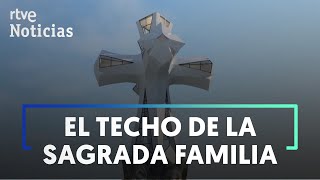 YouTube · RTVE NoticiasAsí será el remate de la Sagrada Familia: una torre de más de 170 metros y una cruz visitable
Explica con infografías cómo se diseñó y construyó la torre central antes de su culminación.
 YouTube · Metrópoli BarcelonaAsí es la espectacular Torre de Jesucristo de la Sagrada Família
Un recorrido en imágenes por la torre ya terminada y sus detalles.
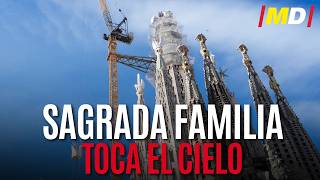 YouTube · Mundo DeportivoLa Sagrada Familia se convierte en la iglesia más alta del mundo con 172,5 metros
Las imágenes del día en que se colocó la última pieza de la cruz.
- Web · Junta Constructora del TemploBasílica de la Sagrada Família
Web oficial con la historia del templo, el estado de las obras y la información de visita.
- Web · Arquitectura VivaLa Sagrada Familia corona sus 172,5 metros de altura
La lectura de una revista de arquitectura sobre el remate de la torre.
- Web · Guinness World RecordsTallest church/cathedral spire
La ficha oficial del récord, con la fecha exacta en que la Sagrada Família superó a la catedral de Ulm.
- Web · Moncloa.comEl negocio de la Sagrada Familia: 97 millones de entradas en un siglo y un modelo millonario
Un desglose claro de cuánto ingresa el templo, de dónde sale ese dinero y a qué se destina.
- Blog · El EspañolJordi Faulí, el arquitecto que terminó la torre sin dejar su firma
Un retrato de Jordi Faulí contado por quienes lo conocen, el día de la inauguración de la torre.
Sources
- Una cruz que llega al cielo de Barcelona (Basílica de la Sagrada Família)
- Bendición e inauguración de la torre de Jesucristo (Basílica de la Sagrada Família)
- La Sagrada Familia alcanza su altura máxima después de más de un siglo (Euronews)
- El papa inaugura y bendice la torre de Jesucristo de la Sagrada Familia (Euronews)
- After 144 years, Barcelona's Sagrada Família church finally reaches its intended full height (BD+C)
- Jordi Faulí, el arquitecto que terminó la torre de la Sagrada Família (El Español)
- El negocio de la Sagrada Familia: 97 millones de entradas en un siglo (Moncloa)
- Las finanzas de la Sagrada Família: 135 M de facturación y 1.600 puestos de trabajo (Ara.cat)
- Spirit in the sky: Barcelona's Sagrada Família becomes the world's tallest church (Euronews)
- Tallest church/cathedral spire (Guinness World Records)
- History of the Basílica (Sagrada Família)
- The Many Hands Behind Sagrada Familia (Aleteia)
- The cathedral in Cologne was under construction for 632 years (Archiweb)
- Centuries of Work: 3 Cathedrals Whose Construction Lasted Longer Than Sagrada Familia (Architizer)
- Historic record: Catalonia surpassed 20 million foreign tourists in 2025 (Ara.cat)
- From 13 million to 27 million: Catalonia's 21st century tourism surge (Catalan News)
- ICOMOS recommendation on the Nativity façade and crypt (UNESCO World Heritage Centre)




