


 Have a great day, y'all!
Over 20,000 visitors in one holiday: cypress sculptures and bread fill Tulcán
The Ecuadorian border city of Tulcán logged more than 20,000 visitors over the Day of the Dead holiday, with bread and flower fairs, a new food map and its famous topiary cemetery spreading the spending across local businesses.

Patricia Ortega has been setting up her stall at Tulcán's Day of the Dead fair for about 25 years. This November she was back with the other members of the Asociación 1 de Noviembre, among stalls of sweet bread dolls, spiced purple corn drink and bunches of flowers, in the city that keeps Ecuador's best-known topiary cemetery. Around her, according to the municipal count, passed more than 20,000 registered visitors over the holiday.
The figure was published on 6 November by the regional newspaper El Norte, based on the Tulcán city government's tally, and was also reported by the community radio network CORAPE, which described the crowd as a mix of Ecuadorian and foreign tourists. For a chilly border city whose fortunes usually rise and fall with the Rumichaca bridge and the exchange rate with Colombia, that is good news with real names attached: the bakers, florists and cooks who saw their streets fill up.
- More than 20,000 visitors were registered in Tulcán over the Day of the Dead holiday, according to the city.
- Three contests, for bread dolls, colada morada and flower arrangements, rewarded nine local residents.
- Ecuador's Ministry of Economic Development launched a food map featuring 20 venues in the city.
- The José María Azael Franco cemetery, with more than 300 cypress sculptures, remained the main draw.
Bread, colada and flowers: the fair that keeps shops busy
The recipe is not new, but this year it worked harder. The city's tourism office organised a Bread Fair and a Flower Fair and added three contests designed so that tradition could be seen, smelled and bought. Diego Guerrero, head of tourism, told El Norte that the entries carried elements of local cultural identity and that both fairs drew local businesses as well as visitors.
The judges had their work cut out. In the bread doll category, first place went to Clara Burbano, ahead of Carlos Tulcanaza and Janeth Castillo. Victoria Castillo won the colada morada contest, with Miriam de la Cruz second and Diana Castillo third. Sandra Chicaiza took the flower prize, followed by Carmen Íñiguez and Susana Portilla.
According to the Ibarra-based paper, several of the bread figures entered in the contest depicted well-known local characters, a detail the panel from the municipal social welfare board singled out. Juan Pablo Orbe, who judged the flower arrangements, praised the turnout of Tulcán's artisans.
For readers who have never tried them: a guagua de pan is a sweet bread shaped like a swaddled baby and decorated with coloured icing. It is eaten with colada morada, a thick drink made from black corn flour, Andean blueberries, blackberries, pineapple, strawberries and spices such as cinnamon, clove and lemon verbena. Families across the Ecuadorian Andes have shared both on 2 November for generations, and in the north the custom remains closely tied to visiting relatives' graves.

Diana Castillo, of the Asociación 1 de Noviembre, thanked the organisers for opening space to promote local businesses. Her colleague Patricia Ortega said that after a quarter of a century of fairs, the yearly event is still her best shop window. Heidi Chimbolema, a visitor from Riobamba, summed up what she saw: the crowds gave local trade a lift.
There is no official estimate yet of how much money the holiday left in Tulcán, and this article will not invent one. What is known is that the city logged more than 20,000 people, and that every one of them could buy bread, colada, flowers, meals and a bed from people who live in the canton.
The cemetery that turned mourning into a day out
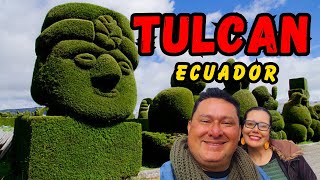
No Day of the Dead holiday in Tulcán makes sense without its cemetery. The municipal burial ground was founded in 1932 on about eight hectares north-east of the city, replacing an older cemetery on Loma de Santiago that the 1923 earthquake had badly damaged. Four years later, in 1936, the head of the city's parks department, José María Azael Franco Guerrero, began clipping the cypress trees with an idea that sounded eccentric at the time: giving them shapes.
Franco tended the garden for almost half a century. Atlas Obscura quotes a line attributed to him, that the place was so beautiful it invited one to die. He died in 1985, aged 85, and was buried among his own living sculptures. Since 2005 the cemetery has officially carried his name. According to Wikipedia, the gardens cover more than four hectares and hold over 300 cypress figures: Ecuadorian animals, arches, faces and motifs borrowed from Roman, Greek, Inca, Aztec and Egyptian cultures. They are split between two areas, the Parque de los Recuerdos near the entrance and the Altar de Dios at the back.

The work did not stop when he died. His son Benigno Salvador Franco took charge of the gardens, and gardener Lucio Reina, who had worked alongside the founder, is credited with the second phase of the Parque de los Recuerdos. Travel site Atlas Obscura reports that Franco's sons and the cemetery staff now look after the clipping.
Official recognition came in 1984. On 28 May that year Ecuador's cultural heritage institute declared the site part of the nation's cultural heritage, and in August the national tourism directorate listed it as a natural site of national tourist interest. In 2009, for the 25th anniversary of that designation, it was restored and lighting was added to the gardens.
That January number was reported by El Universo when the city began charging outside visitors on 19 January. Foreigners pay two dollars and Ecuadorians from other provinces one dollar; residents of Carchi get in free. The city council expected to raise about 300,000 dollars a year, earmarked for upkeep and improvements. When the artworks are living plants that grow every week, that money has an obvious use: shears, watering, staff and fertiliser.
Ahead of the holiday, the city also refurbished the lighting along the cemetery boulevard and its façade, spending 10,000 dollars, according to El Norte. The stated goal was to make night-time theatrical tours possible, an idea that in earlier years had cultural performers dressed as notable local figures guiding groups between the graves.
A map for eating well at the border
The 2026 holiday also brought something the city did not organise. The northern office of the Ministry of Economic and Productive Development (MDEP), which covers Esmeraldas, Imbabura and Carchi, presented a food map of Tulcán listing 20 selected venues, the Carchi broadcaster KCH FM reported on 31 October.
Every venue on the map is registered and graded in the government's Smart Tourism System, known as Siturin. Restaurants display forks as a quality mark and cafés display cups. An acrylic plaque was fixed at each one, so that a visitor crossing from Ipiales, or driving up from Quito, knows where to sit down. Diego García, a ministry technician, said the map also aims to showcase Carchi's coffee culture and a bean with export potential. The initiative was part of a wider holiday programme across the three northern provinces, coordinated by Óscar Ruano, the ministry's regional director.
"[The map] helps consolidate this border city as a gastro-diverse destination."
Roque Arias, Tulcán tourism entrepreneur, speaking to KCH FM (translated from Spanish)
The logic is economic. Tulcán is a city of trade and services, and a large share of its customers come from Colombia. When visitors stay to eat and sleep, the spending reaches far more businesses than when they simply cross over to shop.
The border backdrop has shifted this year too. After months of tariff tension between Ecuador and Colombia, the 100 per cent security levy on Colombian imports was revoked on 1 June, and trade through Rumichaca was expected to return to normal in the following weeks, El Universo reported. A holiday bringing thousands of visitors therefore arrived at a moment when Tulcán's shops needed customers.
The province has already shown its products can compete abroad: recently, a blue cheese aged at 3,200 metres in Carchi won gold in Uruguay.

The pull was felt beyond the provincial capital. Twenty-seven kilometres away, in San Pedro de Huaca, the eighth Bread and Colada Morada Fair brought together more than 40 entrants, who displayed bread figures over a metre tall, most of them devoted to the Virgin of the Purification. El Universo counted more than 3,000 people on 2 November, including visitors from Colombia. Once the show was over, the figures were shared out among local families.
The Huaca contest has an unusual origin. It was started by the parish priest, Carlos Padilla, as a way of remembering the dead. Eight editions later, in a canton of 7,937 people, the pieces take one or two days to make from several kinds of dough, and both institutions and whole families take part.
The calendar helped. November is a festive month in Carchi, which marks the anniversary of its creation as a province; this year it turned 146, celebrated with a street parade of more than 100 delegations through Tulcán. A national holiday, provincial celebrations and the Day of the Dead fell within a few weeks of one another, and the city managed to string them together.
Tulcán has other names that put it on the map. Richard Carapaz, the Olympic road race champion, grew up in El Carmelo, a rural parish of this canton, and is now also a physical education graduate of Carchi's state university. Every time his name appears on a broadcast, the word Carchi travels with him.
What worked in Tulcán echoes other Ecuadorian towns that have turned their identity into an attraction. Cuenca joined the UNESCO Creative Cities Network for its cooking, and Baños de Agua Santa was named among the world's 20 most beautiful towns by an international travel magazine. Tulcán plays in a smaller league, but it has something no other city has: a garden of carved cypresses that has been growing for ninety years.
There is still work to do. Researchers have warned that contradictory information circulates about what several of the sculptures represent. A 2016 thesis at the Universidad Politécnica Estatal del Carchi by Doris Liliana Delgado Pozo recommended consolidating that information, sharing it with cemetery staff and building a photographic record to help conserve the figures. With thousands of visitors every holiday, telling each cypress's story accurately is part of what the city has to offer.
In the meantime, the scene repeats every November. Families climb to the cemetery with flowers, tourists pose under the green arches, and at the fair there are bread dolls like the ones that won Clara Burbano first prize this year.
Further reading
- Tulcán received more than 20,000 tourists over the Day of the Dead holiday (El Norte, in Spanish)
- More than 20,000 tourists visited Tulcán during the All Souls' events (CORAPE, in Spanish)
- Holiday in the north: an agenda linking production, food and tourism (KCH FM, in Spanish)
- Ecuador's topiary cemetery at Tulcán (Atlas Obscura)
- Cypress sculptures of the Parque de los Recuerdos (UPEC repository, in Spanish)
Go further
 YouTube · Moya FilmsAsí es uno de los cementerios más hermosos del mundo: cementerio de Tulcán
Un recorrido visual por los arcos y figuras de ciprés que atraen a miles de visitantes cada feriado.
 YouTube · Andariegos Nelson MaluDescubre el cementerio de Tulcán en Ecuador: guía completa para tu visita
Útil para quien planea ir: accesos, horarios y qué ver dentro del camposanto.
 YouTube · Cuéntele a PabloCementerio de Tulcán, Ecuador, esculturas vivas
Muestra de cerca el trabajo de poda que mantiene vivas las esculturas.
- Web · Atlas ObscuraTulcán Municipal Cemetery
La historia de Azael Franco contada para viajeros de todo el mundo.
- Web · WikipediaCementerio de Tulcán
Fechas, declaratorias patrimoniales y las dos zonas del jardín, en una sola ficha.
- Web · Doris Liliana Delgado Pozo, UPECEsculturas en ciprés del Parque de los Recuerdos del Cementerio José María Azaél Franco y su difusión cultural
Investigación local sobre el significado de cada escultura y cómo difundirlo.
Sources
- Tulcán recibió más de 20.000 turistas durante el feriado de Difuntos (El Norte)
- CARCHI: Más de 20.000 turistas visitaron Tulcán durante las actividades por finados (CORAPE)
- Feriado en el norte del país: agenda conecta la producción, la gastronomía y el turismo (KCH FM)
- Cementerio de Tulcán con cobro de entrada (El Universo)
- Tulcán mejoró la iluminación de su cementerio (El Norte)
- En San Pedro de Huaca, la feria del pan rinde tributo a la Virgen de la Purificación (El Universo)





