


 Have a great day, y'all!
A shuttered Guard armory in Taos gets $5.25 million to train the town's next tradespeople
Two federal grants will turn an empty National Guard building outside Taos into a hands-on training center for plumbers, HVAC techs, IT workers, truck drivers and nurses. UNM-Taos was the only New Mexico college picked for one of them.

On County Road 110, a few minutes south of the Taos Plaza, sits a long, single-story building that the New Mexico Army National Guard used to call its Readiness Center. Locals just call it the Armory. It ran on its own well and septic tank, it sat closed for years, and in 2025 its deed passed to the University of New Mexico-Taos, whose main campus is next door.
This fall the building got what it was missing: money for the inside. UNM-Taos announced on Nov. 6 that it had won two federal grants worth $5.25 million over five years, and the University of New Mexico's newsroom repeated the news on Nov. 12. Most of that money goes into one place. The old Armory is becoming the Taos Workforce Center, a regional hub where people from Taos County and the pueblos and villages around it can learn a trade with their hands on real equipment.
- Two U.S. Department of Education grants, $5.25 million in total, began on Oct. 1, 2026.
- One of them, the Rural Postsecondary and Economic Development (RPED) grant, went to just 19 colleges in the country. UNM-Taos is the only one in New Mexico.
- New programs are planned in heating and cooling, plumbing, information technology and water systems.
- A high school construction pre-apprenticeship is meant to grow from about 35 students a year to more than 60.
- Partners include Los Alamos National Laboratory, Kit Carson Electric Cooperative, a plumbers' union local, Taos Pueblo and Santa Clara Pueblo.
Chancellor Mary Gutierrez framed the project around a tension anyone who has grown up in a small mountain town will recognize. "Many families want careers that let them stay in the communities where they have lived for generations," she said in the college's announcement. Employers, meanwhile, need people with skills they cannot always find locally.
The Taos Workforce Center is where those two needs meet.
Mary Gutierrez, chancellor of UNM-Taos
Two grants, one building
The two awards do different jobs. The first is a Title III Strengthening Institutions grant, a long-running federal program that helps smaller colleges improve their facilities and services. It runs five years, through Sept. 30, 2031, and pays for the bones of the new center: construction and fabrication labs, upgraded electrical power and ventilation, and classroom technology.
The second is the RPED grant, which the Department of Education created to connect rural students with jobs that pay well and are in demand nearby. It runs four years, through Sept. 30, 2030. Here the money pays for programs rather than walls: new courses, agreements with employers, internships and apprenticeships.
The competition for RPED is tight. In the 2024 round, the department spread about $44.5 million across 22 grants nationwide, according to Community College Daily. This year's list had 19 colleges. That a campus of fewer than 900 students in northern New Mexico made the cut says something about how specific its plan was.
Both grants buy equipment that a small college rarely gets to own. The list in the announcement reads like a job fair: computer-controlled cutting tools, a commercial truck driving simulator, heavy construction equipment, and patient simulators for nursing and allied health students.
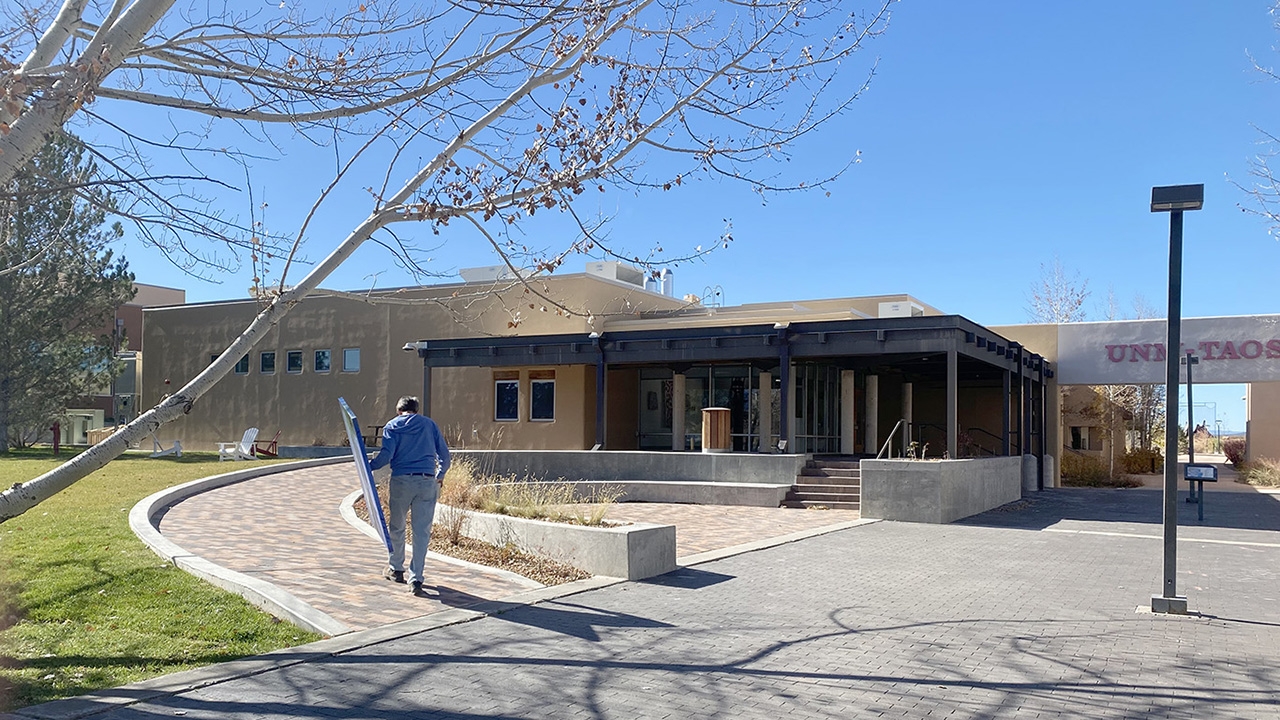
Elizabeth Campbell, who manages workforce development and community outreach at UNM-Taos, described the change in plain terms. "Employers have been telling us for years what they need," she said. "Now we have the classrooms and the equipment to answer them."
What students will actually learn
The RPED grant funds new programs in heating, ventilation and air conditioning, plumbing, information technology and water systems. At least one of them will be designed to qualify for Workforce Pell, a new kind of federal Pell Grant that opened on July 1, 2026, for short job-training programs.
Workforce Pell is a big shift. For decades, Pell Grants paid only for degree programs and longer certificates. The new version covers courses that run at least eight weeks but fewer than 15, between 150 and 599 clock hours, as long as they lead to a recognized credential, have at least 70% completion and job-placement rates, and line up with jobs that the state says are in demand, according to a summary by SHRM. For a 35-year-old in Questa who wants to become a certified plumber's helper without quitting work for two years, that is the difference between a plan and a wish.
The college will also sign formal agreements with regional employers and build at least two new apprenticeship or pre-apprenticeship routes. Each student will get one-on-one guidance that maps classes to careers, employers and support services. And UNM-Taos has committed to tracking regional job demand and student results, so courses can change if what employers need changes.
Why Taos, and why now
Taos County is home to about 34,500 people, according to 2024 Census-based figures compiled by Data USA. Its median age is 52.6, roughly 13 years older than the national figure, and its median household income is about $58,950. The three biggest employers of county residents are health care and social assistance, retail, and construction. Two of those three are exactly the fields the new center targets.
That age profile matters. A county where the median resident is in their early fifties will need many new nurses, electricians, plumbers and drivers over the next decade, and it will need them to be people who can afford to live there. Housing in Taos has long been squeezed by vacation homes and short-term rentals; when the Armory changed hands in 2025, UNM-Taos said it also wanted to host a housing incubator to support affordable housing in the county.
The college itself has grown into the job. According to Construction Reporter, the Taos branch campus opened in 1993 with about 350 students and now enrolls just under 850. It has spent the past three years renovating: a new loop road and parking, an upgraded art building named Fred Peralta Hall, new roofs and heating systems in Pueblo Hall, and an observatory and amphitheater project called Cielo Centro.
The Armory has been on the to-do list since the deed transfer. When the college took the keys in May 2025, its facilities director, Michael Cabral, said the campus was "facing constraints due to a lack of proper facilities for its growing vocational programs." The early plans named construction, welding, commercial driver's licenses, film and digital media arts and culinary arts. John Rush, president of the Great Chefs of Taos, put the local case in one line at the time: "A well-trained culinary workforce will enhance our ability to attract more visitors to the area."
The renovation is being done in stages. The first step connects the building to the Town of Taos water and sewer lines, replacing the old well and septic system. A kitchen renovation for culinary programs is projected for early 2028, and interior work, fire suppression and parking repairs are scheduled to start in early 2029, according to a UNM update from December 2025. The new grants speed up the labs and equipment inside.
A pipeline that starts in high school
The most concrete number in the plan concerns teenagers. Students at Taos High School, Vista Grande High School and Moreno Valley High School in Angel Fire can already earn college credit through a nationally recognized construction trades pre-apprenticeship run with UNM-Taos. Today about 35 students a year take part. The RPED grant aims to push that above 60.
Those classes have a history. In 2020, Los Alamos National Laboratory paid for a union-standard building trades course at Taos High School, run with the New Mexico Building and Construction Trades Council and Taos Municipal Schools. Students who finished it along with their diploma could enter a union apprenticeship at 18. A similar course opened that fall at Questa High School with dual credit through UNM-Taos and a first group of six seniors. At the time, the lab said it expected to hire more than 1,200 craft workers over five years, with apprentices starting at about $18 an hour and journeymen earning $70,000 to $75,000 a year plus benefits.
"Skilled workers are vital to the Laboratory and to many other area employers," Thom Mason, then the lab's director, said when the Questa program launched.
Los Alamos is back on the partner list for the Workforce Center, alongside a cross-section of the regional economy:
- Kit Carson Electric Cooperative, the member-owned utility that in 2023 reached 100% daytime solar power and offers broadband to its members
- UA Local 412, the plumbers and pipefitters union
- The Associated General Contractors of New Mexico
- Holy Cross Medical Center, the Taos hospital
- IATSE Local 480, the film and television crew union
- The Regional Development Corporation and the Northern New Mexico Coalition for Work-Based Learning
- Taos Pueblo and Santa Clara Pueblo
- The state Higher Education Department and Early Childhood Education and Care Department
That list helps explain the choice of fields. A rural electric co-op needs line workers and IT staff. A hospital needs nurses and technicians who can use a patient simulator before they touch a patient. Film crews, drawn to northern New Mexico by its light and landscapes, need grips and electricians. And small water systems across the region, from acequia associations to mutual domestic water consortiums, need certified operators, which is why "water" sits on the list beside plumbing and HVAC.
Now we have the classrooms and the equipment to answer them.
Elizabeth Campbell, workforce development and community outreach program manager, UNM-Taos
How it fits a bigger pattern
Rural places across the English-speaking world are trying versions of the same idea: take a building or a skill that already exists and point it at local jobs. In the Scottish Highlands, a yard that once built oil platforms now makes subsea cables for wind farms. In Canada's Arctic, the hamlet of Arviat is preparing to host the first university in the region so students do not have to leave home to study. Closer to home, Iowa's river town of Lansing just got a new Mississippi bridge five months early, restoring a commuting link for workers on both banks.
What Taos adds is the order of operations. The building came first, then the employer partners, then the high school pipeline, and now the money for labs and teachers. The college's own measure of success is local: whether a young person from Peñasco or Arroyo Seco can learn a trade, find a job nearby and stay.
"These grants give us the building and the equipment to make it work," Gutierrez said.
What still has to happen
The grants pay for equipment, programs and staff. They do not finish the whole renovation, which, under the college's published timeline, stretches into 2029. Some programs will start in existing UNM-Taos spaces while the Armory's interior is completed. Workforce Pell eligibility also depends on state approval and on each program proving its completion and job placement numbers, which takes at least a year of data.
The college has said it will publish what it learns. Under the RPED plan, UNM-Taos will monitor regional demand and student outcomes, including how many people finish, how many get jobs, and in which fields, and adjust the course list accordingly.
The detail you might have missed
The Armory is not the first unusual classroom in this corner of New Mexico. The same college that is now wiring an old Guard building for welding and plumbing has spent the past year building an observatory on its campus, and this fall a group of its dual-credit high school students took a supersonic rocket project to NASA. In a county where the median resident is past 50, the newest training center is being built with the teenagers in mind.
Further reading
Go further
- Web · UNM-TaosUNM-Taos awarded federal grants to build Northern New Mexico's workforce
The college's own announcement, with the full list of employer and tribal partners.
- YouTube · UNM-TaosUNM-Taos on YouTube
The campus channel, where the college posts student projects and program updates from Taos.
- Web · UNM-TaosCareer Technical Education at UNM-Taos
What the trades programs teach today, before the new center opens its doors.
- Web · American Institutes for ResearchWorkforce Pell: Expanding Access to Short-Term Job Training
A clear explainer on the new federal aid for short courses that UNM-Taos plans to use.
- Web · New Mexico Department of Workforce SolutionsPre-Apprenticeship and Apprenticeship Expansion
How the state is widening apprenticeship routes, useful context for the Taos pathways.
- Web · Source NMNew Mexico trying to build and train new workforce for broadband expansion
Background on why rural New Mexico needs more technicians, one of the fields the center will teach.
Sources
- UNM-Taos awarded federal grants to build Northern New Mexico's workforce
- UNM Newsroom: UNM-Taos awarded federal grants
- University of New Mexico at Taos Set to Give New Life to Local Armory
- Handing over the keys: Armory building officially part of Klauer campus
- SHRM: Workforce Pell grants
- Data USA: Taos County, NM
- LANL: New job training collaboration for Taos High School students








