


 Have a great day, y'all!
Cocoa from Ventanas wins blind-tasted gold among the world's top 50
A sample from A&D Sánchez Cocoa Export, based in Ventanas in Ecuador's Los Ríos province, won gold at Cacao of Excellence 2025, a blind evaluation that picked 50 winners from 191 samples and 45 origins. Ecuador took three golds.

On 20 February 2026, inside Amsterdam's old commodities exchange, the Beurs van Berlage, the judges of Cacao of Excellence read out the names of the best cocoa beans on Earth. Among the South American gold medals was a company whose head office sits at kilometre 1 of the road into Ventanas, a maize-growing district in the middle of Ecuador's Los Ríos province: A&D Sánchez Cocoa Export.
It was not alone. Ecuador came home that evening with three golds, from three samples grown in three different provinces: Los Ríos, Esmeraldas and Guayas. The national cocoa exporters' association, Anecacao, called it a "triple gold" the next day, as reported by the Guayaquil daily Expreso.
- 191 samples from 45 origins entered the 2025 edition, the tenth in the competition's history.
- Only 50 reached the final and took gold, silver or bronze.
- Ecuador sent three finalists, and all three won gold.
- One came from Ventanas, in Los Ríos, the province that grows more cocoa than any other in the country.
Eighteen months of blind tasting
Cacao of Excellence is not a trade-show tasting. It is run by the Alliance of Bioversity International and CIAT, part of the CGIAR agricultural research network, and since 2009 it has organised what the programme itself calls the world's most prestigious cocoa competition. The awards are held every two years, and the full evaluation of the 2025 edition took around 18 months.
Selection starts at home. Each producing country sets up a national committee that decides which samples will represent it. In Ecuador, that filter was the Cacao de Excelencia contest Anecacao ran at Chokao 2024, the sector's national fair, held in Samborondón in September 2024. The three winning samples from that contest were the ones shipped to Europe.
The rules, released in June 2024, required at least 7 kilos of beans per entry and set a final deadline of 31 January 2025. At the programme's laboratory in Rome, every sample is checked for physical quality, turned into chocolate under identical conditions and tasted blind. Nobody at the table knows which country, let alone which farm, they are tasting.
The results were announced during Amsterdam Cocoa Week, which ran from 16 to 22 February inside the Chocoa trade fair. The day also featured an auction where fine-chocolate buyers bid on micro-lots of award-winning beans, which turns a medal into something more tangible than a certificate.

Ventanas, better known for corn
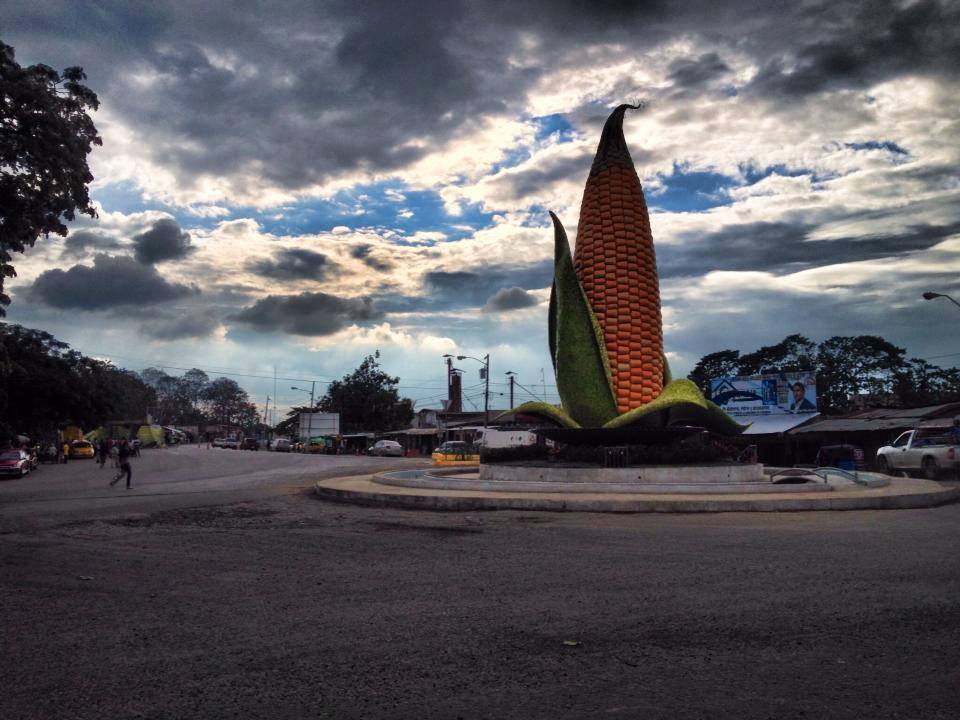
Ventanas covers 533.66 square kilometres and had 73,211 residents at the 2022 census. It became a canton on 10 November 1952, and rivers with names like Lechugal, Oncebí and Sibimbe run through it. At the edge of town, a giant ear of corn tells visitors what many local families live on.
Cocoa, though, was there long before the monument. A study on the history of the "golden bean" published by Ecuador's Ecotec University lists Ventanas, alongside Vinces, Babahoyo, Palenque, Baba, Puebloviejo and Catarama, among the areas where the 19th-century planter dynasties known as the Grandes Cacaos chose to build their estates.
The same paper explains where Ecuador's most famous cocoa label comes from. The first plantations appeared along the Guayas River in the early 1600s and spread upstream along its tributaries, the Daule and the Babahoyo. In foreign markets, those beans became known as "Arriba", Spanish for "upriver", and the name survives today as a mark of Ecuador's fine-flavour cocoa. Between 1880 and 1890, Ecuador was the largest cocoa exporter in the world.
A&D Sánchez Adsancocoa S.A. is a young name in that long story. According to its listing in the EMIS business database, it was incorporated on 12 November 2014, is headquartered in Ventanas and works in support services for crop production. It had 22 employees in 2024. Published reports on the award do not detail the flavour profile of its sample or the farm it came from, and we found no public statement from the company about the award.
The country's cocoa heartland
The gold landed on familiar ground. Los Ríos produces 26% of Ecuador's cocoa, about 120,985 tonnes, according to Anecacao figures published by Expreso in April 2025. It also has the largest planted area, 133,724 hectares, and the most growers: 29,375 families and businesses.
The province is home to a key cocoa breeding centre, the Pichilingue Tropical Experimental Station run by the national agricultural research institute, INIAP, near Quevedo. Clones bred there carry the letters EETP in their names, such as "Floral Pichilingue" and "Sabor Esmeralda", both released in October 2024 after more than twenty years of crosses and field trials.
Money explains why quality matters. In 2025, cocoa beans and cocoa products brought in $4.668 billion in exports, according to Central Bank figures cited by El Diario, overtaking bananas as the top foreign-currency earner among Ecuador's farm products. With world prices high, the temptation is to sell on volume. Awards like this one are a reminder that some buyers still pay for flavour.
This triple gold shows that Ecuador competes, and wins, at the highest international standards.
Merlyn Casanova, executive director of Anecacao
What a gold medal is worth on the farm
The programme's rules list what finalists receive: a detailed technical assessment of the physical and sensory quality of their beans, an official certificate, a winner's profile page and exposure to specialist buyers. For a mid-sized exporter in a farming province, a direct line to chocolate makers hunting for specific origins can be worth more than the trophy.
Much of the quality is decided after harvest. Julien Simonis, who manages the programme, told Anecacao's magazine that fermentation is where the compounds behind a chocolate's complexity are formed, and that it needs constant monitoring depending on the variety and the weather. He has sat on the competition's technical committee since 2017 and argues that collaboration along the supply chain can build a system that "values excellence over quantity".
Ecuador was not the only Latin American story that day. A family farm in San Vicente de Chucurí took silver, as we reported in A family farm in Santander wins silver among the world's best cocoa. Ecuadorian cocoa has also reached other big screens: a short film in the Shuar language about growing it played on the Piccadilly Lights, a story we told in Three minutes in Shuar.
What comes next
The award comes in a demanding year. In November 2026, Anecacao warned that El Niño rains could cut national output by more than 10%, and Los Ríos is among the provinces where rivers have burst their banks. High bean prices do not guarantee that the money reaches the people who prune and ferment.
What the gold does leave behind is a measurable benchmark. A sample from a district best known for its corn finished, in a blind tasting, among the 50 best cocoas from 45 origins. Other Ecuadorian products with a strong sense of place have earned similar recognition, like the blue cheese aged at 3,200 metres in Carchi, and across the border a Colombian coffee set a record at 151 dollars a pound.
The detail you may not know
"Arriba", now printed on chocolate wrappers around the world, is not a botanical variety. It is a geographical tag born on the docks: it was what international traders called the cocoa that reached Guayaquil from estates upriver, along the Daule and the Babahoyo, the same river that flows through Los Ríos and gives its capital its name. More than a century later, a sample from that same basin won again, in a tasting where nobody knew where it came from.
Go further
- Web · Alliance of Bioversity International and CIATCacao of Excellence
La página del programa explica cómo se organiza el concurso, el laboratorio de Roma y el trabajo con bancos de germoplasma.
- Web · Alliance of Bioversity International and CIATCacao of Excellence names 50 highest-ranking cacao producers in 2025 global evaluation
El comunicado oficial con las cifras de la edición 2025: 191 muestras, 45 orígenes y 50 premiados.
- Web · Alliance of Bioversity International and CIATCacao of Excellence Announces the Launch of the 2025 Edition
Las reglas del juego: comités nacionales, 7 kilos por muestra y qué reciben los productores.
- Web · Alliance of Bioversity International and CIATDiverse and sustainable cacao: The Alliance at Amsterdam Cocoa Week 2026
El programa de la semana en que se entregaron los premios, con la subasta de microlotes en la Beurs van Berlage.
- Web · AnecacaoRevista Anecacao n.º 29
Incluye la entrevista con Julien Simonis sobre fermentación y calidad, y el balance de Chokao 2024.
- Web · INIAPInstituto Nacional de Investigaciones Agropecuarias (INIAP)
El instituto que mejora clones de cacao fino de aroma en la estación de Pichilingue, en Los Ríos.
Sources
- Cacao of Excellence names 50 highest-ranking cacao producers in 2025 global evaluation (Alliance Bioversity–CIAT)
- Cacao de Ecuador: su sabor y aroma logran triple oro en el Cacao of Excellence (Expreso)
- Cacao ecuatoriano gana tres oros en certamen internacional (Primicias)
- Triple oro para el cacao ecuatoriano en el certamen Cacao of Excellence 2025 (KCH Comunicación)





