


 Have a great day, y'all!
The Wixárika people's 500 km sacred route is now World Heritage
On 12 July 2025 UNESCO inscribed the pilgrimage path to Wirikuta, linking 20 sacred sites across five Mexican states. Eight months later a court voided 44 mining concessions in the San Luis Potosí desert.

Every year, groups of Wixárika pilgrims leave the mountains where Jalisco, Nayarit and Durango meet and walk east towards the desert of San Luis Potosí, carrying gourd bowls, candles and offerings. On 12 July 2025, in Paris, that path of more than 500 kilometres was added to UNESCO's World Heritage List as the Wixárika Route through Sacred Sites to Wirikuta, or Tatehuarí Huajuyé: the Path of Our Grandfather Fire.
The World Heritage Committee took the decision at its 47th session, the same meeting that inscribed 26 new sites around the world. For Mexico it was property number 36. For the Wixárika people, known in Spanish as Huichol, it closed a campaign that had been running for roughly three decades.
- On 12 July 2025 UNESCO inscribed an Indigenous pilgrimage route that is still in use: 20 sacred sites across five states in north-central Mexico.
- It is Mexico's first associative cultural landscape on the list and, according to the Ministry of Culture, the first living Indigenous tradition recognised this way in Latin America.
- Mexico now has 36 World Heritage properties, the most in the Americas and the seventh-highest total worldwide, according to the national heritage institute INAH.
- In March 2026 a federal court in San Luis Potosí cancelled 44 of the 78 mining concessions covering Wirikuta.
A route with twenty stops
This is not a road or a waymarked trail. UNESCO calls it a "braid of trails" that begins in the Huichol Sierra, crosses several ecological regions and ends at Wirikuta in the Chihuahuan Desert. Travelling the other way, the ritual circuit is completed by sacred sites on the Nayarit coast and at Cerro Gordo in Durango.
There are 20 component parts. According to the INAH bulletin that announced the listing, Nayarit contributes Tatei Jaramara on the Pacific shore; Durango, Huaxa Manaka; Jalisco, Tuapurie; Zacatecas has six; and San Luis Potosí has eleven, including the three Huiricuta enclaves. That puts the heart of the property on the high plateau of San Luis Potosí, in the municipalities around the Sierra de Catorce.

The Committee applied two criteria. Under criterion (iii) it called the route "one of the most representative pre-Columbian routes still in use in the Americas". Under criterion (vi) it described the route as an outstanding example of how culture and nature intertwine in Wixárika spirituality, where hills, weather, plants and animals reveal the ancestors. Maize, deer, the golden eagle and peyote, which the Wixárika call hikuri, turn up at almost every stop.
The walk is also a classroom. The official listing notes that during the pilgrimage elders pass their knowledge to younger generations through stories, songs, dance and art. The mara'akate, or shamans, lead the sequence of rituals that gives each of the twenty sites its meaning.
This recognition is of the utmost importance for Mexico because it is the first time in all of Latin America.
Claudia Curiel de Icaza, Mexico's Minister of Culture, as quoted by Mexico News Daily
Thirty years in the making
The Wixárika formally approached Mexico's National Institute of Anthropology and History in 2003 to ask for protection, The Art Newspaper reported. The final nomination was drawn up with the Wixárika Regional Council, the Wixárika Regional Council for the Defence of Wirikuta, the National Institute of Indigenous Peoples, the Ministry of Culture and support from the civil organisation Conservación Humana.
The community behind it is small. Mexico's 2020 census counted around 60,000 speakers of the Wixárika language, most of them in northern Jalisco and neighbouring parts of Nayarit and Durango. For them the listing has a practical purpose: it is the strongest legal protection for heritage available under international law, and that is how the Regional Council itself framed it.
Francisco Vidargas, who heads INAH's World Heritage office, called it "an act of justice for the Wixáritari" and said the communities themselves will write the management plans according to their own traditions. Humberto Fernández, co-founder of Conservación Humana, told the same publication that "the inscription is legally binding", which puts the onus on the state to look after the route for the long term.
Not every voice was celebrating. The Union of Wixárika Ceremonial Centres of Jalisco, Durango and Nayarit argued that the process lacked enough community participation. Vidargas replied that talks with the group were continuing.

What came next: homework and a court ruling
The listing came with conditions. On 15 July 2025, at a press conference in Mexico City, UNESCO's representative in Mexico, Andrés Morales, set out six recommendations from the Committee, summarised in a second INAH bulletin:
- Ban mining inside the property and its buffer zones, and mitigate existing extraction.
- Tighten rules against urban sprawl along the path.
- Set up a management unit with a site manager and guarantee free passage along all 500 kilometres.
- Draft a management plan for each of the 20 components, with a visitor strategy that brings income to local Indigenous communities.
The sixth calls for stronger Wixárika participation in every decision. Some of the framework already exists: the Integrated Management, Conservation and Safeguarding Plan 2024-2030, drawn up with the communities, and a 2023 federal decree recognising the sacred places and pilgrimage routes of the Wixárika, Náayeri, O'dam and Mexikan peoples.
The most concrete result arrived eight months later. On 11 March 2026, the Fourth District Court of San Luis Potosí ruled on an amparo lawsuit that Wixárika communities had filed in 2011 against mining concessions in Wirikuta. According to Mexico News Daily, the decision voided 44 of the 78 concessions, every one that lay inside the state-designated protected natural area.
In a statement dated 30 March, the Wixárika Regional Council welcomed the court's recognition of the people's right to self-determination and to be consulted from the moment a concession is requested, as well as its order to translate the ruling into Wixárika. The council also said it would appeal the part of the decision that leaves concessions outside the protected area in force. It wants all of them cancelled, the reserve upgraded to federal status and UNESCO's recommendations carried out.
They are very important to us, and we cannot allow them to be destroyed.
Maurilio Ramírez Aguilar, coordinator of the Wixárika Regional Council, speaking to Mexico News Daily about the Wirikuta lands

Several fronts remain open. UNESCO's evaluation flags extractive mining, fences on private land that block access, urban growth, inappropriate tourism and peyote consumption by visitors. That last issue weighs heavily in Wirikuta, where hikuri is scarce and gathering it is a ritual act. Geographer Tunuari Chávez reminded Mexico News Daily that groundwater does not respect the boundaries of a protected polygon.
Mexico's listing joins other stories about living heritage that The Positive Way has covered this year: Cuenca's cooking joining UNESCO's Creative Cities network, Sweden returning looted objects to Benin and Bolivia and a short film shot in the Shuar language that reached Piccadilly. On a very different scale, the Sagrada Família marked its own milestone by reaching 172.5 metres.
Something you might not know
The sacred territory of Wirikuta covers more than 140,000 hectares of the Sierra de Catorce and its plains, spread across six municipalities in San Luis Potosí: Catorce, Charcas, Matehuala, Villa de Guadalupe, Villa de La Paz and Villa de Ramos, according to the Wixárika Research Center. In Wixárika cosmology it is the birthplace of the sun, and Cerro Quemado, one of its shrines, is the peak where the sun first rose. That is why the roughly month-long pilgrimage does not end on arrival. From the desert the path turns back towards the Nayarit sea and Cerro Gordo in Durango, closing the cycle that brings the rain and the maize harvest.
Go further
 YouTube · INAH TVSignificado de la ruta Wixárika por los sitios sagrados a Wirikuta
El INAH explica qué representa cada parada del camino y por qué la UNESCO lo considera un paisaje vivo.
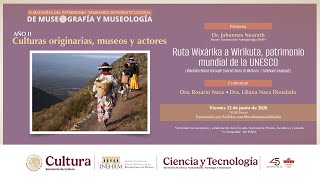 YouTube · Instituto Mora DifusiónConferencia: Ruta Wixárika a Wirikuta, patrimonio mundial de la UNESCO
Charla larga del antropólogo Johannes Neurath, del Museo Nacional de Antropología, para entender la peregrinación desde dentro.
- Web · UNESCO World Heritage CentreWixárika Route through Sacred Sites to Wirikuta (Tatehuarí Huajuyé)
La ficha oficial con mapas, criterios, documentos de la candidatura y galería de fotos.
- Web · Lugares INAHRuta Wixárika por los sitios sagrados hasta Wirikuta
Guía del INAH con los elementos simbólicos de la ruta: el agua de mar, el venado, las jícaras, las velas.
- Web · Wixárika Research CenterWhat is Wirikuta
Explica la geografía y el sentido sagrado de Wirikuta y distingue el territorio del Cerro Quemado.
- Web · The Art NewspaperWixárika Indigenous pilgrimage route in Mexico gains Unesco World Heritage designation
Reportaje con las voces del INAH, ICOMOS y el Consejo Regional Wixárika, incluidas las críticas al proceso.
Sources
- UNESCO World Heritage Centre: Wixárika Route through Sacred Sites to Wirikuta (Tatehuarí Huajuyé)
- INAH, Boletín 334: la Ruta Wixárika, inscrita en la Lista del Patrimonio Mundial (12/07/2025)
- INAH, Boletín 338: recomendaciones de la UNESCO para la Ruta Wixárika (15/07/2025)
- The Art Newspaper: Wixárika pilgrimage route gains Unesco World Heritage designation
- Mexico News Daily: Court ruling cancels dozens of mining concessions in Wirikuta (07/05/2026)
- Consejo Regional Wixárika: comunicado sobre la sentencia de Wirikuta (30/03/2026)





