


 Have a great day, y'all!
Milk for farewells, wine from abroad and a baby bottle: what Calescoves cave 45 held
Chemical tests on 34 vessels from a cliff tomb in Alaior show how Iron Age people on Menorca said goodbye to their dead more than 2,000 years ago.

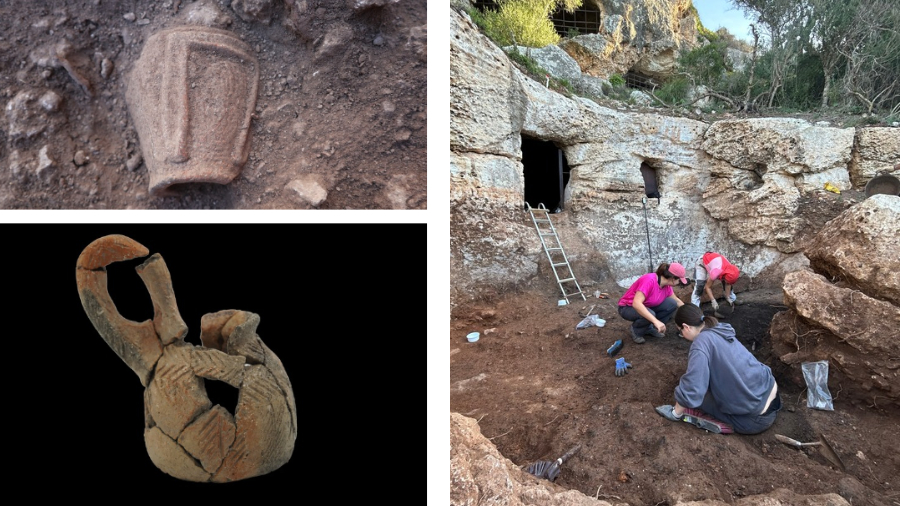
At the cove of Calescoves, in the municipality of Alaior on Menorca's south coast, the cliff is pocked like a honeycomb. More than a hundred caves were cut by hand into the rock over two thousand years ago to bury the dead. In front of one of them, cave 45, archaeologists Sònia Carbonell and Margalida A. Coll excavated a small open-air courtyard in 2023 and 2024. They found 34 ceramic vessels, many intact and some exactly where someone had set them down.
Now we know what was in them. A study published on 16 November in the Journal of Archaeological Science by researchers at the Barcelona Supercomputing Center, Pompeu Fabra University and the Autonomous University of Barcelona found milk, wine, animal fats and plant oils in the vessels. It is the first evidence that wine played a part in funerary rites on Menorca.
The essentials:
- 34 vessels from the courtyard of cave 45 were analysed; 24 were complete.
- The pottery dates from the 4th to the 1st century BC, the so-called Post-Talayotic period.
- About 70% of the high-footed cups typical of Menorca held dairy residues.
- Four pieces carried traces of wine, the first evidence of its funerary use on the island.
- A small spouted jug turned out to be a baby feeding bottle with milk fats.
A courtyard for the living, a chamber for the dead
Cave 45 has two parts. Inside is the burial chamber, carved into the stone, where bodies were laid. Outside, in front of the entrance, an open courtyard was cut into the rock. Excavating that courtyard, the eastern half in 2023 and the western half in 2024, allowed something unusual in archaeology: recovering a large, coherent set of vessels, many still in their original positions.
That context is gold for anyone studying ritual. A broken pot in a rubbish heap says little about how it was used. An intact cup placed by the door of a tomb speaks of a specific gesture.
The team proposes that inside and outside served different purposes. Objects that accompanied the dead, such as the feeding bottle, stayed in the chamber. The courtyard vessels reflect what the living did at the tomb's threshold: offerings, shared drinking, farewells. The courtyard, put simply, was the place of mourning.
Milk in the high-footed cups
The most characteristic piece in the set is the high-footed cup, a tiny vessel with very little capacity, typical of Menorcan culture. About 70% of those analysed held traces of dairy products. Milk, or something made from it, was the most common offering.
Other types turned up alongside them. There are truncated-cone vessels, found across the Balearics, and so-called incense burners, a form known only from Menorca. In the one tested, residues were plant-based and possibly oily, with no burn marks, which calls into question a name given out of habit. Three vessels held only tiny amounts of fat, and 17 showed organic acids that may come from fruit, though they could not be traced to grapes.
"This feeding bottle speaks to us of child-rearing and care."
Margalida A. Coll Sabater, Department of Humanities, Pompeu Fabra University (our translation)
The feeding bottle deserves its own paragraph. It is a little globular jug with a pouring spout. It held milk fats and no trace of plant oil, confirming it was used to feed small children. Its presence in a tomb is one of those small clues that bring people from two thousand years ago closer: someone placed beside the dead the object used to feed them.

The wine that came by sea
The most striking finding sits in just four vessels: two small one-handled jugs, a larger handmade jug and a bowl. They held traces of wine. One of the jugs also contained milk.
What matters is the type of pottery. These are not imports but what the team calls "inspired" wares: pots made on the island that copy forms from other Mediterranean cultures, mostly Punic, the culture of Carthage and its colonies. The only clearly imported piece in the set, a wheel-made cup, held no wine; its residues were plant-based.
"The island's inhabitants adopted foreign ceramic forms and continued to use them for wine, precisely the substance for which they were originally designed."
Sònia Carbonell Pastor, Barcelona Supercomputing Center
The most likely explanation, the authors say, is trade. Carbonell puts it this way: the wine "probably reached the island through trade networks". In those centuries Ibiza was a Punic outpost, and vine growing there picked up from the 4th century BC. Contacts between the islands and Carthage were close: Balearic slingers, famed for their aim, served as mercenaries in Carthaginian armies.
The study does not read the wine as a cultural break. Menorcans took it up in their own way, in their own pots and alongside the milk they had always offered.
"The incorporation of wine does not seem to imply a replacement of local traditions."
Sònia Carbonell Pastor (our translation)
How to read an empty pot
The technique behind the study has an unpoetic name: organic residue analysis. It rests on a simple fact. Unglazed pottery is porous, and when it holds milk, oil or wine, a small share of those substances soaks into the vessel wall. There, shielded from light and air, some molecules can survive for thousands of years.
In the lab, those molecules are extracted from a powdered fragment of pottery and identified with analytical chemistry. Fats, for instance, have different profiles depending on whether they come from milk, meat or plants. For wine, archaeologists usually look for markers such as tartaric acid, which is abundant in grapes and scarce in other Mediterranean fruit. That is why the team can say that 17 vessels held acids probably from fruit, but not that the fruit was grapes.
It is slow work, and destructive: each test uses up part of an object more than two thousand years old. Which is why the next step matters.
Archaeologists have used this approach elsewhere to trace the first dairy farmers in Europe, the spread of olive oil and the arrival of wine in places where no amphorae survive. What makes the Menorcan case useful is the context: not scattered sherds from a rubbish pit, but a group of vessels left on purpose in one place, for one kind of occasion. The chemistry and the setting reinforce each other.
One test for two substances
Behind the result lies a small technical step forward. The vessels were so small that there was little material to sample. Detecting dairy and detecting wine normally takes two separate chemical procedures, and twice as much sample.
"In the UAB laboratories we managed to combine them into a single procedure."
Adrià Breu Barcons, Department of Prehistory, Autonomous University of Barcelona (our translation)
Combining them halved the amount of pottery that had to be sacrificed. Before that, each piece was scanned and micro-excavated in the lab, with the soil inside removed layer by layer. According to the UAB, it is the first organic-residue study of such a large and coherent Menorcan set.
The project, Ritual and funerary practices at Calescoves: excavations in the courtyard of cave 45, is led by Carbonell and Coll and funded by the Consell Insular de Menorca, the island's council.

Calescoves, a cemetery with sea views
Calescoves is one of the best-known funerary sites of Balearic prehistory. Two small coves open into a ravine on the south coast, and the caves were cut into its walls during the Iron Age. Some are simple chambers; others, like cave 45, have a courtyard, a worked façade or several rooms.
The site has drawn researchers for decades. The priest and archaeologist Cristóbal Veny excavated several tombs in the 1970s and published a monograph on the necropolis in 1982. Since then archaeology has changed its toolkit. Today it is possible to know what was inside a cup even when nothing visible remains, thanks to molecules the pottery absorbs and keeps for centuries.
The vessels' dates, from the 4th to the 1st century BC, place the ritual in the islands' last centuries of independence. In 123 BC the Roman general Quintus Caecilius Metellus conquered the Balearics. Cave 45 therefore shows a society open to the Mediterranean, with active trade links, that still kept its own way of saying goodbye.
Menorca has worked hard to protect that past. The sites of Talayotic Menorca were added to UNESCO's World Heritage List in 2023, and the island has been a biosphere reserve since 1993. Every new excavation with modern methods adds layers to a story that until recently was told almost entirely from stones.
We have followed other finds that read the past with new techniques, such as the 2,500-year-old bronze cart from Casas del Turuñuelo in Extremadura and the 694 Visigothic graves now on show in Madrid. In the Balearics, science also watches today's shoreline: an AI from SOCIB traces beaches using bathers' phone photos.
What we still don't know
The study leaves open questions. Nobody knows how many people were buried in cave 45, or whether milk offerings were made at every funeral or only on special dates. Nor can the team say where the wine came from or whether it was mixed with anything. The organic acids found in 17 vessels point to fruit, but the analysis cannot say which.
The team plans to compare these results with other courtyards at Calescoves and with cemeteries on Mallorca and Ibiza. If the pattern repeats, it will help map in more detail how wine spread through the islands and what place it held in the beliefs of those who drank it, or offered it.
The detail you might not know
For decades, archaeologists called one type of vessel with pierced side handles, found only on Menorca, an "incense burner". The name assumed it was used to burn fragrant substances. In cave 45 the example tested had no burn marks at all, and its residues were plant-based and possibly oily. Here, chemistry is questioning a label inherited out of habit.
Further reading
Go further
- Web · Universitat Autònoma de BarcelonaLeche y vino para el ritual funerario menorquín de hace más de 2.000 años
La nota oficial con las fotos de la excavación y de las vasijas.
- Web · Carbonell Pastor, Coll Sabater y Breu BarconsMilk and wine for the departed: Menorcan funerary idioms during the late Iron Age
El artículo científico en Journal of Archaeological Science.
- Web · Agencia SINCHallan leche y vino en rituales funerarios de Menorca hace 2.000 años
Resumen claro de la agencia pública de noticias científicas.
- Blog · La Brújula VerdeCups with traces of milk and wine and a 2,000-year-old feeding bottle
Desglose vasija por vasija de los resultados, en inglés.
- Web · Menorca TalayòticaThe Inscriptions of the Cova des Jurats
Documental sobre otra de las cuevas de Calescoves y sus inscripciones.
- Blog · Camí de Cavalls 360Calescoves, a natural and archaeological treasure
Para quien quiera llegar caminando por el sendero que rodea la isla.




