


 Have a great day, y'all!
A dog shelter born after Ecuador's 2016 quake is now a protected forest
On 13 October 2025 Ecuador declared the 129.87 hectares of dry forest at the El Perro Feliz sanctuary, in Manabí's Sucre canton, a legally protected forest, with more than 88% set aside for strict conservation.

In April 2016, on the outskirts of Bahía de Caráquez, a handful of local residents began picking up dogs wandering among collapsed houses. Nine years later, that makeshift shelter holds a status few private plots on Ecuador's coast ever reach: on 13 October 2025 the state formally declared it a protected forest.
That Monday, Ecuador's Ministry of Environment and Energy handed over the ministerial agreement recognising the Santuario de Vida El Perro Feliz ("Happy Dog Life Sanctuary"), in the Sucre canton of Manabí province, as a Bosque y Vegetación Protectora, the country's legal category for protected forest and vegetation. The designation covers 129.87 hectares of tropical dry forest, which from that day became part of the national forest estate under legal protection, as reported by Teleamazonas and Primicias.
- What: a 129.87-hectare private property in Manabí becomes a legally protected forest through a ministerial agreement.
- When: the designation was made official on 13 October 2025.
- How it will be used: more than 88% of the land is set aside for strict conservation and 13 hectares for forest restoration.
- Why it matters: it shields a fragment of dry forest, one of Ecuador's most fragile ecosystems, surrounded by cleared land.
- With this addition, the national network now counts 174 protected forests, according to the ministry.
What the designation changes
A protected forest and vegetation area is one of the conservation categories within Ecuador's National Forest Heritage. It does not turn land into a national park, nor does it expropriate it. The property stays in private hands, but its owners commit to managing it under a state-approved plan whose main purpose is to protect water, soil, plants and wildlife.
According to the official procedure page on the government portal gob.ec, applicants must prove ownership and submit a technical justification signed by a qualified professional, a baseline survey of the area with coordinates, and an integrated management plan with zoning. The resulting agreement is entered in both the property register and the forest register, has no expiry date, and requires the plan to be updated every five years.
In practice, anything other than conservation, research, low-impact tourism or restoration needs the ministry's prior approval. For a forest that in recent years has been hemmed in by chainsaws, maize fields and farm burning, that is a layer of legal security it simply did not have before.
The approved zoning dedicates most of the property to strict protection and allocates 13 hectares to forest restoration, meaning trees will be brought back to areas that were logged or degraded. The ministry presented it as an ecological corridor and a "living classroom" for environmental education.
At the same event, the ministry also granted an operating permit to the Casa Beatriz ex situ conservation centre, a butterfly house on the lower part of the property that is used for environmental education with the local community.
From emergency shelter to dry-forest reserve
The story begins with the earthquake of 16 April 2016, which struck Manabí's coast hard. Dozens of ownerless dogs were left among the rubble. A group of people, including Verónica Fernández Orrantia, opened a shelter on less than ten hectares of land at kilometre 8 of the road to Bahía de Caráquez.
It grew quickly. In 2022, the Guayaquil newspaper Expreso reported that the foundation was caring for around 500 animals on 32 hectares planted with native species, funded by sponsors giving 20 dollars a month and by sales of a book of rescue stories. Current reports put the number at between 800 and 900 dogs, alongside cats, donkeys, chickens and pigs, all receiving veterinary and surgical care, with an adoption programme running alongside.
The leap from animal shelter to forest reserve happened almost by chance. Fernández told Primicias that when the shelter covered 32 hectares, the neighbouring 103-hectare plot held about 260 guayacán trees, 20 to 25 years old, already numbered for felling. By her account, she stood in front of the tractor to stop it, and she and her husband then bought the land to save it.
"When we had 32 hectares, the land next to El Perro Feliz had 103."
Verónica Fernández, co-founder of the sanctuary, speaking to Primicias
Once the forest was protected, its residents became visible. The sanctuary's team has recorded ocelots, pumas and peccaries, as well as giant anteaters, squirrels, parrots, coral snakes, woodpeckers, owls, native stingless bees and capuchin monkeys, a species Primicias describes as threatened. Fernández estimates the forest holds around 240 species of trees and shrubs.
Why a dry forest in Manabí matters
Tropical dry forest is not much to look at for a good part of the year. In the dry season many trees shed their leaves and the hills turn grey. Yet it harbours species found nowhere else in Ecuador and plays a key role in holding soil and water on a coast where rain falls in short, intense bursts.
It is also among the most pressured ecosystems in the country. In a Mongabay Latam report, the Ministry of Environment estimated that Ecuador had about 41,000 hectares of deciduous dry forest, a little over half of it inside the national protected areas system. The same report cited a study of southern Ecuador finding that human-driven deforestation was removing around 71 square kilometres of dry forest a year, more than three times the loss attributed to climate change.
In Manabí, the flagship for protecting this ecosystem is Machalilla National Park. Outside state reserves, conservation depends largely on private landowners and communities, and that is where tools like the protected-forest designation matter: they lock in fragments that, small as they are, serve as refuges and stepping stones for wildlife.
El Perro Feliz is exactly that kind of fragment, an island of trees in open farmland. "All around it, everything is completely deforested," Fernández told Primicias.
A network that now counts 174 forests
With this designation, Ecuador's National Network of Protected Forests and Vegetation reaches 174 areas, according to figures the ministry shared at the ceremony. Many of its pieces are private or communal properties whose owners voluntarily bind themselves to a long-term conservation plan.
The agreement was presented by Deputy Environment Minister Daniela Limongi. The procedure is open to Ecuadorian or foreign individuals and to private legal entities that can prove ownership, which leaves the door open for other coastal landowners to follow the same path.
For readers following Ecuador's environmental good news, the case sits alongside other recent efforts, such as the survey looking for geothermal energy beneath a Galápagos volcano to cut the islands' reliance on diesel, or the forest-friendly cacao portrayed in the Shuar-language short film that reached Piccadilly. It is also a reminder that sustained protection pays off over time, as the recovery of Antarctic blue whales shows.
What remains to be done
The designation is a starting point rather than a finish line, and the threats remain just beyond the fence. From December to April neighbouring plots are planted with maize, and for the rest of the year they lie bare, while expanding farmland presses on the forest's edges. Agricultural burning, legal in some circumstances, easily gets out of hand: Fernández said that in 2024 one such fire came close to reaching the forest.
The foundation relies on donations to feed and treat hundreds of animals, and in 2025 its mobile veterinary clinic was barely able to operate because of insecurity in the area, according to Primicias. During the dry season, the team sets out water troughs in the forest for wild animals.
The founders aim to keep buying adjacent land and, with state support, to promote a biological corridor along the Cordillera del Bálsamo, a chain of coastal hills stretching north towards Esmeraldas. For now this is an aspiration, not an approved project. Visits are arranged through the forest's social media: the butterfly house is open to the public, while hikes on the trails, which are not easy, depend on group size and purpose.
The detail you might not know
The sanctuary was created to save dogs, not trees. But the decision to buy a neighbouring plot to stop 260 guayacán trees from being felled multiplied its original area more than tenfold and ended up turning an emergency shelter into a legally protected dry forest home to pumas and ocelots. In 2016 it covered under ten hectares; in October 2025, the state recognised nearly 130.
Go further
 YouTube · petepuaAlbergue Animal El Perro Feliz. Conoce la historia de estos Héroes Sin Capa de Ecuador
Recorrido por el albergue y la historia de quienes lo sostienen, antes de la declaratoria.
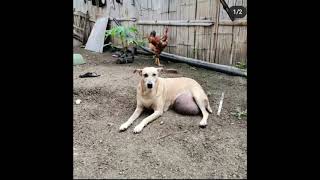 YouTube · El Perro Feliz¡La historia de Sara! Albergue El Perro Feliz
Un caso de rescate contado por el propio canal del santuario.
- Web · PrimiciasEl bosque protector El Perro Feliz y sus especies
Reportaje sobre la fauna, las amenazas y el corredor que sueñan sus fundadores.
- Web · Ministerio del Ambiente y Energía (gob.ec)Declaratoria de Bosques y Vegetación Protectores
Requisitos oficiales para que cualquier propietario proteja su bosque con esta figura.
- Blog · Antonio Paz Cardona, Mongabay LatamUna oportunidad para salvar el bosque seco de Ecuador
Contexto sobre por qué el bosque seco ecuatoriano es tan valioso y tan vulnerable.
- Web · Santuario de Vida El Perro FelizBosque El Perro Feliz en Instagram
Canal para coordinar visitas al mariposario y a los senderos.
Sources
- Ministerio del Ambiente y Energía: Declaratoria de Bosques y Vegetación Protectores
- Teleamazonas: Gobierno declara 129 hectáreas como nuevo bosque protector en Manabí
- Primicias: Así es el Santuario de Vida El Perro Feliz, el nuevo bosque protector de Manabí
- Primicias: El bosque protector El Perro Feliz y sus especies
- Vistazo: El Santuario de Vida El Perro Feliz en Manabí ya es bosque protector
- Expreso (2022): el albergue El Perro Feliz y su libro de 20 historias





