


 Have a great day, y'all!
One case in 2,091 children: El Salvador becomes Central America's first trachoma-free nation
On 13 July 2026 WHO validated El Salvador as having eliminated trachoma, the world's leading infectious cause of blindness. It is the first Central American country, and the second in the Americas, to do so.
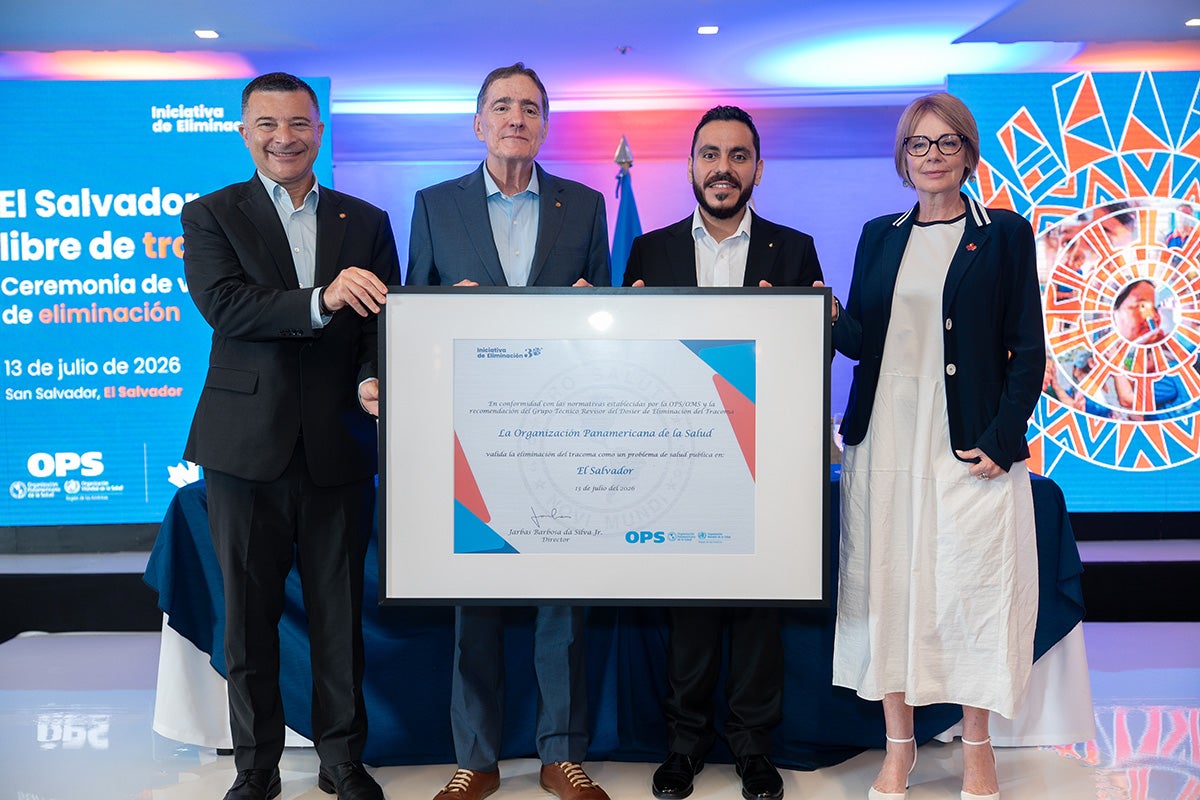
Health teams went door to door in twelve rural municipalities of El Salvador, turning back the eyelids of 2,091 children. They found a single case of trachoma-related inflammation. Among 1,016 adults checked for the blinding stage of the disease, they found none. On the strength of those numbers, the World Health Organization validated on 13 July 2026 that the country has eliminated trachoma as a public health problem.
El Salvador is the first country in Central America to reach that status and the second in the Americas, nine years after Mexico. The certificate, signed by Pan American Health Organization (PAHO) director Jarbas Barbosa, was handed over at a ceremony in San Salvador that same Monday.
- What: WHO confirms that trachoma, the world's leading infectious cause of blindness, is no longer a public health problem in El Salvador.
- When: 13 July 2026, after assessments carried out between 2023 and 2026.
- How it was measured: 3,248 people covered across 12 evaluation units in five departments.
- Result: one case of inflammation in children, zero cases of trichiasis in adults.
- Who: the Ministry of Health, with technical support from PAHO and funding from the Government of Canada.
What is trachoma, and why did it matter?
Trachoma is caused by the bacterium Chlamydia trachomatis. It spreads through contact with discharge from the eyes and nose of an infected person, carried on hands, clothes, towels or flies that land on the face. One infection rarely leaves lasting harm. Repeated ones do.
Each bout scars the inside of the eyelid. Over the years the scarring folds the lid inward until the lashes scrape the eyeball with every blink. Doctors call that stage trachomatous trichiasis, and without surgery it leads to permanent blindness.
The WHO fact sheet puts the toll at about 1.9 million people who are blind or visually impaired because of the disease. It is tied to poverty, thriving where clean water, sanitation and nearby clinics are scarce, and it concentrates in rural, remote and indigenous communities.
El Salvador was never on the list of known hotspots in the Americas. What it lacked was proof, gathered in its most isolated villages, that the disease was absent. It set out to get that proof in 2023, when it joined the Initiative for the Elimination of Trachoma in the Americas, a PAHO programme funded by Canada.
How do you prove a disease is gone?
You start by deciding where to look. The Ministry of Health set up a national technical committee with academic, community and international partners, and built a territorial vulnerability index. It weighed poverty, access to water and sanitation, and geography to flag the places where trachoma would most likely be hiding, if it existed at all.
That produced 38 priority communities in five departments: Ahuachapán, Chalatenango, Morazán, San Miguel and Usulután, according to PAHO's country fact sheet. They are spread across the west, north and east of the country.

In 2024 and 2025, doctors, nurses and community health promoters trained to the standards of Tropical Data, the platform behind trachoma surveys in dozens of countries, worked through those communities house by house. Children aged 1 to 9 had their inner eyelids checked for inflammation. People over 15 were checked for in-turned lashes.
The International Coalition for Trachoma Control (ICTC) published the breakdown: 3,248 people covered, 2,091 children examined with just one case of follicular inflammation, and 1,016 adults with no trichiasis at all.
WHO sets three tests for validation. Inflammation must be under 5% in children in every formerly endemic district. Trichiasis unknown to the health system must be under 0.2% in people aged 15 and over. And there must be a system able to find and treat any new cases. El Salvador met all three.
The survey teams also used the visits to test adults' eyesight, give vaccinations, sample drinking water and control the mosquito that spreads dengue.
This validation reflects El Salvador's commitment to reaching populations in the most vulnerable conditions.
Jarbas Barbosa, PAHO director
Why does it matter beyond El Salvador?
The club is small. The ICTC counts El Salvador as the 32nd country validated by WHO for eliminating trachoma, alongside nations such as Morocco, Ghana, India, Viet Nam and Pakistan. In the Americas only Mexico had done it before, on 24 April 2017, after closing its last focus in Chiapas: 246 communities where new cases dropped from 1,794 in 2004 to zero in 2016.
"We are proud to have reached this achievement in just three years," Health Minister Francisco Alabí said in PAHO's release. The validation also places the country among 64 nations that have eliminated at least one neglected tropical disease, seven of them in the Americas.
The global trend points the same way. In January 2026, WHO reported that the number of people needing trachoma interventions had fallen below 100 million for the first time: 97.1 million in November 2025, down from 1.5 billion at risk in 2002. That is a 94% drop.
I congratulate El Salvador on this remarkable achievement.
Tedros Adhanom Ghebreyesus, WHO Director-General
Across the region, trachoma remains a problem in rural and remote parts of Brazil, Colombia, Guatemala and Peru, and PAHO is investigating whether it is present in Bolivia, Ecuador, Guyana, Panama, Paraguay and Venezuela. San Salvador became a reference point almost at once: from 13 to 15 July it hosted the regional meeting of trachoma programme managers, with delegations from ten countries.
At that meeting Martha Saboyá, PAHO's senior adviser on disease elimination, argued that ending trachoma takes far more than interventions aimed at a single disease. The approach is to use every survey as a way to bring vaccines, safe water and primary care to villages the health system rarely reaches. It echoes the path taken by Suriname against malaria and by Barbados against mother-to-child HIV.

What happens next?
Validation is not the finish line. WHO asks countries to keep up surveillance and permanent access to eye care so the disease cannot creep back. El Salvador has pledged to fold that surveillance into primary care and to use its health system's electronic records to flag any suspected case.
The follow-up plan, branded the National Elimination Plan 30+, includes ongoing staff training, a national eye-health strategy, and integrated care for other infections such as intestinal worms, hepatitis B and Chagas disease.
ICTC chair Michaela Kelly said the result "underscores the value of epidemiological assessment". Sometimes good news comes from proving, with data, that a problem is no longer there.
The global target is to eliminate trachoma as a public health problem by 2030. WHO estimates that about US$300 million is still needed to close the funding gap. Medicine is not the bottleneck: Pfizer has donated more than 1.1 billion doses of the antibiotic azithromycin through the International Trachoma Initiative. Other recent gains against neglected diseases, such as a public university in Medellín making malaria pills, point the same way: get treatment and surveillance to where people live.
The detail you might not know
Since 2012, someone somewhere has been examined for trachoma every 25 seconds on average, according to WHO. Tropical Data has supported more than 4,000 surveys in 55 countries, checking over 13.1 million people. The 3,248 Salvadorans examined are a drop in that ocean, but they were enough to close the case. Other stories of the same kind, like Timor-Leste's victory over malaria, follow the same rule: measure first, certify after.
Further reading
Go further
 YouTube · PAHO TV (OPS/OMS)El Salvador y su camino hacia un futuro libre de tracoma
Reportaje de la OPS con las brigadas que recorrieron las comunidades salvadoreñas buscando la enfermedad.
- Web · International Coalition for Trachoma ControlTrachoma is not a public health problem in El Salvador, WHO confirms
La explicación más detallada del método: cuántas personas se examinaron y qué se encontró.
- Web · OPS/OMSIniciativa para la Eliminación del Tracoma en las Américas
Situación país por país del programa regional que acompañó a El Salvador.
- Web · OPS/OMS en FlickrÁlbum de fotos: El Salvador elimina el tracoma
Galería oficial con imágenes del trabajo de campo y de la ceremonia.
- Web · Organización Mundial de la SaludTrachoma: fact sheet
Todo lo básico sobre la enfermedad, la estrategia SAFE y los países que ya la eliminaron.
- Web · Organización Mundial de la SaludGlobal population requiring interventions against trachoma falls below 100 million for the first time
El contexto mundial: una caída del 94 % de la población en riesgo desde 2002.
Sources
- OPS/OMS: El Salvador es validado por la OMS por haber eliminado el tracoma como problema de salud pública
- ICTC: Trachoma is not a public health problem in El Salvador, WHO confirms
- El Diario de Hoy: la OMS valida que El Salvador eliminó el tracoma
- OPS: Hoja informativa sobre el tracoma en El Salvador (2026)





