


 Have a great day, y'all!
A robot named Salvapoy brings El Salvador its first world youth robotics gold
Five students from Soyapango, trained by the Fundación Salvador del Mundo, won gold at the 2026 FIRST Global Challenge in Incheon, South Korea, in an alliance with Venezuela, Uzbekistan and Moldova. It was the country's ninth appearance at the event.

The robot was called Salvapoy, and its job was easy to describe and hard to pull off. Scoop up foam balls standing in for flames, carry them to suppression units, and finish each match by climbing a frame. On 10 October, at the Songdo ConvensiA convention centre in Incheon, South Korea, that machine, built in the Salvadoran city of Soyapango, ended the final of the FIRST Global Challenge on the gold-medal alliance.
It was El Salvador's ninth appearance at the youth robotics championship, which brings together national teams from more than 190 countries. It had never finished on top before.
- Five students from the Fundación Salvador del Mundo (FUSALMO) won gold at the 2026 FIRST Global Challenge, held in Incheon from 7 to 10 October.
- They played alongside the national teams of Venezuela, Uzbekistan and Moldova, because this tournament is won by alliances, never by a single country.
- Their robot, Salvapoy, went through three prototypes in roughly three months.
- El Salvador has competed since 2018 with students trained in an after-school programme that reached 4,850 children and young people in 2025.
This year's challenge, titled Igniting Innovation, was about wildfires: how to prevent them, how to limit the damage and how to restore the land afterwards. Every team received the same standard kit of parts and had to design, build and program a robot able to work on a field that simulated a burning forest, as the organiser FIRST Global explained when it announced the host city in March.
There were 500 foam balls on the field, each one a piece of fire. The robots had to act like a fire crew, collecting the balls, hauling them and firing them into suppression units, while one team member, known as the human player, fed material in from the sideline.
Building a winning robot in Soyapango
The Salvadoran delegation was small: five students aged 16 to 18 from the Nova X team in Soyapango, plus their mentor. Each had a set role. There was a captain, a programmer, a mechanics lead, a driver who steered the robot with a controller and a human player who kept the machine supplied from the edge of the field, according to a feature in elsalvador.com.
Getting there meant clearing several hurdles. The first was the Crea league of the STEAM Maker Challenge, the national robotics competition FUSALMO runs every year. The senior round took place in early June at the Multigimnasio Don Bosco with 51 teams, who played the DECODE game from the 2025-2026 FIRST Tech Challenge season, Diario El Mundo reported.
Then came a two-day bootcamp. Candidates took robots apart and rebuilt them, solved technical problems against the clock, defended their work before an outside jury and proved they could handle a second language and the competition's official rulebook, Infobae reported. The language test was practical. In Incheon, game plans with alliance partners were worked out in English, often minutes before a match.

Salvapoy's design grew out of an internal contest held on 26 August, where the foundation's teams showed off prototype launchers, extending arms and climbing systems. The best ideas were folded into one machine. The final version had an intake, a launcher, a climbing frame and a mechanism that decided whether stored balls were fired or handed back to the human player.
There were three prototypes before the one that flew to Korea. Some mechanisms failed and had to be rebuilt, and during testing the robot fell over more than once. Several members of the team had never worked with a robot before they joined the programme.
What struck me most was realising I could go from having an idea to turning it into something real.
The Salvadoran team's mechanics lead, speaking to elsalvador.com
The team's mentor, Stephanie Orantes, knows the route from the inside. She joined FUSALMO at 15 and captained El Salvador's team at the 2023 Singapore and 2024 Greece editions, according to the team's official profile on the FIRST Global website. Now she coaches the next group. "I started at FUSALMO when I was fifteen, and it changed how I saw technology," she told Infobae in February.
A medal won with strangers
The FIRST Global Challenge has one rule that sets it apart from almost every other contest: nobody wins alone. In each match, several national teams form a temporary alliance and score together. That forces teenagers who share neither a language nor a culture to agree, quickly, on who collects, who shoots and who climbs.
In the final, El Salvador's partners were Venezuela, Uzbekistan and Moldova. According to the South Korean weekly Economist Korea, silver went to an alliance that included the United Arab Emirates, Japan and Luxembourg, and bronze to one made up of China, Turkmenistan, the Cayman Islands and Türkiye.
These were strong partners. Uzbekistan won all 16 of its matches, scored 637 points and also took the award for the highest cumulative score of the tournament, UzDaily reported. Moldova arrived with eight golds, the best record in the event's history, and left with a ninth, according to FinChannel. Its team, drawn mostly from the rural community of Boșcana, also presented Ember Mesh, a network of sensor capsules that detect fires under the forest canopy.
For El Salvador, the pairing carried a practical lesson. A country whose educational robotics programme is nine years old shared the top step with Moldova, which has spent more than a decade building a national network of over 270 robotics clubs and 60,000 students.
InstagramVer en Instagram ↗On 10 October the foundation broke the news on X in capital letters: "¡EL SALVADOR CONQUISTA EL ORO EN FIRST GLOBAL 2026!" (El Salvador wins gold at FIRST Global 2026). The Foreign Ministry shared the result two days later, and the ambassador to Korea, Federico Guerrero, congratulated the delegation, which the embassy had supported during its stay, elsalvador.com reported.
Nine appearances, one gold
The Incheon medal is the latest point on a line that started eight years ago. This is the Salvadoran team's record at the tournament, based on its profile published by FIRST Global:
- 2018, Mexico City: the team's debut.
- 2019, Dubai, United Arab Emirates.
- 2020 and 2021: virtual editions during the pandemic.
- 2022, Geneva, Switzerland.
- 2023, Singapore.
- 2024, Athens, Greece.
- 2025, Panama City.
- 2026, Incheon, South Korea: gold with Venezuela, Uzbekistan and Moldova.

Behind that list sits an organisation that rarely shows up in podium photos. FUSALMO is a non-governmental group founded in 2001, inspired by the Salesian order, with centres in Soyapango, Santa Ana and San Miguel. It says it has reached more than 550,000 children and young people over 25 years and currently works with about 5,000 students aged 4 to 35, figures its executive director, Lilia Ivette Padilla, shared with Infobae in February.
Its robotics programme, the STEAM Maker Academy, has run since 2017. It teaches mechanics, coding and 3D printing outside school hours and, by the foundation's own count, served 4,850 children, teenagers and young adults in 2025. The team's FIRST Global profile mentions 571 public-school students in the competitive track, with strong representation from Soyapango, San Miguel and Santa Ana, and two stated aims: narrowing the digital divide and getting more girls into science and technology.
The base of the pyramid is wide. The second STEAM Maker Challenge, which the foundation bills as the country's largest robotics competition, brought together 187 teams in June across four age leagues: Comparte (ages 4 to 6), Sueña (7 to 10), Transforma (11 to 13) and Crea (14 to 17). Its 653 participants had completed seven months of training, Infobae reported in May.
We want young people to develop interpersonal skills and resilience.
Lilia Ivette Padilla, executive director of FUSALMO
The foundation is open about its limits. The cost of robotics equipment is its biggest logistical hurdle, Padilla acknowledged, and its website devotes a full page to recruiting sponsors for everything from renting the competition venue to the national team's plane tickets. The programme's deputy director, Marian Rodríguez, put the results this way in May: since it began, the STEAM Maker Challenge has had a visible effect on students' technical skills.
That kind of groundwork has paid off elsewhere in the region, as The Positive Way has reported: from the 100-gram robot from Quito that beat entrants from 34 countries in Romania to the Costa Rican rocket with a homemade motor that won in Mexicali and the ESPOL team that won a programming contest with no automated help.
What Incheon leaves behind
The Korean edition drew around 2,000 young competitors and close to 3,000 family members and staff, according to the Incheon city government. It was the first time South Korea had hosted the championship, which began in Washington in 2017 and has since travelled to Mexico City, Dubai, Geneva, Singapore, Athens and Panama.
The individual awards brought more good news for Latin America. Mexico won the Albert Einstein Award, which recognises a national team's all-round excellence, and the Cayman Islands took the new-technologies category, the part of the event in which each team proposes real solutions to wildfires in its own country, Economist Korea reported.
Two more announcements came at the closing ceremony. First, Madrid will host the 2027 edition. Second, FIRST Global and the International Telecommunication Union's AI for Good initiative agreed to expand robotics and AI education for young people. FIRST Global will supply 60 robotics kits to the finalists of a youth challenge to be held in Geneva from 21 to 24 June 2027. The musician will.i.am, a FIRST Global board member, attended the event.
The gold comes as Salvadoran technical education looks increasingly towards Korea. Twelve days after the final, on 22 October, the technical college ITCA-FEPADE opened a training centre for robotics, artificial intelligence and smart manufacturing on its Santa Tecla campus, built with support from the Korean cooperation agency KOICA. The project totals 5.8 million dollars across the building, equipment, two new technical degrees and teacher training, with advice from Hanyang University, according to El Diario de Hoy.
For the five teenagers from Soyapango, the next step is more personal. The team's programmer, who has trained with the foundation for three years, has said she wants to study computer science engineering. A member of last year's national team, a student from eastern El Salvador who competed in Panama, told Infobae in May that he hopes to study mechatronics or electrical engineering.
Patient work has paid off for El Salvador in other fields recently too. In July, the country became the first in Central America to eliminate trachoma as a public health problem. And next door, Guatemala has just written its national scholarship fund into law, another way of opening doors to science careers.
The Incheon medal fits in one hand. The robot that won it, built from standard parts after three discarded versions, has gone home to Soyapango, where the next Crea league generation will soon start work on the 2027 challenge. This time the destination is Madrid.
Further reading
- FIRST Global Challenge: the tournament's official site, with rules, past editions and details on Madrid 2027.
- FUSALMO's STEAM Maker Challenge: the national competition that produced El Salvador's team, and how to support it.
- Team El Salvador on FIRST Global: the team's history, mentors and programme goals.
- How Salvadoran robotics learners won gold in South Korea: elsalvador.com's account of how Salvapoy was built (in Spanish).
- FUSALMO bets on robotics and AI: Infobae's interview with the foundation's leadership and mentors (in Spanish).
Go further
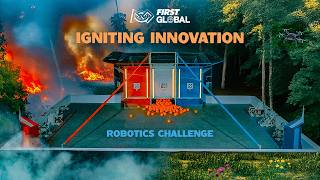 YouTube · FIRST GlobalIgniting Innovation Game Explanation
Explica con animaciones cómo se jugaba el reto de incendios forestales que ganó la alianza de El Salvador.
- Web · FUSALMOSTEAM Maker Challenge
La competición nacional de la que sale la selección salvadoreña, con su calendario y cómo patrocinarla.
- Web · FIRST GlobalTeam El Salvador 2025
Ficha oficial del equipo con su historial desde 2018 y sus mentores.
- Web · FIRST GlobalThe FIRST Global Challenge
Qué es el torneo, cómo funcionan las alianzas y qué viene en Madrid 2027.
- Blog · InfobaeFUSALMO apuesta por la robótica y la inteligencia artificial para preparar a la juventud salvadoreña
Entrevista con la directora y la mentora del equipo sobre cómo funciona el programa y cuánto cuesta.
- Web · elsalvador.comSalvadoreños aprendices de robótica a ganar la medalla de oro en Corea del Sur
La crónica más detallada sobre cómo se diseñó y construyó Salvapoy.
Sources
- Team El Salvador – FIRST Global
- STEAM Maker Challenge – FUSALMO
- Jóvenes salvadoreños ganan medalla de oro en robótica en Corea – elsalvador.com
- Salvadoreños aprendices de robótica a ganar la medalla de oro en Corea del Sur – elsalvador.com
- Jóvenes salvadoreños ganan campeonato mundial de robótica en Corea del Sur – Diario El Mundo
- FIRST Global Challenge 2026 Incheon – Economist Korea
- Cinco estudiantes salvadoreños competirán en el FIRST Global Challenge – Infobae







