


 Have a great day, y'all!
An Idaho-run program is testing a faster, cheaper way to build reactors
A federal nuclear program headquartered at Idaho National Laboratory has partnered with Purdue University to test whether factory-built steel-and-concrete modules can keep new reactor projects from running years late and billions over budget.
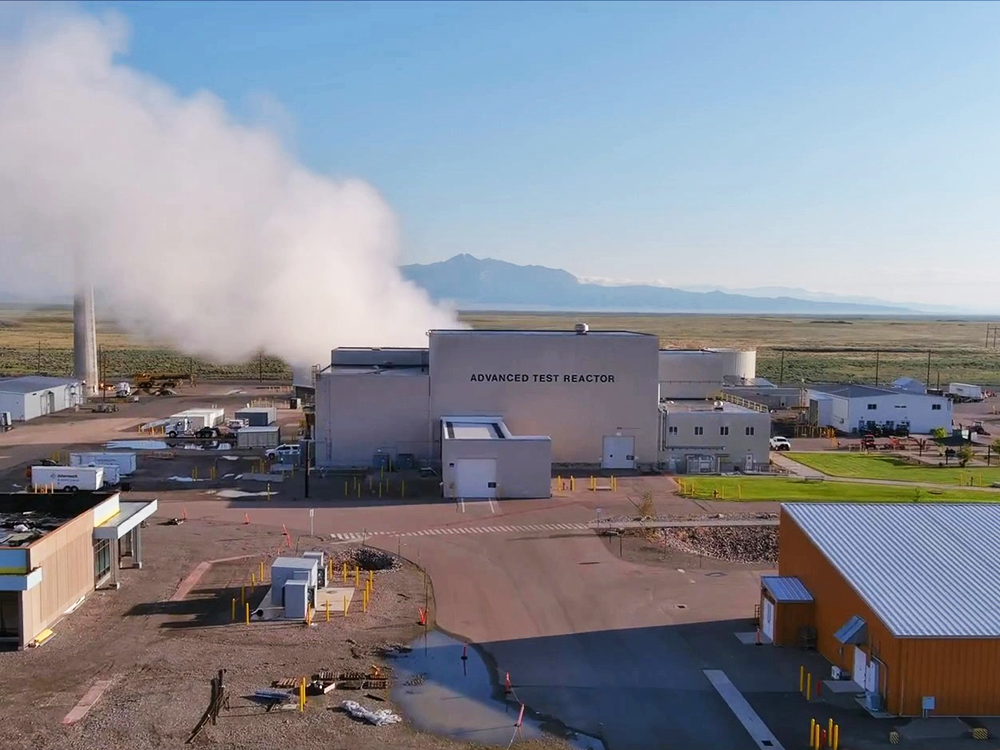
- The National Reactor Innovation Center, based at Idaho National Laboratory (INL), announced on November 5 a new project with Purdue University to test a different way of building nuclear reactor structures.
- The method swaps traditional on-site concrete forming and rebar tying for shop-built steel modules that are shipped to the site and filled with concrete.
- Engineers will build, test, and then take apart a full-scale mock containment vessel and reactor building at Purdue's Bowen Laboratory in Indiana — no nuclear fuel or radioactive material is involved.
- The effort responds to a well-documented industry problem: the last large U.S. reactor project, Georgia's Vogtle expansion, finished seven years late and $17 billion over budget.
- Idaho-based NRIC Director Brad Tomer says construction, not reactor design, has become the main obstacle to getting new nuclear plants built.
A test building with no reactor inside
The news arrived in a short release from Idaho National Laboratory's media office on a Wednesday in early November, the kind of institutional announcement that rarely makes it past trade newsletters. But the project it describes points at a problem that has quietly stalled American nuclear power for most of two decades: not the physics of splitting atoms, but the unglamorous business of pouring concrete and welding steel on time and on budget.
The program behind it, the National Reactor Innovation Center (NRIC), was created by the U.S. Department of Energy in 2019 and is headquartered at Idaho National Laboratory (INL), the federal research complex that sprawls across the desert west of Idaho Falls. NRIC does not design reactors itself. Its job is to clear the practical obstacles — testing sites, construction methods, regulatory pathways — that stand between a reactor blueprint and a plant that actually generates power.
Under NRIC's Advanced Construction Technology Initiative (ACTI), the lab has now partnered with Purdue University's Applied Research Institute (PARI) to build and then deliberately tear down a full-scale demonstration structure: a steel-plate composite containment vessel and the reactor building around it, according to INL's November 5 press release. The structure will go up — and come down — at Purdue's campus in West Lafayette, Indiana, where the university's Robert L. and Terry L. Bowen Laboratory for Large-Scale Civil Engineering Research has the room and the instrumentation to pull it apart and measure what happened.
Nothing radioactive touches the project. As the trade outlet MarketScale reported, the mock containment vessel exists purely to answer a construction question: can shop-fabricated steel modules be built, joined, inspected, and filled with concrete in a tightly controlled sequence that a construction crew could repeat reliably on a real reactor site?
Why construction, not physics, is the hard part
That history sits behind nearly every sentence of the NRIC-Purdue announcement. Conventional nuclear construction still relies heavily on building wooden forms on site, tying steel reinforcing bar by hand, and pouring concrete in stages that each have to cure and get inspected before the next step can begin — a sequence that is hard to speed up and easy to get wrong, with every error adding days or weeks.
The construction method being tested swaps much of that site work for factory-built modules: pairs of steel faceplates, pre-fitted with the connections and reinforcement a reactor building needs, that arrive on site ready to be joined together and filled with concrete. The steel plates act as both the mold and the structural reinforcement at once, a design intended to let crews pour concrete faster and inspect welds rather than chase rebar placement errors.
"Construction risk associated with nuclear facilities has been one of the biggest obstacles" between reactor designs and working power plants.
Brad Tomer, Director, National Reactor Innovation Center
Leading the technical work at Purdue is Amit Varma, the Karl H. Kettelhut Professor of Civil Engineering and director of PARI's Infrastructure Innovation Lab, with colleagues Rinaldo Hunt, Sanjeev Malushte, Josh Harmon and Jungil Seo, according to MarketScale's account of the project team. Varma's lab recently earned ISO 9001 quality-management certification for the Bowen facility, a credential the university is highlighting as it takes on federally scrutinized testing work.
"Bowen Laboratory brings the large-scale testing expertise this project demands."
Amit Varma, Purdue University
Two outside organizations are lending technical weight to the project. The **Electric Power Research Institute** (EPRI) will apply its expertise in non-destructive evaluation, advanced welding assessment, and "digital twin" validation — essentially, building a software model of the structure that updates as construction proceeds, so engineers can flag problems before they become expensive to fix. The Nuclear Energy Institute (NEI), the industry's main trade association, is advising on quality assurance and how the work lines up with regulatory expectations, though no regulatory approval or licensing is attached to this particular demonstration.
Idaho's role: coordinating, not pouring concrete
None of the physical construction happens in Idaho. That distinction matters for understanding the story accurately: NRIC directs and funds the project from its headquarters at INL, but the demonstration structure itself will rise and fall more than 1,800 miles away, in Indiana. Idaho's contribution is institutional and strategic rather than physical — it is the hub that selects, funds and oversees a national portfolio of nuclear demonstration projects, a role the state has built over nearly seven decades.
Idaho National Laboratory's history with reactors goes back to the earliest days of civilian nuclear power — the laboratory's site hosted the world's first reactor to generate usable electricity in 1951 — and the lab has operated as the Department of Energy's primary home for nuclear-energy research ever since, managed under contract by Battelle Energy Alliance. According to the lab's own FY2025 economic impact figures, INL now employs more than 6,200 people, making it Idaho's fifth-largest employer, and supports roughly 11,520 additional jobs across other sectors of the state economy through its spending and operations — more than $377 million of which went directly to Idaho businesses.
NRIC itself has built a track record of attracting outside projects to Idaho even when, as in this case, a specific demonstration happens elsewhere. The center's DOME test bed — built inside the decommissioned containment structure of the old Experimental Breeder Reactor-II at INL's desert site — has already begun hosting privately developed microreactors for fueled testing. Radiant Industries became DOME's first tenant in 2026, and in October the slot after it went to a company called Deployable Energy, whose 1-megawatt design reached zero-power criticality at INL on July 1, 2026, according to Nuclear News. The Purdue construction project is a companion effort: while DOME tests whether new reactor designs work, ACTI tests whether the buildings around them can be put up without the delays that have become nuclear construction's reputation.
What independent observers are watching for
Industry coverage of the announcement has been measured rather than celebratory, which is itself informative. Engineering trade outlets pointed out that the November 5 release contains no verified percentage figures for cost or labor savings, and that NRIC has not yet disclosed the specific welding processes or inspection protocols the team will use. Antonio Zavarce, writing for the engineering publication Inspenet, noted that the real test will be in the details — how module joints are sealed, how inspectors get access to welds buried inside a filled module, and whether the assembly sequence can be repeated by an ordinary construction crew rather than a specialized research team.
That caution is a reasonable response to a genuine unknown. The steel-plate composite method itself is not brand new — variations have been used in other industrial and defense construction — but applying it at the scale of a nuclear containment building, under the oversight of agencies that will eventually need to certify it for safety, is the part nobody has demonstrated yet in the United States. The Bowen Laboratory test is designed to produce exactly the kind of structural-performance data that regulators and future reactor developers would need before trusting the method on a live project.
What comes next, according to the ACTI program description, is design finalization for the demonstration structure, followed by fabrication, field erection at Purdue, and finally the structural testing and controlled deconstruction that will generate the program's core data set. No completion date has been published publicly for the demonstration's full cycle.
The Detail You Might Not Know
The Purdue reactor building going up for this test will never generate a watt of power or hold a gram of nuclear fuel — and once engineers finish measuring it, the plan is to tear it back down on purpose. The entire multimillion-dollar structure exists for a single purpose: watching exactly how it fails, bends, or holds up under stress, so that the next real reactor building, wherever it ends up being constructed, doesn't have to learn those lessons the expensive way.
For More - INL: Department of Energy and Purdue Partner to Improve Nuclear Reactor Construction - Nuclear News: INL and Purdue University collaborate on construction demonstration - MarketScale: Purdue's model SMR containment will test whether shop-made steel modules cut field work - NRIC Advanced Construction Technology Initiative - INL Economic Impacts, FY2025
Go further
- Web · National Reactor Innovation Center / INLAdvanced Construction Technology Initiative (NRIC)
Official program page describing ACTI's goals and partners
- Blog · MarketScale NewsroomPurdue's model SMR containment will test whether shop-made steel modules cut field work
Trade-press writeup with extra technical detail and named Purdue researchers
- Web · ConstructConnect NewsDOE, Purdue to test construction methods for advanced reactors
Construction-industry trade coverage of the same announcement
Sources
- Department of Energy and Purdue Partner to Improve Nuclear Reactor Construction
- INL and Purdue University collaborate on construction demonstration
- Purdue's model SMR containment will test whether shop-made steel modules cut field work
- NRIC Advanced Construction Technology Initiative
- INL Economic Impacts
- Vogtle cost/delay context








