


 Have a great day, y'all!
Sewn like a garment: the concrete beam that uses a third of the material
MIT engineers cast a 3-metre beam in a hand-sewn cotton mould. It carries its design load with a third of the concrete and half the steel, and costs 10 to 20% less under Global South prices.
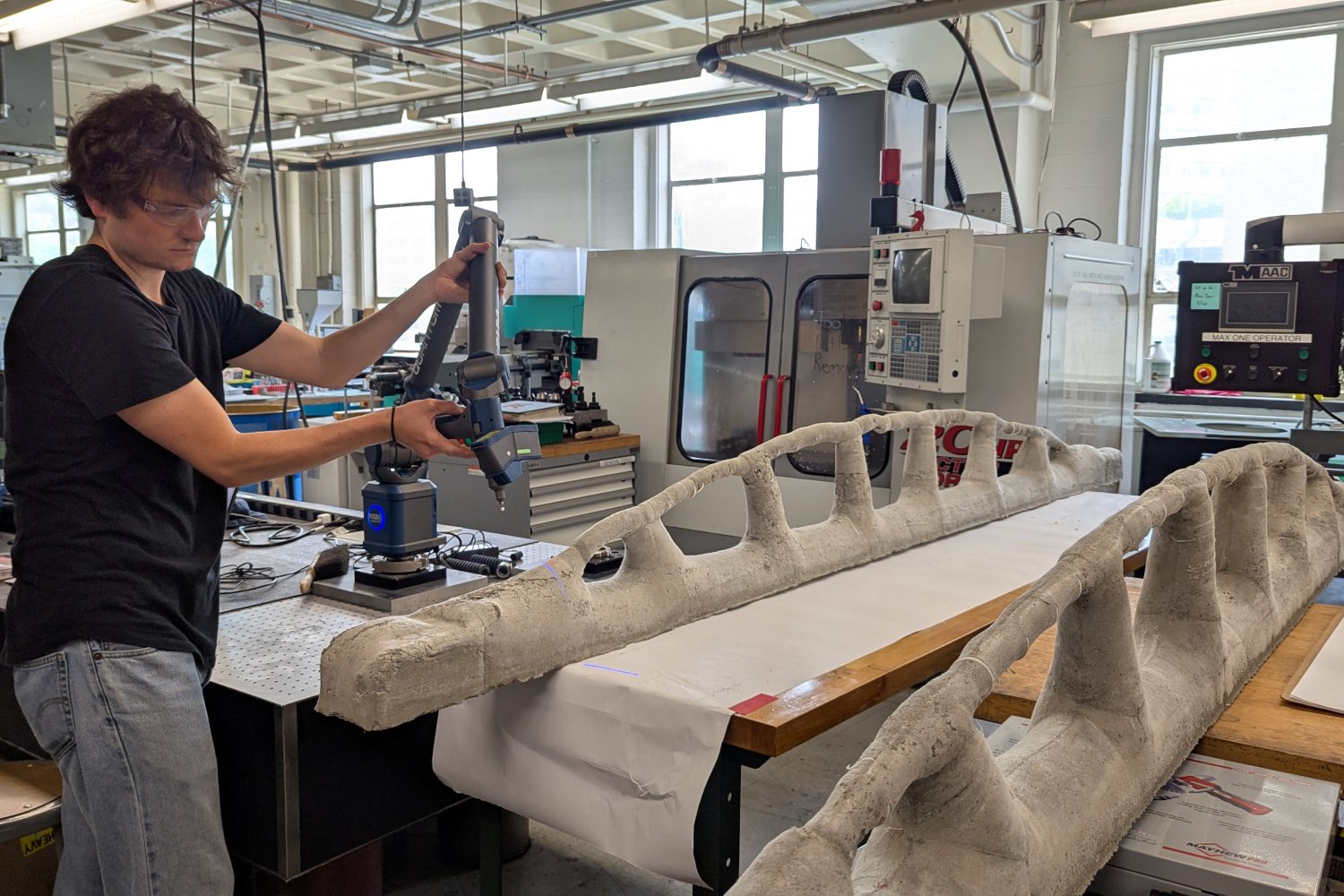
The beam lying on a workbench at the Massachusetts Institute of Technology looks less like a building part than a spine. A thick chord runs along the bottom, a thinner one along the top, and between them sits a row of slanted legs with open gaps where an ordinary beam would be solid. Mark Hellrich runs a 3D scanning arm over it, checking every curve against the design. The three-metre beam was cast in a hand-sewn cotton mould, and it carries the load it was designed for using roughly a third of the concrete and half the steel of a conventional beam.
Optimised beams have come out of university labs before. What is different about this one, announced by MIT on 6 November and published in the Journal of Building Engineering, is how it was made. No bespoke timber formwork, no expensive 3D printer: just fabric, staples and a light wooden frame. Where labour is cheap and cement is not, that recipe already beats the standard way of doing things on cost.
- What it is: a 3-metre reinforced concrete beam whose shape was computed to strip out every bit of material that is not doing work.
- How it was made: in a cotton mould sewn from 56 flat pieces and stapled to a timber frame.
- What it saves: about two-thirds of the concrete and half the steel compared with a conventional beam for the same load.
- What it costs: 10 to 20% less under Global South labour and material prices.
- What is missing: tests to failure on several beams, and a way to scale the method to longer spans.
What exactly did they build?
Giving every part of a structure exactly the shape its job requires is an old idea. Building it has always been the hard part. A rectangular beam can be boxed in with four planks; a beam that thickens where stresses are high and thins out where they are not needs a mould full of curves, angles and voids that nobody wants to pay for if it will be used once.
The group led by **Josephine Carstensen**, a professor in MIT's Department of Civil and Environmental Engineering and the study's senior author, has spent years on that problem using topology optimisation. The computer starts from a solid block and carves away material that carries little stress until the most efficient form for a given load remains. The results often look like bone, or like the web of a truss bridge.
The same family of algorithms has been used for years in the aircraft and car industries to lighten brackets and metal parts, which are often 3D printed. It has been slower to reach concrete for a practical reason. A metal part can be machined or printed, but a concrete beam has to be cast in something, and that something has to match the computed shape exactly. Building a one-off timber mould for every optimised beam usually wipes out the savings in material.
Here the team paired two tools. For the steel bars they used graphic statics, a nineteenth-century drawing method that quickly traces how forces travel through a structure, and shaped the reinforcement so each stretch of bar carries a similar share of the load. For the concrete they used topology optimisation, which is slower, to decide where material was needed and where it could go.

Then came the craft. Software built with computer scientists at Boston University flattens the 3D form into sewing patterns, much like a dressmaker's, and pre-compensates for how far the cotton will stretch and sag once it fills with wet concrete. The pieces are cut, sewn together and stapled to a simple timber frame.
The researchers tried three versions of the same mould, sewn from 36, 56 and 76 pieces. More seams gave finer local control but did not make the overall shape more accurate, because small errors pile up seam by seam. The 56-piece mould struck the best balance between accuracy and effort. "All three beams were free of wrinkles and creases," said Hellrich, the lead author, who completed his master's degree at MIT this year.
Casting needed no special kit either. The team used a fairly wet, sand-rich mix with small stones and worked it into the narrow legs by hand, tapping and kneading the fabric from outside. No vibrator, the tool normally used on site to drive air bubbles out of fresh concrete, was required.
The load test was just as low-tech. The team hung 36 buckets of water from the beam, reaching about 30% of its design load, and measured how far it bent at midspan. The deflection landed within about 2% of the model's prediction, a narrow gap for something cast in a soft mould. The group's previous project produced a 1.2-metre beam; this one is two and a half times longer.
"We joke that we are developing the H&M of the construction industry."
Jackson Jewett, MIT PhD and co-author
The joke has a point. The mould is made the way clothes are, with patterns, scissors and a sewing machine, rather than the way a carpenter builds formwork.
Why does saving concrete matter?
Concrete is the most widely used material on Earth after water, and its key ingredient, cement, comes out of kilns that roast limestone at well over 1,400°C. A report by the London think tank Chatham House put cement production at around 8% of global CO2 emissions. As a country, it would rank among the world's largest emitters.
"Cement production is highly carbon-intensive, so using less concrete is an important part of decarbonizing construction."
Josephine Carstensen, MIT
The wider sector weighs even more. The latest global status report from the UN Environment Programme and the Global Alliance for Buildings and Construction, released in May, found that buildings and construction account for 37% of global emissions and almost half of all material extracted from the planet, according to UNEP's release. The world's built floor area reached 273 billion square metres in 2024 and is still growing, fastest in India and South-East Asia.

MIT notes that the number of buildings worldwide is expected to nearly double by 2050, with about 85% of that growth in developing countries. That is what makes the cost analysis interesting. The study priced the beams under two sets of assumptions. Using Global South material and labour costs, a fabric-formed beam came out 10 to 20% cheaper than a conventional one. Using Global North wages, the sewing pushed costs up by 16 to 55%.
The trade-off is simple: the method swaps material for labour. Where cement and steel dominate the bill more than a worker's hours do, cutting two-thirds of the concrete more than pays for the stitching. Where labour is expensive, the material savings fall short.
The authors do not pitch the technique as a replacement for everything. They see it working best for one-off pieces and short runs: exposed beams, long-span roof framing, footbridges and landscape features. For the repetitive rectangular beams of an ordinary building in a high-wage country, reusable formwork still wins.
An idea with a long history
Sewing moulds for concrete is not new. Mark West, a researcher linked to the Centre for Architectural Structures and Technology (CAST) at the University of Manitoba in Canada, has been pouring concrete into tensioned fabric for decades. One of his projects, which won a Holcim Awards bronze for North America in 2005, described beams with up to 50% less concrete and formwork for a 12-metre beam that weighed about 10 kilograms.
In 2018, Mariana Popescu, then a doctoral researcher in the Block Research Group at ETH Zurich, worked with Zaha Hadid Architects on KnitCandela in Mexico City, a tribute to the Spanish-Mexican shell builder Félix Candela. Its concrete shell, almost 50 square metres and more than five tonnes, was cast over machine-knitted formwork weighing about 55 kilograms. Popescu, now an assistant professor at MIT's Computer Science and Artificial Intelligence Laboratory, sums up the field's long-standing problem: fabric formwork "has had a tradition for a while but never ended up being the mainstream way of building things."

The obstacle has been unpredictability. Fabric sags under wet concrete, and the final shape was hard to foresee. That is the gap the MIT team set out to close: its software calculates the deformation before any cloth is cut. "The key realisation was that this flexibility is not just a limitation to manage," Carstensen told the trade publication Construction Briefing. In their method, the droop of the fabric is part of the calculation.
Architecture has a famous precedent for that way of thinking. Antoni Gaudí hung chains and little bags of shot from his workshop ceiling so gravity would draw the arches of his churches, then turned the shapes upside down. The basilica that grew from those models has just reached 172.5 metres.
What stands between the lab and a building site?
Quite a lot, and the authors say so. The beam was loaded to about 30% of its design load, not to breaking point. The next step is to cast several beams and test them to failure, to see how they behave at the limit and what safety margin they offer. Longer beams cannot simply be stretched versions of this one either: the concrete's own weight and the pressure on the fabric grow with length, so the mould has to be redesigned.
Practical questions remain that the paper does not settle: how the pieces age, how they fit each country's building codes, and who would train the crews to sew the moulds. The study, funded in part by the US National Science Foundation, is a laboratory demonstration, not a product.
It does sit alongside other work aimed at doing more with less material. In recent months The Positive Way has covered sodium-ion batteries closing in on lithium's cost with more abundant ingredients, and a Caltech robot that assembled a structure in orbit with no human help. The power feeding the world's factories is getting cleaner too: renewables have overtaken coal in global electricity. Cement remains one of the hardest fronts.
For Carstensen, the fabric stops being a flaw to tame and becomes a design tool. The next round of tests will show whether the sewn beam makes it out of the workshop.
The detail you might have missed
To load the beam, the team did not use a hydraulic press. It hung 36 buckets of water, one at a time. A litre of water weighs a kilogram, so each bucket is a precise and nearly free weight: a test any engineering school with a small budget could repeat.
Further reading
Go further
- Web · Block Research Group, ETH ZurichKnitCandela - A flexibly formed, thin concrete shell at MUAC, Mexico City
Vídeo del pabellón de Ciudad de México colado sobre un encofrado tejido: la misma idea de usar tela, a escala de edificio.
- Web · MIT CSAILKnitting the Future of Construction with MIT CSAIL Assistant Professor Mariana Popescu
Entrevista con la investigadora que teje encofrados a máquina y explica por qué la tela nunca llegó a ser la forma habitual de construir.
- Web · Holcim Foundation / Mark WestMaterial Reduction: Efficient fabric-formed concrete
El proyecto pionero de Manitoba con vigas de hasta un 50 % menos de hormigón y encofrados de 10 kilos.
- Web · FabWikiFabWiki: fabric-formed concrete
Archivo de proyectos y técnicas de hormigón colado en tela de todo el mundo.
- Web · Zaha Hadid ArchitectsKnitCandela
Ficha técnica del pabellón homenaje a Félix Candela, con sus cifras de peso y superficie.
- Web · Chatham HouseMaking Concrete Change: Innovation in Low-carbon Cement and Concrete
El informe de referencia sobre el peso del cemento en las emisiones y las vías para reducirlo.
Sources
- Fabric molds could bring material-saving concrete beams within reach (MIT News, 6 Nov 2026)
- Affordable construction of topology optimized reinforced concrete through fabric formwork (Journal of Building Engineering)
- Fabric formwork beams require one third as much concrete, researchers find (Construction Briefing, 9 Nov 2026)
- Fabric molds could bring material-saving concrete beams within reach (TechXplore)
- UNEP: Global Status Report for Buildings and Construction 2025-2026
- Holcim Foundation: Material Reduction, efficient fabric-formed concrete
- Zaha Hadid Architects: KnitCandela







