


 Have a great day, y'all!
Sodium batteries are closing in on lithium's cost: how they work and who makes them
A Wood Mackenzie report counts more than 70 GWh of supply deals and estimates that over 20 years, storing energy with sodium can be 21% cheaper. The chemistry has been studied since the 1980s, and CATL, BYD and HiNa now make it at scale.

For years, sodium-ion batteries were a lab-bench promise: an alternative to lithium built on a cheap, abundant element, the same one found in table salt. A report from energy consultancy Wood Mackenzie, published on 5 November, suggests that phase is ending. The industry has already signed more than 70 gigawatt-hours (GWh) of supply agreements, and the leading manufacturers could match the cell-level cost of lithium iron phosphate (LFP) batteries before the end of 2026.
The report's title, Sodium-ion batteries: commercialisation begins, economics to follow, sets the tone: upbeat about the direction of travel, careful about the timing.
- Wood Mackenzie counts more than 70 GWh of sodium-ion supply contracts and expects cell-level cost parity with LFP by the end of 2026.
- A sodium-ion storage system costs about 229 dollars per kWh today against 200 for LFP, yet over 20 years its total cost could be 21% lower.
- The most advanced cells, such as CATL's Naxtra, reach about 175 Wh/kg and keep around 90% of their capacity at minus 40 degrees.
- The technology does not replace lithium: it complements it, especially in grid storage and cold climates.
Why a sodium battery matters
Lithium batteries dominate both electric cars and storage for renewable energy today. But lithium is mined in relatively few places, and its supply chain is highly concentrated. Sodium is everywhere, in the Earth's crust and in seawater. The International Renewable Energy Agency (IRENA) puts it at roughly a thousand times more abundant than lithium.
That gap shows up in raw material prices, according to the same agency:
Wood Mackenzie focuses on a specific use: large grid-connected batteries that store solar or wind power and release it hours later, in projects holding between two and four hours of electricity. For that market, the consultancy sums up sodium's advantages like this.
"SIB wins on supply chain security, cycle life and wide thermal threshold."
Ankita Chauhan, research director for global supply chains and renewables, Wood Mackenzie
That last point means the batteries cope better than some other chemistries in hard frost. And this kind of storage is growing fast: the International Energy Agency (IEA) estimates that 108 gigawatts of batteries were added worldwide in 2025, around 40% more than the year before.

How it works inside
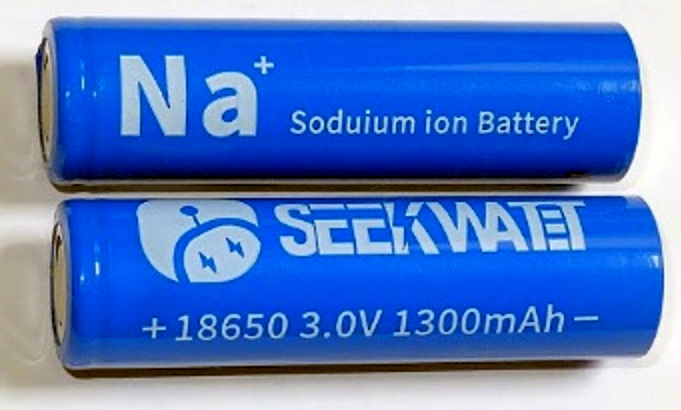
A sodium-ion battery looks a lot like a lithium-ion one. It has a positive electrode (cathode), a negative electrode (anode), an electrolyte and a separator. When it charges, ions travel from cathode to anode; when it is used, they travel back. Engineers call this the "rocking-chair" mechanism, because the ions swing back and forth. What changes is the passenger: sodium ions instead of lithium ions.
Sodium is larger and heavier, so it stores somewhat less energy per kilo. Cathode designers work with three main families of materials:
- Layered oxides, sheets of metals such as nickel, iron or manganese with sodium ions slotted between them. These currently offer the highest energy density.
- Prussian blue analogues, chemical cousins of the blue pigment painters have used since the 18th century, with an open framework that lets sodium move in and out easily.
- Polyanionic compounds, very stable phosphate-based materials such as sodium iron pyrophosphate (NFPP), which put safety and lifespan first.
On the anode side, the workhorse is hard carbon, a carbon with a disordered structure. The graphite in lithium batteries does not work well with sodium.
One more detail shows up in the bill. With sodium, both electrodes can use aluminium foil instead of the copper lithium requires on the anode, so the cell ends up cheaper and lighter.
A story half a century in the making
The idea is not new. According to the IEA, sodium-ion batteries have been studied in laboratories since the early 1980s, before lithium-ion batteries reached the market in the 1990s. Once lithium conquered phones and laptops, sodium was pushed to the sidelines.
In 2000, researchers Stevens and Dahn showed that hard carbon could store sodium. In Japan, a country that imports all of its lithium, the group led by Professor Shinichi Komaba at the Tokyo University of Science kept working on sodium at a time when many considered a battery without lithium to be "nonsense". In 2009 the team reported a sodium-ion battery that could charge and discharge stably, and international interest picked up again.
Industry took over a decade later. Chinese manufacturer CATL announced its first sodium-ion battery in 2021. The first sodium-ion storage system had been installed in China in 2019, and the first sodium-ion electric car appeared there in late 2023, according to the IEA's timeline.
Who is making them
Wood Mackenzie's report examines China, the United States, Germany and India. China is well ahead: the IEA expects the country to hold more than 95% of planned manufacturing capacity in 2030. BYD has planned 30 GWh of sodium-ion manufacturing capacity, and CATL, the world's largest battery maker, is targeting at least 1 GWh of sodium-ion shipments by the end of 2026, according to the consultancy's figures as reported by trade site SolarQuarter.
CATL and the Naxtra range
CATL launched its Naxtra brand on 21 April 2025 in Ningde. According to the company's official announcement, the passenger-car cell reaches 175 Wh/kg, exceeds 10,000 cycles and operates between minus 40 and plus 70 degrees. In February 2026, Changan and CATL unveiled the Nevo A06, a passenger car with a 45 kWh sodium-ion pack and up to 400 kilometres of range. In June, at the Intersolar Europe fair in Munich, CATL showed Tener Sodium, a storage system rated at more than 30 MWh per unit with 15,000 cycles at 25 degrees.
"We believe that sodium and lithium together will form the twin foundations of the future energy storage system."
William Wu, director of CATL's Energy Storage Technology Center
HiNa, BYD and others
HiNa, a spin-off of the Chinese Academy of Sciences, supplied the cells for Datang's storage station in Qianjiang, Hubei province. Its first phase, rated at 50 MW and 100 MWh, was connected to the grid on 30 June 2024 and can meet the daily power needs of about 12,000 households. BYD has launched a 2.3 MWh sodium-ion storage container. Electric two-wheeler maker Yadea introduced sodium-powered scooters in January 2025 that can reach 80% charge in about 15 minutes.
Outside Asia, US company Peak Energy is betting on NFPP chemistry: in March 2026 it installed, with RWE Americas in Wisconsin, the first sodium-ion system on the Midwest's MISO grid. The company says the system is passively cooled, without energy-hungry climate control.
What the numbers say
The figure that matters most is total cost. Today, a sodium-ion storage system costs on average about 229 dollars per kilowatt-hour to build, compared with roughly 200 dollars for LFP. So the upfront investment is still somewhat higher. But once everything a project costs over a 20-year life is added up, Wood Mackenzie estimates that the total cost of ownership for sodium is 21% lower, mainly because it avoids mid-life capacity top-ups and lowers operating costs.
The consultancy also expects costs to fall quickly. For China it projects a learning rate of 18% to 20% between 2026 and 2035: each time cumulative production doubles, costs drop by roughly that share. Cell-level parity with LFP is expected among market leaders by the end of 2026; parity at module and full system level, after 2030. IRENA notes that some manufacturers expect cell costs to reach 40 dollars per kWh once production scales up.
Lithium is getting cheaper too. According to BloombergNEF, average lithium-ion pack prices fell to 108 dollars per kWh in 2025, 8% lower than a year earlier, while packs for stationary storage dropped to 70 dollars. "Cut-throat competition is making batteries cheaper every year," said Evelina Stoikou, who leads BNEF's battery technology team. Sodium is chasing a target that keeps moving.
Policy counts as well. China reimposed a consumption tax on lithium-ion batteries in July 2026, while sodium-ion batteries are exempt until the end of 2028. US tariffs on Chinese energy storage cells are around 58%, and India is backing battery manufacturing with a 1.25 billion dollar incentive scheme.
Strengths and limits
Sodium's biggest strength is cold weather. The IEA says the latest generation keeps around 90% of its capacity at minus 40 degrees, and is already cost-competitive for cars and storage in very cold climates. CATL adds safety to the list: it says Naxtra removes combustion-supporting factors at the material level. And, the agency notes, the raw materials are mined in a wider range of places than those for lithium.
The main limit is energy density. The best sodium-ion cells are around 175 Wh/kg, against up to 205 for LFP and 255 for nickel-manganese-cobalt cells, according to the IEA. An average SUV running on sodium would travel about 350 kilometres, versus 400 to 600 with lithium. That is why its natural niches are grid storage, small city cars, scooters and motorbikes, and hybrid packs that combine both kinds of cell.
A study by Adrian Yao, Sally Benson and William Chueh at Stanford University modelled more than 6,000 scenarios and concluded that raising energy density is the fastest and most certain route to making sodium cheaper, as reported by Energy-Storage.news. "Technologies only succeed at the systems level," Yao cautioned. Cell price, in other words, is not the whole story.
What it means for lithium-producing countries
For major lithium producers such as Chile or Argentina, the experts do not see a threat. IRENA stresses that sodium-ion batteries should complement lithium-ion rather than replace it. According to the US Geological Survey (USGS), world lithium output reached about 290,000 tonnes in 2025, with Chile at 56,000 and Argentina at 23,000.
What could change is volatility. The average price of lithium carbonate went from 63,700 dollars a tonne in 2022 to about 9,000 in 2025, according to the USGS, and swings like that make it hard to plan mines and factories. The IEA sees sodium as a hedge against such spikes.
For Latin America, cheaper storage is also an opportunity in its own right. Chile added close to 1 GW of batteries in 2025, and projects such as the search for geothermal energy beneath a volcano in the Galápagos show the appetite to move beyond imported diesel. The technical talent is there too, as ESPOL showed at the ICPC programming contest.
Electrification already shows up in fuel demand: electric cars now displace 1.2 million barrels of oil a day.

What still needs to happen
Wood Mackenzie is not writing lithium's obituary. "LFP remains the preferred and commercially established option for two-to-four-hour energy storage projects being deployed today," said senior analyst Priya Shrivastava, quoted by SolarQuarter.
Sodium still has to prove at industrial scale that it delivers, and that lenders see it as a bankable technology. The IEA points out that global sodium-ion output in 2025 was less than 1% of lithium-ion production, and that the chemistries closest to market use nickel and manganese, whose processing is also concentrated. The 70 GWh, moreover, are signed contracts: turning them into working batteries will take factories, testing and time.
"The 2030-2035 window is where the economics decisively shift."
Priya Shrivastava, senior research analyst, Wood Mackenzie
The report is a market analysis by a private consultancy, not a peer-reviewed study; its figures are estimates and not investment advice. Sodium, like the ocean protected by the high seas treaty, now in force, is everywhere: in seawater and in table salt.
The detail you might not know
Sodium-ion cells can be stored and shipped fully discharged, at zero volts, as British company Faradion demonstrated. That simplifies logistics. It also fits Wood Mackenzie's sums: the battery costs more on the day it is installed, but over 20 years it comes out 21% cheaper.
Further reading
- Sodium-ion batteries: A technology brief, IRENA's technical report.
- Sodium-ion battery momentum grows, but challenges remain, an IEA analysis.
- What's the deal with sodium-ion batteries?, an episode of the Volts podcast.
- Sodium-ion battery on Wikipedia, a primer on the chemistry.
Go further
 YouTube · Benchmark Mineral IntelligenceBenchmark's Sodium ion Batteries 101
Una introducción breve de analistas de materias primas a cómo funcionan las baterías de sodio y dónde encajan.
 YouTube · The Limiting FactorThe Hype and Reality of Sodium Ion Batteries // A Technical Review
Un repaso técnico y detallado que separa las promesas de los datos de esta química.
- Podcast · Volts (David Roberts) con Landon Mossburg, Peak EnergyWhat's the deal with sodium-ion batteries?
Conversación larga sobre por qué el sodio puede abaratar el almacenamiento en la red eléctrica.
- Podcast · IONS by Peak EnergyEpisode 3: Sodium-ion Deep Dive
Un ingeniero de celdas explica la química de fosfatos NFPP pensada para almacenamiento estacionario.
- Web · Agencia Internacional de la Energía (AIE)Sodium-ion battery momentum grows, but challenges remain
Análisis independiente con cifras de densidad, capacidad industrial y rendimiento en frío.
- Web · IRENASodium-ion batteries: A technology brief
Informe técnico de la agencia de renovables sobre costes, materias primas y perspectivas del sodio.
Sources
- Wood Mackenzie: Sodium-ion batteries establish a foothold as a lithium alternative
- SolarQuarter: Sodium-ion batteries gain commercial momentum with 70 GWh supply agreements
- pv magazine: Natrium-Ionen-Batteriezellen nähern sich der Kostenparität mit Lithium-Eisenphosphat
- IEA: Sodium-ion battery momentum grows, but challenges remain
- Electrek: First sodium-ion battery EV debuts (Changan Nevo A06)
- IRENA: Sodium-ion batteries – A technology brief (2025)
- BloombergNEF: Lithium-ion battery pack prices fall to $108 per kWh
- Energy-Storage.news: Stanford sodium-ion study
- RenewEconomy: CATL debuts Tener Sodium storage system
- IEA: Battery storage is scaling up and taking on a larger system role
- Tokyo University of Science: Komaba group sodium-ion research
- CATL: Naxtra Battery Breakthrough & Dual-Power Architecture (21 Apr 2025)
- USGS Mineral Commodity Summaries 2026: Lithium
- ESS News: World's largest sodium-ion battery goes into operation (Datang/HiNa)
- Wikipedia: Sodium-ion battery
- electrive: Yadea starts integrating sodium-ion batteries in electric scooters
- Electrek: Sodium-ion batteries hit the Midwestern grid (Peak Energy, RWE)
- Energy-Storage.news: BYD launches sodium-ion grid-scale BESS product







